Overtime Tax Deduction 2026 - Eligibility, Limits & How to Claim - CPA Pilot
federal tax automation
Overtime Tax Deduction 2026 - Eligibility, Limits & How to Claim
Learn how the 2026 overtime tax deduction works, who qualifies, deduction limits, FLSA rules, and how to calculate and claim eligible overtime pay on your tax return.
CPA Pilot
Oct 26, 2026·10 min read
What You'll Learn
4 key concepts covered
1Overtime pay is not tax-free; it is a federal income tax deduction.
2Eligibility depends on FLSA coverage, nonexempt status, and qualified overtime premiums.
3Deduction caps are $12,500 per return or $25,000 jointly, with MAGI phaseouts.
4Learn how to claim it on Schedule 1-A with standard or itemized deductions.
Are you also wondering whether overtime pay is now tax-free under the One Big Beautiful Bill Act (OBBBA)?
Well, the answer is: it's not entirely. The benefit sometimes called the overtime tax credit is actually a federal income tax deduction for qualified overtime compensation—not a tax credit or a complete tax exemption.
Available for tax years 2025 through 2028, the deduction applies to overtime compensation required under Section 7 of the Fair Labor Standards Act (FLSA) that exceeds an employee’s regular rate.
Eligible taxpayers may deduct up to $12,500 per return or $25,000 for a joint return, subject to actual qualified compensation and income-based reductions.
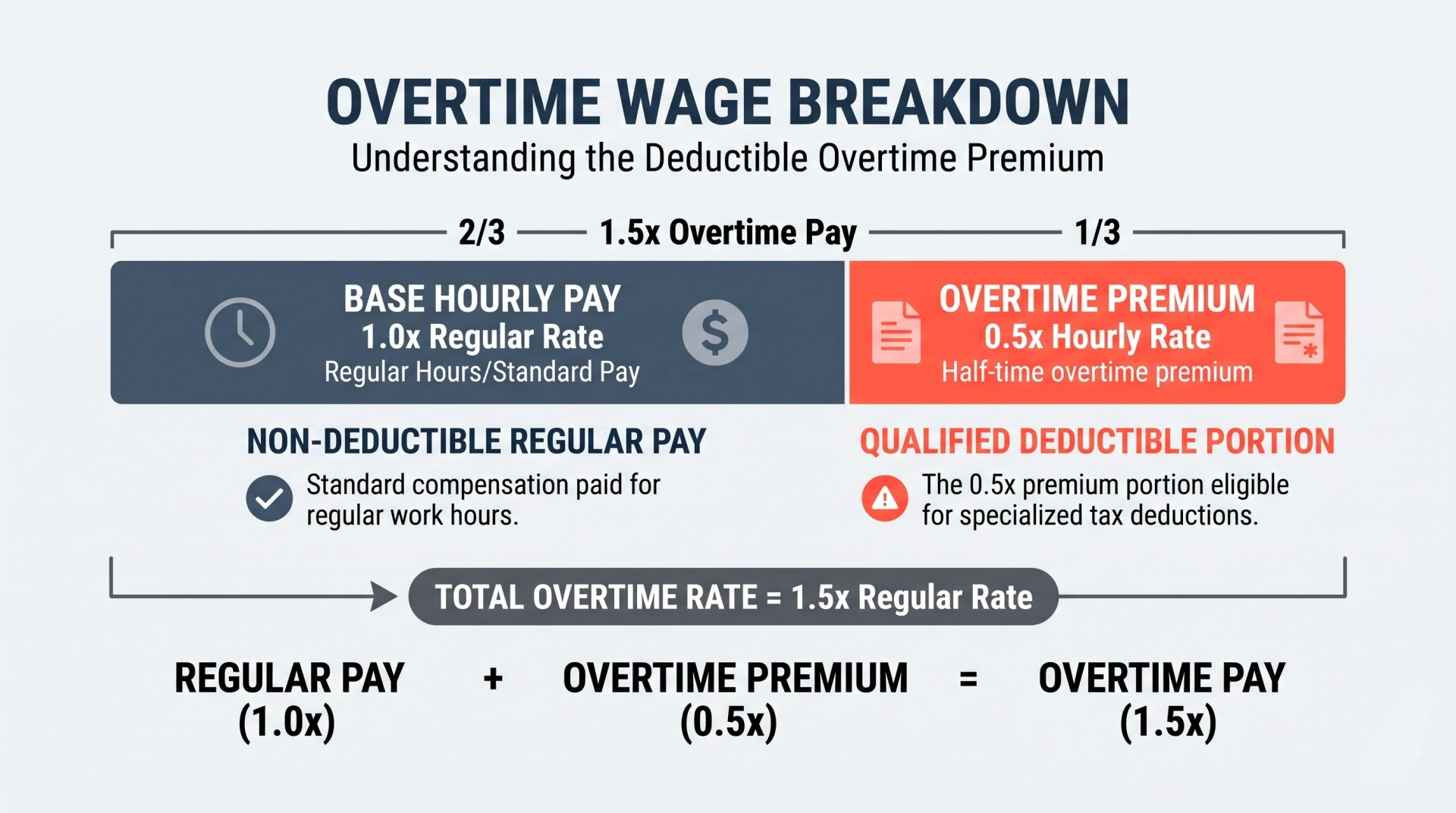
For standard time-and-a-half overtime, the deductible amount is generally the additional half-time premium, not the entire overtime payment. (Source)
Quick Answer: How Does the New Overtime Tax Deduction Work?
The OBBBA provides a federal income tax deduction for qualified overtime compensation received during tax years 2025–2028. Eligible taxpayers can deduct up to $12,500 per return or $25,000 for a joint return.
The deduction begins to phase out when modified adjusted gross income (MAGI) exceeds $150,000, or $300,000 for joint filers.
Taxpayers claim it on Schedule 1-A, whether they itemize or take the standard deduction. (Source)
What is the Overtime Tax Deduction Under the One Big Beautiful Bill Act?
The overtime tax deduction is a federal income tax benefit established by the One Big Beautiful Bill Act. The legislation added Internal Revenue Code Section 225 to allow eligible individuals to deduct certain overtime compensation required under federal labor law.
Unlike an exclusion from gross income, the deduction does not remove overtime earnings from reported wages. Instead, it reduces income subject to federal income tax.
Is the Overtime Tax Benefit a Credit or a Deduction?
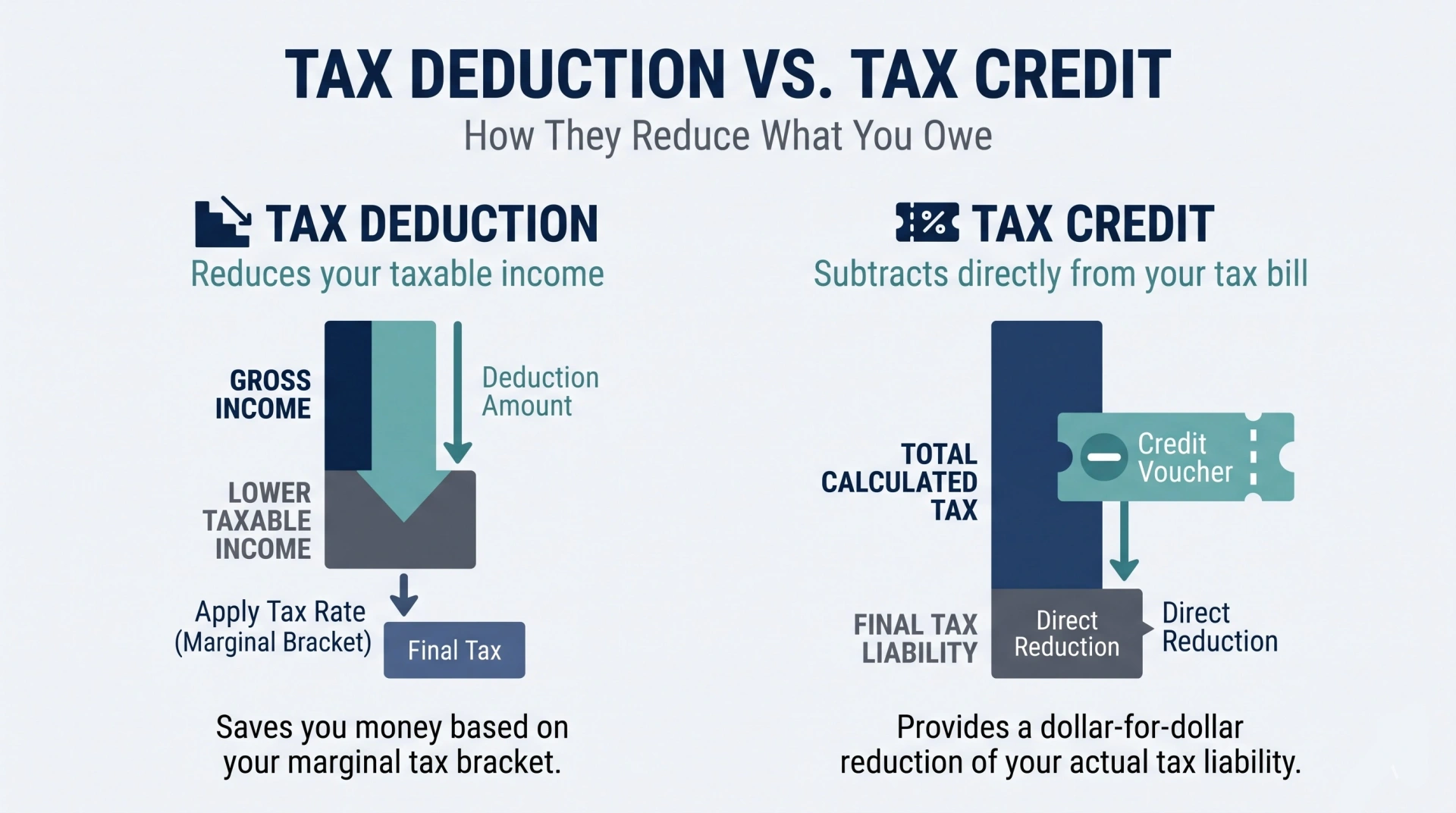
The new overtime tax benefit is a deduction, not a tax credit. A deduction reduces taxable income, whereas a tax credit directly reduces the tax owed amount.
For example, if a taxpayer qualifies for a $5,000 overtime deduction and the entire amount would otherwise be taxed at a 22% marginal federal income tax rate, the potential federal income tax savings would be approximately $1,100. The taxpayer does not receive a $5,000 tax credit or an automatic $5,000 refund.
Who is Eligible for the Overtime Tax Deduction in 2026?
Workers generally qualify when they are covered by the FLSA, are not exempt from its applicable overtime requirements, and receive compensation required under Section 7. (Source)
Eligibility depends on the employee’s FLSA coverage and exemption status, together with the nature of the payment—not simply whether an employer labels earnings as overtime.
What Counts as Qualified Overtime Pay Under FLSA Rules?
Qualified overtime compensation generally means the portion of federally required overtime pay exceeding the employee’s regular rate.
FLSA coverage: The employee must be covered by applicable federal overtime requirements.
Nonexempt status: The employee must not be exempt from those requirements.
Qualifying compensation: The additional payment must be required under Section 7 of the FLSA.
Overtime required solely by state law generally does not qualify unless the payment also satisfies an applicable federal FLSA requirement. For example, overtime paid after eight hours in one day under state law does not automatically qualify when federal overtime requirements have not been triggered.
Similarly, a collective bargaining agreement does not independently establish deduction eligibility. Additional contractual premiums beyond what federal overtime law requires generally are not deductible.
Special rules for public-sector and healthcare employees. Certain workers, including qualifying healthcare employees, public-sector firefighters, and law enforcement personnel, may be subject to alternative FLSA overtime arrangements.
For eligible state and local government employees receiving compensatory time under FLSA Section 207(o), qualified overtime compensation is generally treated as paid when the compensatory time is used and paid as wages or cashed out, rather than when originally earned. Special calculation rules apply. The IRS’s August 2026 overtime FAQs explain these arrangements.
Who is Not Eligible for the Overtime Tax Deduction?
Employees exempt from the FLSA’s overtime requirements generally cannot claim the deduction merely because their employer voluntarily pays additional compensation. Situations requiring exclusion or further review include:
FLSA-exempt employees: Certain executive, administrative, professional, outside sales, and computer employees meeting applicable exemption requirements.
State-only or contractual overtime: Additional compensation not required under Section 7 of the FLSA.
Voluntary premiums: Certain weekend, holiday, or other payments beyond federally required overtime compensation.
Married taxpayers filing separately: Married taxpayers generally must file jointly to claim the deduction.
An individual receiving qualified overtime must have a Social Security number valid for employment, issued by the Social Security Administration by the return’s due date, including extensions. For joint returns, each spouse receiving qualified overtime compensation must satisfy the applicable SSN requirement.
A salary does not automatically make an employee ineligible. Salaried workers may qualify when covered by the FLSA, nonexempt, and paid federally required overtime.
How Much is the Overtime Tax Deduction in 2026?
The allowable deduction depends on actual qualified overtime compensation, the annual statutory cap, and any reduction based on modified adjusted gross income (MAGI).
How Do You Calculate the Qualified Overtime Tax Deduction?
For standard time-and-a-half overtime under FLSA Section 7(a), qualified compensation generally equals one-half of the regular hourly rate multiplied by qualifying overtime hours.
This formula applies to the general FLSA method. Alternative statutory overtime arrangements may require different calculations. Example: An eligible employee earns $24 per hour and works 50 hours in one workweek, with time-and-a-half for the 10 additional hours. Assume no other payments affect the regular rate.
Compensation component
Calculation
Amount
Regular hourly rate
—
$24
Overtime hourly rate
$24 × 1.5
$36
Qualifying overtime hours
50 − 40
10
Total overtime wages
10 × $36
$360
Qualified overtime premium
10 × $12
$120
Although the employee receives $360 in overtime wages, only $120 represents the qualifying half-time premium. If the employee receives the same $120 premium for 40 workweeks, annual qualified overtime compensation totals $4,800 before the cap or MAGI reduction.
For employees receiving commissions, bonuses, or variable earnings, the FLSA regular rate may differ from basic hourly wages. The Department of Labor’s regular-rate guidance explains which earnings must be included.
What are the Deduction Limits and MAGI Phaseout Rules?
The deduction is limited to $12,500 per return or $25,000 for a joint return, before applying the MAGI reduction, and cannot exceed actual qualified overtime compensation.
Deduction provision
Single, head of household, or other eligible non joint return
Married filing jointly
Maximum annual deduction
$12,500
$25,000
MAGI phaseout threshold
$150,000
$300,000
For this deduction, MAGI generally begins with adjusted gross income, with applicable adjustments for certain excluded foreign income. The allowable deduction decreases by $100 for every complete $1,000 of MAGI above the threshold.
Example: A single taxpayer has $10,000 in qualified overtime compensation and MAGI of $165,500. The excess over the $150,000 threshold is $15,500, representing 15 complete $1,000 increments and a $1,500 reduction.
Calculation
Amount
Qualified overtime compensation
$10,000
MAGI-based reduction
−$1,500
Allowable overtime deduction
$8,500
The allowable deduction cannot be less than zero. This example follows the finalized 2025 Schedule 1-A calculation. Taxpayers filing 2026 returns should follow final 2026 instructions once available.
How Do You Claim the Overtime Tax Deduction on Your 2026 Tax Return?
Eligible taxpayers calculate the deduction using Schedule 1-A (Additional Deductions) and report the result with their federal individual income tax return. Reporting differs between 2025 and 2026 because mandatory separate reporting starts in tax year 2026.
Where is Qualified Overtime Reported on Form W-2 in 2026?
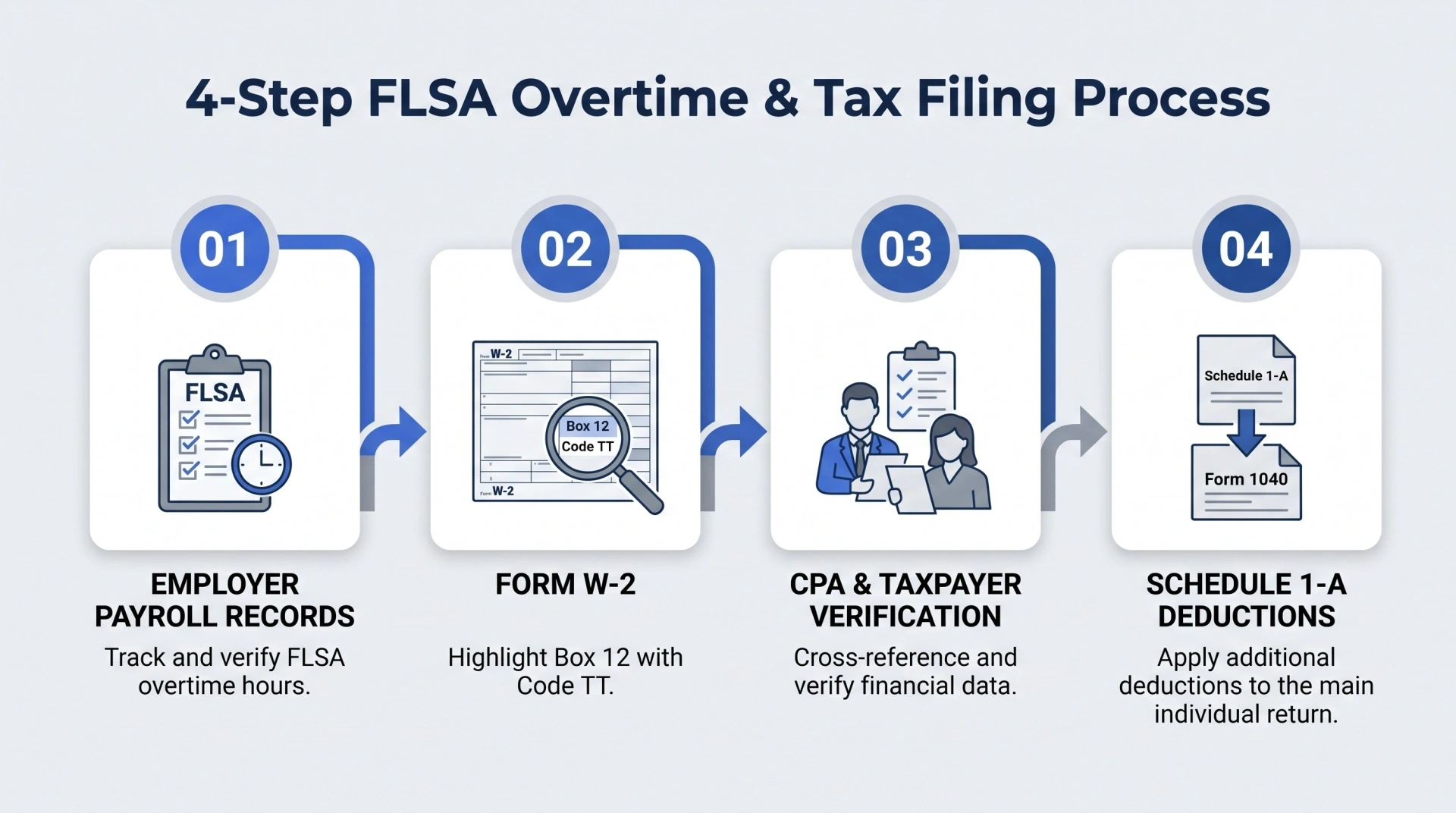
Starting in tax year 2026, employers must separately report qualified overtime compensation on Form W-2, box 12, code TT.
Employers report total qualified overtime paid, even if the eventual deduction is smaller due to the cap or phaseout. See the 2026 Instructions for Forms W-2 and W-3.
Reporting requirement
Tax year 2025
Starting in tax year 2026
Separate reporting
Transitional relief
Mandatory
Form W-2
Voluntary disclosure in box 14 or separate statement
Box 12, code TT
Missing or understated amount
Permitted calculation methods may apply
Form W-2c generally required
Supporting evidence
Payroll records and employer statements
W-2 and corrected W-2c, if necessary
What if qualified overtime is missing from a 2026 W-2? Starting with tax year 2026, an employee cannot use qualified overtime omitted from or exceeding the amount reported in W-2 box 12, code TT.
Special Form 1099 reporting. Rarely, a worker can be an employee under the FLSA but an independent contractor for federal tax purposes. In that circumstance, qualified overtime may be separately reported on:
Form 1099-NEC, box 1d — Qualified overtime compensation.
Form 1099-MISC, box 14 — Qualified overtime compensation.
How Do You Report the Overtime Deduction on Schedule 1-A?
The qualified overtime deduction is calculated in Part III of Schedule 1-A, where qualifying compensation is subject to the cap and any MAGI reduction. The general process is:
Identify qualified overtime from Form W-2 or an applicable Form 1099.
Complete Schedule 1-A, Part III, using the qualifying amount.
Apply the annual deduction cap and MAGI reduction.
Calculate total additional deductions.
Transfer the total to Form 1040 according to the tax-year instructions.
For tax year 2025, the finalized 2025 Schedule 1-A transfers total additional deductions to 2025 Form 1040, line 13b. The available draft 2026 Schedule 1-A places overtime in Part III and indicates total additional deductions on line 44, transferring to Form 1040, Form 1040-SR, or Form 1040-NR line 13a.
The 2026 Form 1040 and Schedule 1-A materials cited here remain draft or provisional individual-return filing materials. By contrast, 2026 information-reporting guidance identifies W-2 box 12 code TT, 1099-NEC box 1d, and 1099-MISC box 14. Use final individual-return forms and instructions when filing 2026 returns.
Does the Overtime Deduction Reduce Income Tax Withholding or Payroll Taxes?
The overtime deduction can reduce federal income subject to tax, but it does not automatically reduce paycheck withholding or exclude overtime from employment taxes.
Overtime generally remains subject to applicable federal income tax withholding, Social Security, Medicare, and federal unemployment tax rules.
Generally remains applicable under employment-tax rules
State income tax
Depends on state law
Employers cannot independently reduce federal income tax withholding to account for the deduction. Employees expecting to qualify can submit an updated Form W-4, Employee’s Withholding Certificate, accounting for their expected deduction in Step 4(b).
Employees should consider annual income, other deductions, and expected tax liability before changing withholding. Insufficient withholding may leave a balance due when the return is filed. See CPA Pilot’s guide to adjusting Form W-4 withholding.
How Can CPAs Verify and Plan for the Overtime Tax Deduction?
The overtime deduction adds documentation and interpretation requirements to individual income tax planning. CPAs and enrolled agents should reconcile employer-reported compensation with each client’s tax circumstances before calculating the allowable amount.
Payroll reconciliation: Compare reported qualified overtime with statements and records.
FLSA eligibility: Verify coverage, exemption status, and special overtime calculation methods.
Return-level requirements: Confirm filing status, employment-valid SSN, and MAGI.
Deduction reporting: Review Schedule 1-A and Form 1040 treatment.
Client communication: Explain the impact on taxable income and withholding.
How CPA Pilot Helps CPAs Research Overtime Deductions and Review Form 1040
Taxpayers searching for an overtime tax credit may assume all overtime earnings are tax-free or that the benefit reduces tax liability dollar for dollar. CPAs must distinguish those misunderstandings from actual federal deduction requirements when advising clients.
CPA Pilot is an AI tax planning assistant built for CPAs, enrolled agents, and US tax firms. It supports AI-assisted tax research and converts completed Form 1040 information into plain-English summaries, helping professionals explain returns and communicate with clients.
For overtime deduction planning, CPA Pilot can support research and interpretation of completed returns. The CPA remains responsible for FLSA eligibility, payroll review, qualified compensation calculations, and deduction accuracy.
Turn tax research into clearer client conversations. Use CPA Pilot to support individual tax research and explain completed Form 1040 information in plain English. Explore CPA Pilot and request a demo.
Overtime Tax Deduction FAQs
Can salaried employees qualify for the overtime tax deduction?
Yes. Salaried employees may qualify if they are covered by the FLSA, nonexempt from its overtime requirements, and receive federally required qualified overtime. Salary alone does not determine eligibility.
Can part-time employees claim the overtime deduction?
Yes, if they receive compensation required under the FLSA overtime rules. Working beyond scheduled part-time hours does not automatically qualify unless applicable federal overtime requirements are met.
Does overtime paid under a union contract qualify?
It can, but only to the extent required under FLSA Section 7. Additional premiums required solely by a collective bargaining agreement generally do not qualify.
Can you claim the overtime deduction if your employer does not report it separately?
For 2025, transitional calculations may apply. Starting in 2026, separate reporting is generally required. Omitted or understated amounts cannot be used unless the applicable corrected information return is furnished.
Can you claim the overtime deduction while taking the standard deduction?
Yes. Eligible taxpayers claim the qualified overtime deduction separately on Schedule 1-A, whether they take the standard deduction or itemize.
Editorial verification note — October 8, 2026: This article incorporates IRS Fact Sheet FS-2026-13, issued August 6, 2026, which supersedes January 2026 FAQs. FAQs may be revised and do not override controlling tax law. The referenced 2026 Form 1040 and Schedule 1-A materials are provisional pending final filing instructions.
Key Takeaways
4 essential insights
Overtime isn’t tax-free; it’s a federal income tax deduction, 2025–2028.
Deduct only qualified FLSA-required overtime premium, often just the extra half-time.
Maximum deduction is $12,500 per return or $25,000 joint, subject to limits.
Phaseout starts at MAGI $150,000 or $300,000 joint; claim on Schedule 1-A.
I’m Harsh Mody, CPA, founder of CPA Pilot—an AI Tax Assistant for CPAs, Enrolled Agents, and U.S. tax firms. With 18+ years in accounting, tax auditing, consulting, and product management, I’ve seen how compliance-heavy work limits true advisory impact. I built CPA Pilot to change that—by applying AI-driven tax research, deduction optimization, and IRS/state code automation to help firms unlock tax savings and scale advisory services with speed and accuracy.