Tax-Exempt Interest Income: Forms 1099, AMT & Form 1040 Line 2a - CPA Pilot
federal tax automation
Tax-Exempt Interest Income: Forms 1099, AMT & Form 1040 Line 2a
Learn how tax-exempt interest from municipal bonds, Forms 1099, and Schedule K-1 is reported on Form 1040 Line 2a, including AMT and state tax considerations.
Harsh Mody
CPA & Founder of CPA Pilot · Aug 2, 2026·13 min read
Did a client receive a Form 1099-INT, Form 1099-OID, Form 1099-DIV, or a brokerage statement showing “tax-exempt interest” and wonder why tax-free income still appears on Form 1040?
Well, the question is common. Tax-exempt interest income is generally excluded from regular federal taxable income, but it still must be reported on the individual income tax return.
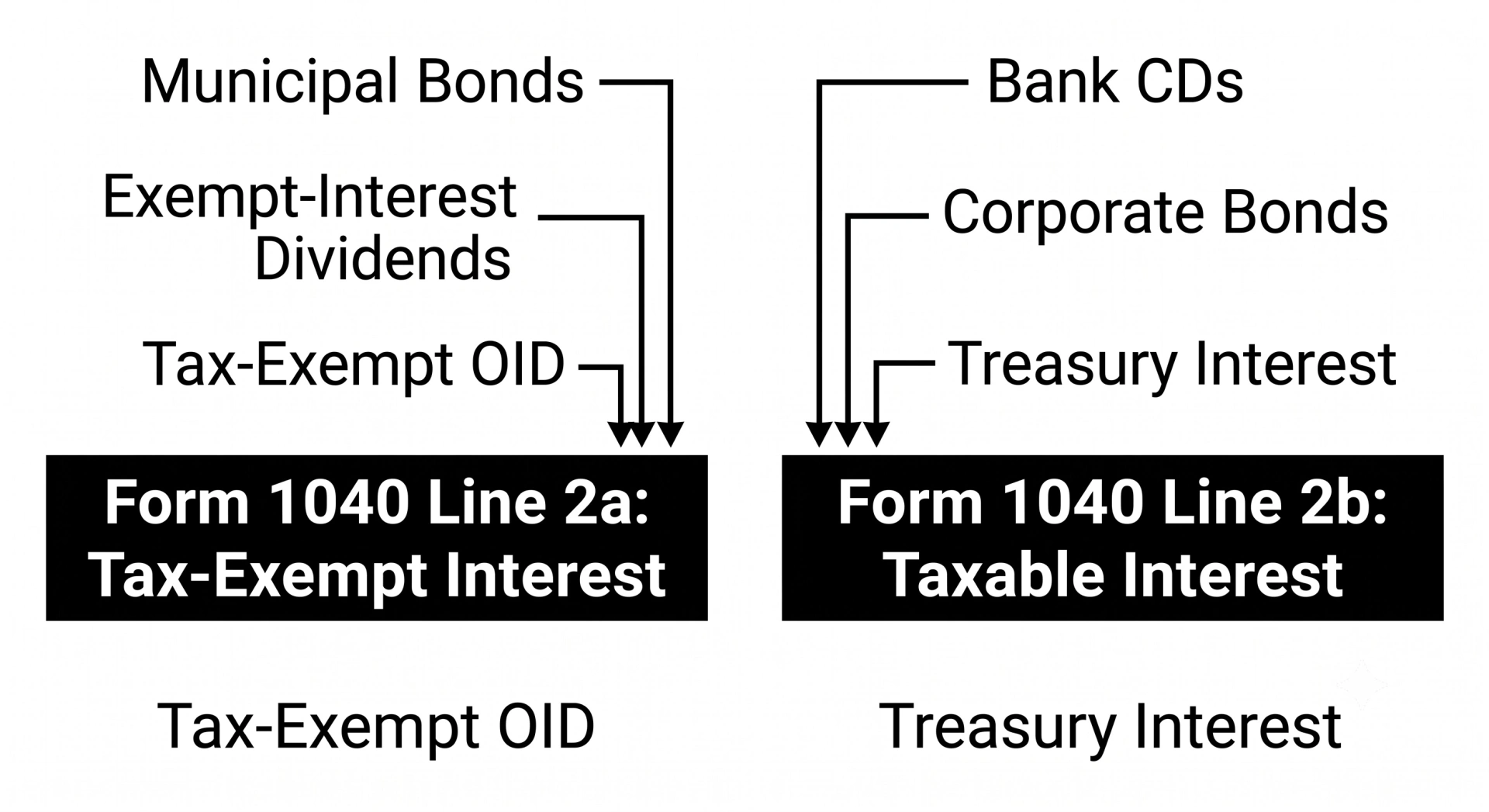
On IRS Form 1040, tax-exempt interest is reported on line 2a. Taxable interest is reported separately on line 2b. Common sources include municipal bond interest, tax-exempt original issue discount, and exempt-interest dividends from municipal bond funds or regulated investment companies.
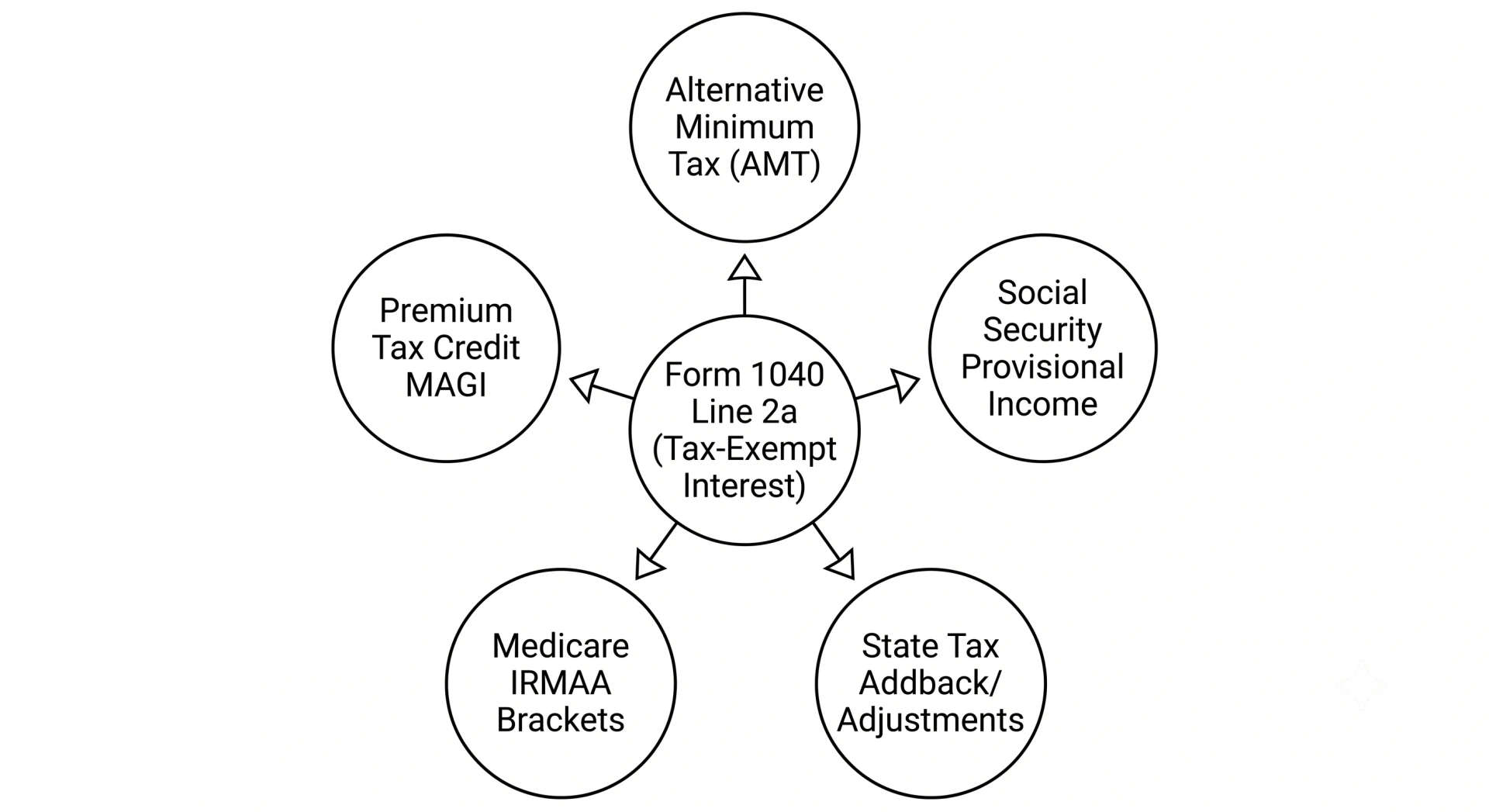
The short answer is this: Tax-exempt interest may not increase regular federal taxable income, but it can still affect IRS information matching, state tax treatment, Alternative Minimum Tax review, Social Security benefit taxation, and specific income calculations.
For CPAs and tax preparers, Form 1040 line 2a is not a throwaway field. It is a cue to review the source documents, 1099 boxes, state allocation details, and any bond premium or acquisition premium adjustments.
Before reviewing line 2a, it helps to define exactly what counts as tax-exempt interest.
What Qualifies as Tax-Exempt Interest Income?
Tax-exempt interest income is interest that is generally not subject to regular federal income tax. The most common example is interest from qualifying state or local government obligations, often called municipal bonds.
Tax-exempt interest may include:
Interest from qualifying municipal bonds
Interest from certain state or local government obligations
Interest from certain U.S. territory obligations
Tax-exempt original issue discount
Exempt-interest dividends from municipal bond funds or regulated investment companies
For example, if a taxpayer receives $800 of qualifying municipal bond interest, that amount may be excluded from regular federal taxable income. However, it still generally belongs on Form 1040 line 2a.
The IRS explains in Publication 550 that certain state, local, District of Columbia, and U.S. territory obligations may produce tax-exempt interest when the requirements are met.
What are Examples of Tax-Exempt Interest Income?
Common examples of tax-exempt interest income include interest from qualifying municipal bonds, exempt-interest dividends from municipal bond funds, tax-exempt original issue discount, and tax-exempt interest passed through on Schedule K-1. These amounts are generally reported on Form 1040 Line 2a even though they are excluded from regular federal taxable income.
1. Interest From Municipal Bonds
A taxpayer receives $1,200 of interest from a qualifying bond issued by a state or local government. The payer reports the amount in Box 8 of Form 1099-INT. The taxpayer generally includes $1,200 on Form 1040 Line 2a.
2. Exempt-Interest Dividends From a Municipal Bond Fund
A municipal bond mutual fund pays a taxpayer $750 in exempt-interest dividends. The fund reports the amount in Box 12 of Form 1099-DIV. The taxpayer includes the $750 on Form 1040 Line 2a. IRS Form 1099-DIV instructions explain that Box 12 reports exempt-interest dividends from mutual funds and other regulated investment companies.
3. Tax-Exempt Original Issue Discount
A taxpayer holds a qualifying tax-exempt bond that accrues $300 of original issue discount, or OID, during the year. The tax-exempt OID is generally shown in Box 11 of Form 1099-OID and included on Form 1040 Line 2a. The IRS Instructions for Schedule B confirm that tax-exempt OID is reported as tax-exempt interest.
4. Tax-Exempt Interest Reported on Schedule K-1
A partnership allocates $500 of tax-exempt interest to a partner in Box 18, Code A, of Schedule K-1 (Form 1065). The partner includes the $500 on Form 1040 Line 2a. The same principle can apply to tax-exempt interest passed through by an S corporation, estate, or trust.
Example: Combining Multiple Sources
Assume a taxpayer receives:
$1,200 from a municipal bond
$750 from a municipal bond fund
$300 of tax-exempt OID
$500 through a partnership Schedule K-1
The taxpayer generally reports $2,750 on Form 1040 Line 2a, subject to applicable adjustments such as amortizable bond premium.
Tax-exempt does not always mean irrelevant to every tax calculation. Interest from certain private activity bonds may affect the alternative minimum tax, and state tax treatment can depend on the bond issuer and the taxpayer’s state of residence. CPAs should therefore verify both the income source and its reporting document rather than relying only on the “tax-exempt” label.
Why is Tax-Exempt Interest Reported on Form 1040?
Tax-exempt interest must be reported because the IRS uses the amount for information reporting and certain tax calculations. Reporting tax-exempt interest on Form 1040 line 2a does not convert it into taxable interest.
Tax-exempt interest may matter for:
IRS matching against Forms 1099
Alternative Minimum Tax review
State income tax additions or subtractions
Social Security provisional income
Context-specific modified income calculations
Medicare-related income thresholds
The IRS Instructions for Form 1040 explain that tax-exempt interest, including tax-exempt OID and exempt-interest dividends, is entered on line 2a.
A client-friendly explanation is:
“Tax-exempt interest appears on your federal return because the IRS requires it to be reported. Reporting it on Form 1040 line 2a does not mean it is taxable as regular federal income, but it may affect other tax calculations.”
Once the reporting reason is clear, the next step is knowing exactly where the amount belongs.
Where is Tax-Exempt Interest Reported on Form 1040?
Tax-exempt interest income is reported on Form 1040 line 2a. Taxable interest is reported on Form 1040 line 2b.
Form 1040 Line
What It Reports
Common Examples
Line 2a
Tax-exempt interest
Municipal bond interest, tax-exempt OID, exempt-interest dividends
Line 2b
Taxable interest
Bank interest, CD interest, corporate bond interest, Treasury interest
For example, if a taxpayer has $800 of municipal bond interest and $1,200 of bank interest, the municipal bond interest generally goes on line 2a. The bank interest generally goes on line 2b.
Because tax-exempt interest often comes from multiple 1099 sources, firms building repeatable review systems may also benefit from a broader 1040 tax preparation workflow.
Which Forms 1099 and Boxes Feed Form 1040 Line 2a?
Tax-exempt interest can come from several information returns. The preparer should review the full Form 1099 package and brokerage supplemental details before finalizing line 2a.
Source Document
Box or Location
What It Reports
Review Point
Form 1099-INT
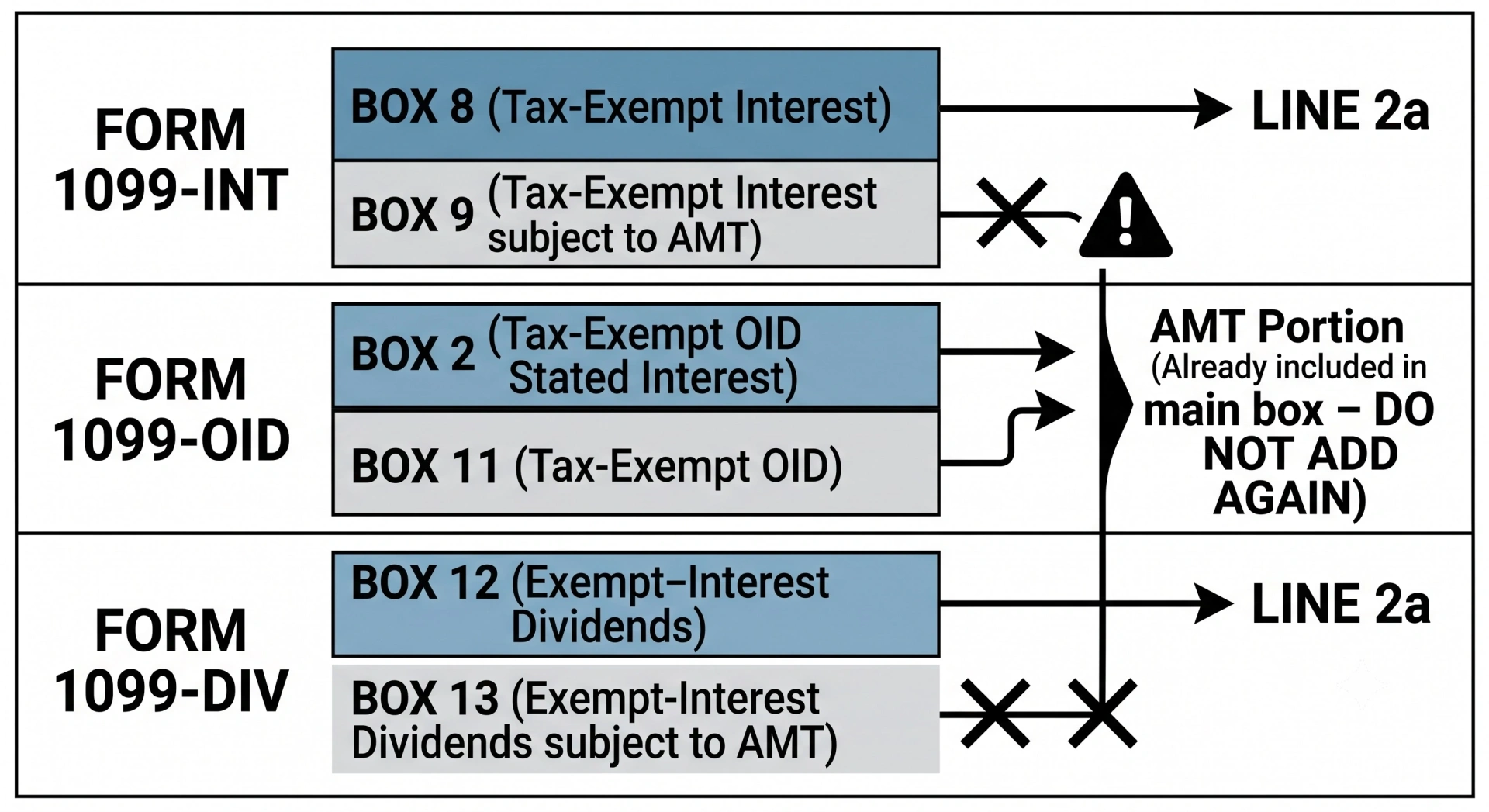
Box 8
Tax-exempt interest
Usually reported on Form 1040 line 2a
Form 1099-INT
Box 9
Tax-exempt interest subject to AMT
Included in box 8; do not double count
Form 1099-OID
Box 2
Tax-exempt stated interest on a tax-exempt OID bond
Box 9 and box 13 are review signals. They are not extra amounts to add again to line 2a.
How Is Tax-Exempt Interest From Form 1099-OID Reported?
For a tax-exempt OID bond, Form 1099-OID can report two different tax-exempt amounts. Box 2 may report tax-exempt stated interest, while box 11 reports tax-exempt original issue discount.
This distinction matters because stated interest and OID are different items. Stated interest is interest payable under the bond’s terms. OID generally reflects the difference between the bond’s issue price and its stated redemption price at maturity.
For Form 1040 line 2a, CPAs should review both boxes where applicable. If the taxpayer acquired a tax-exempt OID bond at an acquisition premium, the reportable tax-exempt OID may need to be reduced before the final amount is included on line 2a. The IRS Form 1099-OID shows box 11 for tax-exempt OID, and the Form 1040 instructions explain how tax-exempt OID and acquisition premium can affect line 2a reporting.
How Do You Calculate Tax-Exempt Interest for Form 1040 Line 2a?
To calculate Form 1040 line 2a, collect all tax-exempt interest sources, separate them from taxable interest, avoid double counting, apply required adjustments, and reconcile the result to the return.
A CPA review workflow should include:
Collect Forms 1099-INT, 1099-OID, 1099-DIV, and brokerage statements.
Separate taxable interest from tax-exempt interest.
Confirm Form 1099-INT box 9 is not added to box 8 a second time.
Confirm Form 1099-DIV box 13 is not added to box 12 a second time.
Review Form 1099-OID box 2 and box 11, where applicable.
Apply bond premium or acquisition premium adjustments.
Reconcile the final number to Form 1040 line 2a.
This step matters because line 2a is not always a simple sum of visible 1099 boxes. The IRS Instructions for Form 1040 explain that tax-exempt bond premium and acquisition premium can require net reporting.
After line 2a is reconciled, the next question is whether Schedule B is required for the broader return.
Does Tax-Exempt Interest Need to Be Reported on Schedule B?
Tax-exempt interest is reported on Form 1040 line 2a. It is not treated the same as taxable interest reported on Schedule B Part I.
Schedule B is generally required when the taxpayer has more than $1,500 of taxable interest or ordinary dividends, or when another Schedule B reporting condition applies.
Schedule B may also be required if the taxpayer has:
Foreign accounts
Foreign trusts
Nominee interest
Seller-financed mortgage interest
Other Schedule B reporting conditions
For example, a taxpayer with only municipal bond interest may still report the tax-exempt amount on Form 1040 line 2a without needing Schedule B, if no Schedule B trigger applies. But a taxpayer with more than $1,500 of taxable bank interest or ordinary dividends generally needs Schedule B.
Once Schedule B is addressed, the preparer should review whether tax-exempt interest affects other calculations.
How Does Tax-Exempt Interest Affect AMT, Social Security, and MAGI?
Tax-exempt interest generally does not increase federal adjusted gross income, but it can still affect specific income formulas. The key is to identify which calculation is being reviewed instead of using “MAGI” as a general shortcut.
For Social Security benefits, tax-exempt interest is included in the provisional income formula used to determine whether benefits are taxable. IRS Publication 915 explains the Social Security benefit taxation rules and the income formula used for that purpose.
Tax-exempt interest may also matter for:
Alternative Minimum Tax review
State tax additions or subtractions
Medicare premium surcharges, known as IRMAA, using the SSA definition of MAGI
Premium Tax Credit calculations, depending on the applicable MAGI definition
IRA contribution or deduction rules, depending on the applicable MAGI definition
Other tax provisions that use their own modified income formula
For AMT, the key review points are Form 1099-INT box 9 and Form 1099-DIV box 13. Some tax-exempt private activity bond interest may be an AMT preference item, but not all private activity bond interest is treated that way.
IRS Publication 550 says interest on certain bonds is not a tax preference item and is not subject to AMT, including qualified 501(c)(3) bond, New York Liberty bonds, qualified mortgage bonds issued after July 30, 2008</a>, and qualified veterans’ mortgage bonds issued after July 30, 2008
Preparers should use Form 1099-INT box 9, Form 1099-DIV box 13, bond-level details, and Form 6251 to determine whether AMT review is required. When box 9 or box 13 appears, the AMT-related amount should be reviewed separately rather than added again to Form 1040 line 2a.
Is Federally Tax-Exempt Interest Taxable at the State Level?
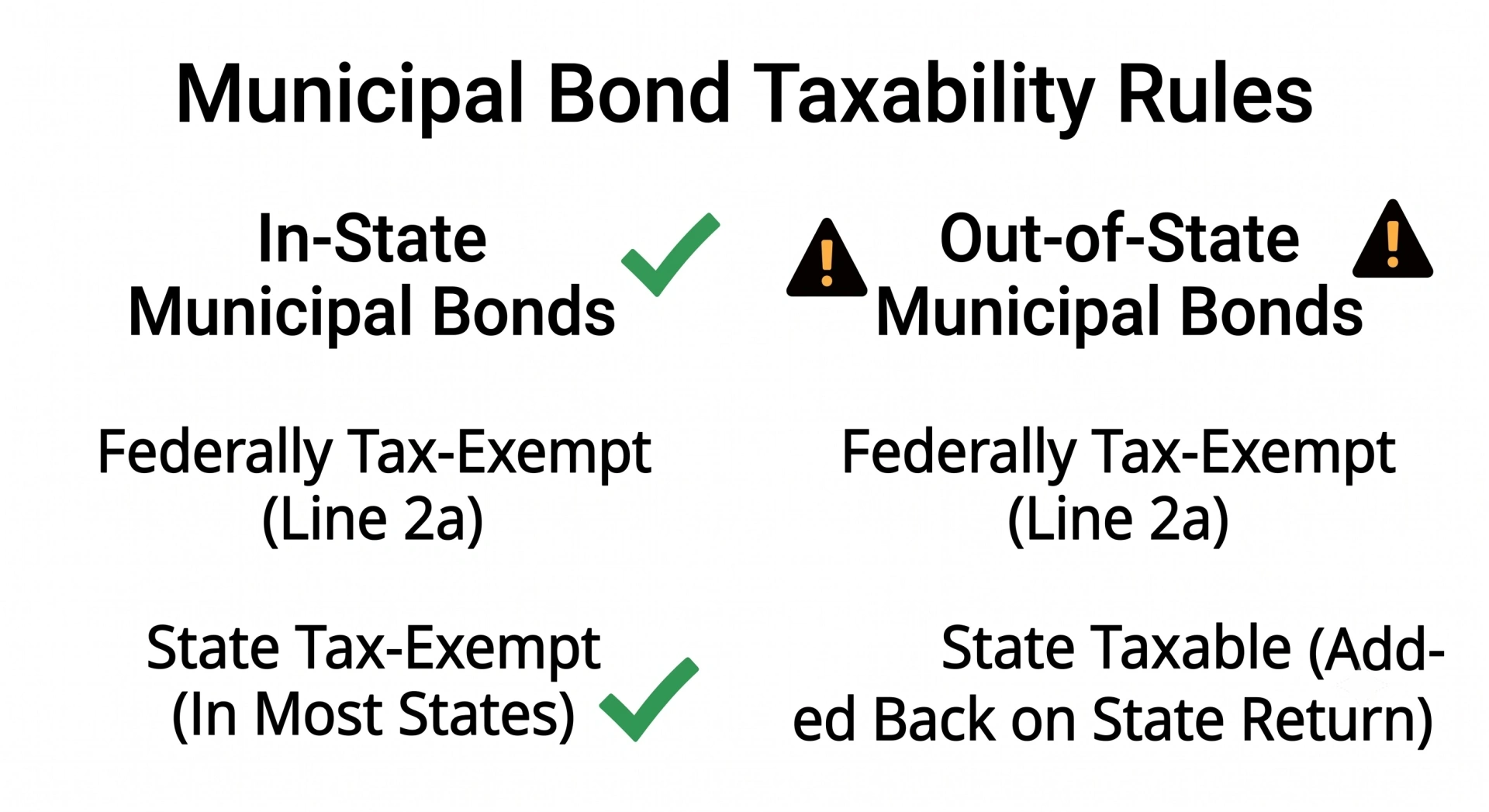
Tax-exempt interest for federal purposes is not always tax-free at the state level. State treatment depends on the taxpayer’s resident state, the issuing jurisdiction, and the type of bond or fund.
In general:
In-state municipal bond interest may receive favorable state treatment.
Out-of-state municipal bond interest may be taxable by the resident state.
Multi-state municipal bond funds may require allocation schedules.
U.S. territory obligations may have separate rules.
Brokerage supplemental statements often provide state allocation details.
For example, a taxpayer may properly report municipal bond interest on federal Form 1040 line 2a and still need a state-level adjustment. Federal reporting and state taxability are related, but they are not the same determination.
This is one reason federal and state tax treatment should be reviewed separately, especially when municipal bond interest crosses state lines. CPA Pilot’s guide to federal vs. state tax differences gives broader context.
Advanced Tax-Exempt Interest Reporting Issues for CPAs
Some tax-exempt interest issues require deeper review because they may not be obvious from the main 1099 summary page.
Tax-Exempt Interest Without a Form 1099
A taxpayer may still need to report tax-exempt interest even if no information return was received. The filing obligation depends on the income and tax rules, not only on whether a payer issued a form.
Nominee Tax-Exempt Interest
Nominee interest occurs when the taxpayer receives interest that belongs partly or entirely to another person. In that case, the preparer may need allocation support or nominee reporting.
Market Discount on Tax-Exempt Bonds
Market discount on a tax-exempt bond can create taxable income when the bond is sold, redeemed, or otherwise disposed of. IRS Publication 550 discusses market discount rules for tax-exempt bonds, including when gain may be treated as ordinary income.
Corrected Brokerage Statements
Corrected brokerage statements can change tax-exempt interest, AMT classifications, bond premium adjustments, or state allocation details. CPA firms should confirm whether corrected statements were issued before finalizing the return.
These advanced issues are also where tax-exempt interest is most often confused with other tax-free income categories.
Tax-Exempt Interest vs. Other Types of Tax-Free Income
Tax-exempt interest income is not the same as every type of tax-free income. Form 1040 line 2a is specifically for tax-exempt interest.
The IRS Form 1040 specifically says not to include interest earned on an IRA, HSA, Archer MSA, Medicare Advantage MSA, or Coverdell education savings account on line 2a.
That distinction helps prevent common reporting mistakes.
Common Form 1040 Line 2a Reporting Mistakes to Avoid
The most common mistakes happen when taxpayers confuse “tax-exempt” with “not reportable” or when preparers double count AMT-related boxes.
Avoid these errors:
Leaving line 2a blank because the interest is federally tax-exempt
Reporting tax-exempt interest on line 2b
Adding Form 1099-INT box 9 to box 8
Adding Form 1099-DIV box 13 to box 12
Missing Form 1099-OID box 2 or box 11 where applicable
Missing exempt-interest dividends
Ignoring bond premium or acquisition premium
Assuming federal exemption guarantees state exemption
Skipping AMT review
Treating all tax-exempt income as line 2a income
A clean review process prevents most of these issues before the return reaches final review.
Form 1040 Line 2a Tax-Exempt Interest Review Checklist
Use this checklist when reviewing tax-exempt interest income on Form 1040:
Collect all Forms 1099-INT, 1099-OID, and 1099-DIV.
Review consolidated brokerage statements.
Identify Form 1099-INT boxes 8 and 9.
Identify Form 1099-OID boxes 2 and 11.
Identify Form 1099-DIV boxes 12 and 13.
Separate taxable interest from tax-exempt interest.
Confirm AMT boxes are not double-counted.
Review tax-exempt OID and acquisition premium.
Apply tax-exempt bond premium adjustments where required.
Reconcile the result to Form 1040 line 2a.
Review state allocation details.
Consider AMT, Social Security, Medicare, and provision-specific MAGI effects.
Document unusual positions in the workpapers.
Documentation also supports recordkeeping. The IRS explains that taxpayers should keep records that support income, deductions, credits, and other items shown on a return until the relevant period of limitations expires. See the IRS guidance on how long taxpayers should keep records.
For CPA firms, this documentation step turns tax-exempt interest reporting from a quick line entry into a repeatable Form 1040 review process.
How CPA Pilot Helps Firms Standardize Tax-Exempt Interest Reviews
CPA Pilot helps CPAs, Enrolled Agents, and U.S. tax firms bring more structure to AI tax research and Form 1040 review. For tax-exempt interest income, CPA Pilot can help teams organize Form 1099 review points, compare federal and state treatment, identify AMT and income-formula questions, draft client-ready explanations, and document reviewer notes more consistently.
This is especially useful when firms want junior preparers to follow the same logic reviewers expect. Instead of treating every Form 1099 question as a one-off research task, CPA Pilot helps the team turn recurring issues into a clearer workflow.
To see how this can work inside your firm, explore the CPA Pilot demo and review the available CPA Pilot pricing plans to choose the right setup for your team.
FAQs About Tax-Exempt Interest Income
Can Tax-Exempt Interest Create a Federal Filing Requirement?
Tax-exempt interest income generally does not count as gross income for federal filing thresholds. However, if a taxpayer is otherwise required to file, tax-exempt interest should be reported on Form 1040 line 2a.
How Is Schedule K-1 Tax-Exempt Interest Reported on Form 1040?
Tax-exempt interest from a partnership, S corporation, estate, or trust may pass through on Schedule K-1. The taxpayer generally reports the tax-exempt interest amount on Form 1040 line 2a.
Does Tax-Exempt Interest Count Toward the Net Investment Income Tax?
Tax-exempt interest is generally excluded from net investment income for NIIT purposes. However, CPAs should review the full return because other investment income may still trigger Form 8960.
Does Tax-Exempt Interest Affect Premium Tax Credit Eligibility?
Tax-exempt interest can affect Premium Tax Credit eligibility because Form 8962 MAGI generally adds tax-exempt interest back to AGI. CPAs should review line 2a when reconciling marketplace coverage.
Is Municipal Bond Fund Income Always Exempt From Federal and State Tax?
Municipal bond fund income is not always fully tax-exempt for every purpose. Exempt-interest dividends may be federally tax-exempt, but state tax, AMT, and fund allocation details still require review.
Does Tax-Exempt Interest Income Appear on Form W-2?
No. Tax-exempt interest is not wage income and generally does not appear on Form W-2. It is usually reported on Form 1099-INT, Form 1099-OID, Form 1099-DIV, or Schedule K-1 and entered on Form 1040 Line 2a. (Source: IRS guidance )
Does Tax-Exempt Interest Income Affect FAFSA Eligibility?
Yes. The FAFSA requests tax-exempt interest from Form 1040 Line 2a and uses it when calculating financial-aid eligibility. Applicants should report the amount requested for the applicable FAFSA year. (Source : Federal Student Aid guidance)
Is Interest From Puerto Rico Government Bonds Tax-Exempt?
Interest from qualifying Puerto Rico government bonds is generally exempt from federal, state, and local income tax. A U.S. taxpayer generally reports federally tax-exempt interest on Form 1040 Line 2a. (Source: 48 U.S.C. § 745)
I’m Harsh Mody, CPA, founder of CPA Pilot—an AI Tax Assistant for CPAs, Enrolled Agents, and U.S. tax firms. With 18+ years in accounting, tax auditing, consulting, and product management, I’ve seen how compliance-heavy work limits true advisory impact. I built CPA Pilot to change that—by applying AI-driven tax research, deduction optimization, and IRS/state code automation to help firms unlock tax savings and scale advisory services with speed and accuracy.