How to Adjust W-4 Withholding in 2026 - Step-by-Step Guide - CPA Pilot
AI Tax Planning
How to Adjust W-4 Withholding in 2026 - Step-by-Step Guide
Learn how to adjust W-4 withholding in 2026, including extra withholding, multiple jobs, tax credits, deductions, exemptions, and mid-year changes.
CPA Pilot
Sep 22, 2026·18 min read
To adjust your federal income tax withholding in 2026, submit a new Form W-4, Employee’s Withholding Certificate, to your employer.
If you want more federal income tax withheld, Step 4(c) lets you request an additional dollar amount per pay period. If too much tax is being withheld, accurately accounting for eligible credits in Step 3 or deductions in Step 4(b) may reduce withholding.
The objective is usually to bring withholding reasonably close to your expected federal income tax liability—not simply to generate the largest refund or paycheck.
Quick answer: To change your W-4 withholding in 2026, submit a new Form W-4 to your employer. Use Step 4(c) when you want additional federal income tax withheld. Properly account for eligible credits in Step 3 or deductions in Step 4(b) when those items should reduce withholding. If you have multiple jobs, a working spouse, or are changing withholding during the year, the IRS Tax Withholding Estimator can help calculate a more accurate adjustment.
A W-4 review can be particularly important after a new job, marriage or divorce, the birth or adoption of a child, a second job, a substantial income change, or another event that changes your expected tax position.
Claim exemption from federal income tax withholding
Exemption checkbox below Step 4(c), if eligible
A W-4 changes how federal income tax is collected from wages during the year. It does not, by itself, change the tax liability ultimately calculated on your return.
What is Form W-4 and How Does It Affect Your Paycheck?
Form W-4 gives your employer information used to calculate the federal income tax withheld from your wages.
Depending on your circumstances, it can account for your:
anticipated filing status;
multiple jobs or working spouse;
dependent and other tax credits;
income that does not already have withholding;
eligible deductions;
requested additional withholding.
Your employer combines that information with your wages, payroll frequency, and federal withholding rules to determine how much income tax to withhold each pay period.
Your final federal income tax liability is calculated separately when you prepare your return.
If tax payments and refundable credits exceed your final liability, you may receive a refund. If too little tax was paid during the year, you may have a balance due and, depending on the circumstances, an underpayment penalty.
The relationship is straightforward:
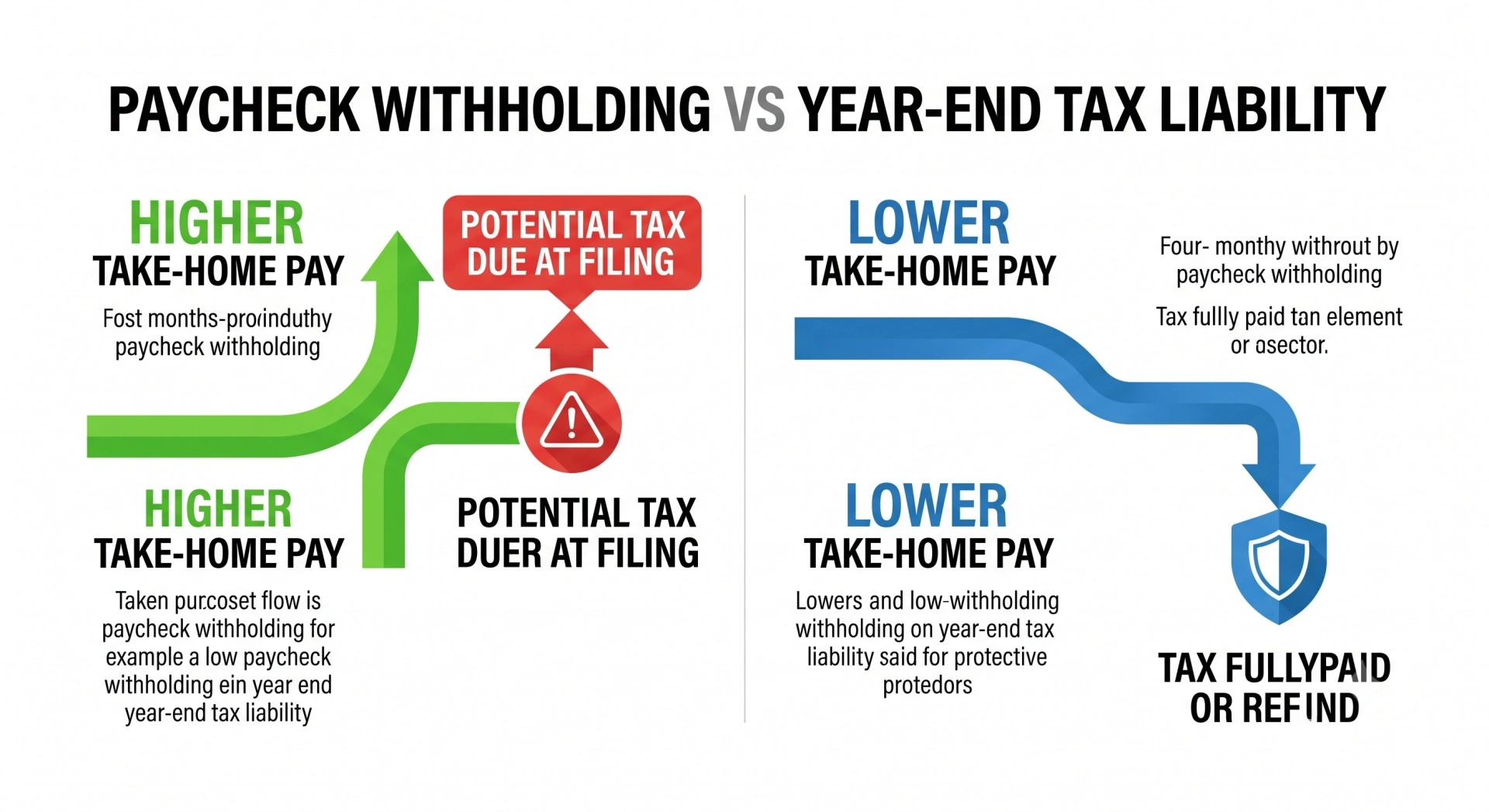
More withholding → lower take-home pay now → potentially a smaller balance due or larger refund later.
Less withholding → higher take-home pay now → potentially a smaller refund or larger balance due later.
Neither outcome is automatically preferable. The appropriate amount depends on your expected tax liability and cash-flow needs.
When Should You Adjust Your W-4?
You can submit a new W-4 when your withholding circumstances change.
Common reasons to review your withholding include:
starting a new job;
taking a second job;
a spouse starting or leaving work;
getting married or divorced;
having or adopting a child;
receiving a substantial raise;
experiencing a major reduction in income;
beginning freelance or gig work;
receiving significant investment or retirement income;
changes in expected deductions or credits;
receiving an unexpectedly large refund;
owing substantially more tax than expected when filing.
A prior-year refund or balance due can provide useful context, but current-year wages, withholding, deductions, credits, and other income matter more for the current W-4 calculation.
For tax professionals performing these reviews as part of year-round advisory work, CPA Pilot's guide to mid-year and year-end tax planning provides a broader workflow for analyzing year-to-date income, withholding, estimates, and planning actions.
How to Adjust Your W-4 Withholding Step by Step
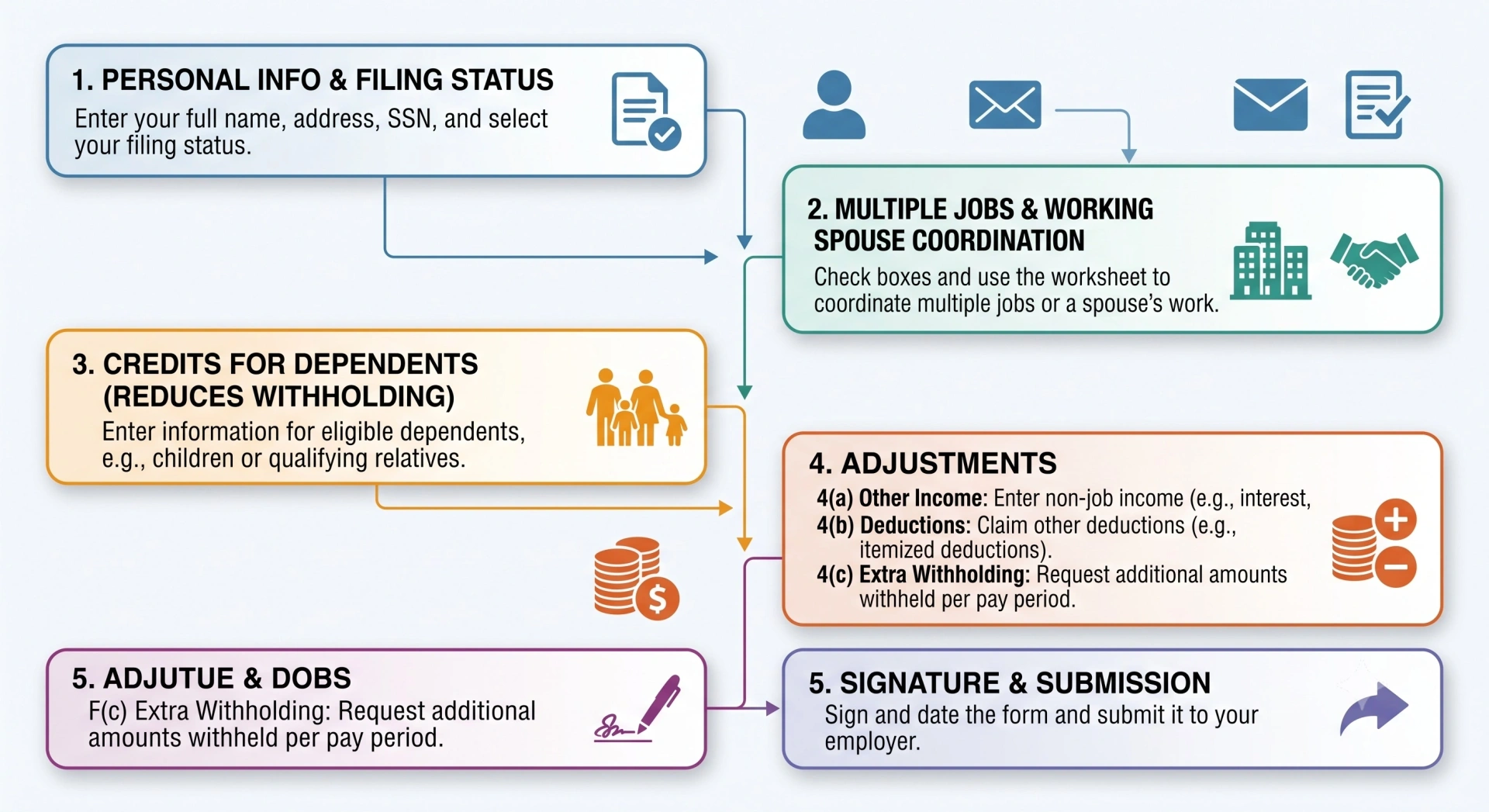
The 2026 Form W-4 is organized into five main steps. Steps 2 through 4 apply only when relevant to your circumstances.
Step 1: Enter Your Personal Information and Filing Status
Step 1 asks for your identifying information and anticipated filing status.
The available filing-status choices include:
Single or Married filing separately;
Married filing jointly or Qualifying surviving spouse;
Head of household.
Your anticipated filing status affects the standard deduction and tax-rate assumptions used in withholding calculations.
Choose the status you reasonably expect to use on your federal income tax return rather than whichever option creates the paycheck amount you prefer.
Step 2: Account for Multiple Jobs or a Working Spouse
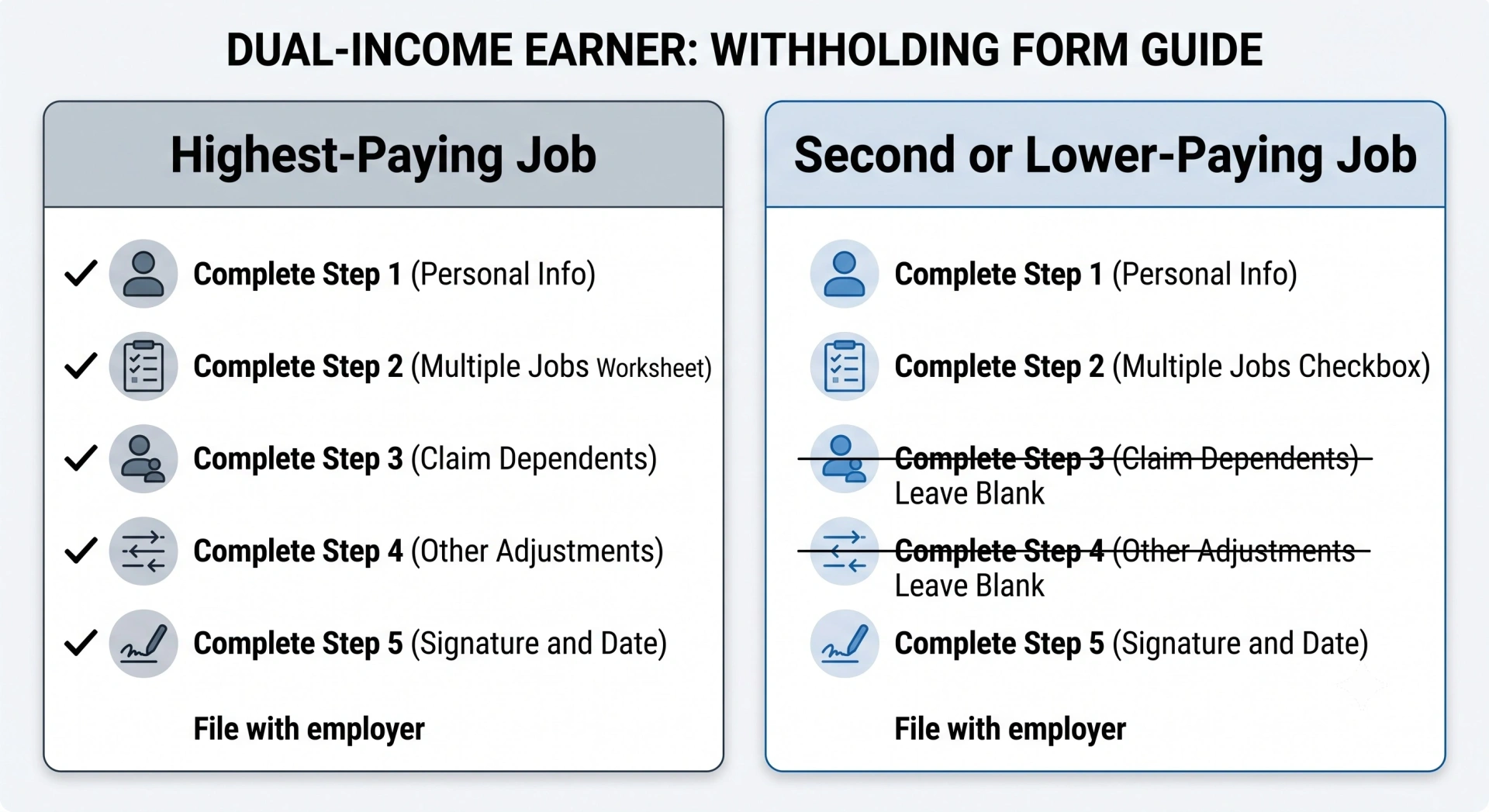
Complete Step 2 if you:
hold more than one job at the same time; or
are married filing jointly and your spouse also works.
This section matters because each employer generally calculates withholding using only the wages it pays, while your final federal income tax can depend on household income from all jobs combined.
Form W-4 provides three main approaches.
Option 1: Use the IRS Tax Withholding Estimator
The IRS Tax Withholding Estimator is generally the most flexible approach when household wages differ significantly or the situation includes several jobs, bonuses, non-wage income, or mid-year employment changes.
Option 2: Use the Multiple Jobs Worksheet
The Multiple Jobs Worksheet included with Form W-4 estimates additional withholding based on wages from multiple jobs.
The resulting additional withholding amount is generally entered in Step 4(c).
Option 3: Use the Step 2(c) Checkbox
Step 2(c) may be used when there are only two jobs total.
This could mean you personally have two jobs, or you and your spouse each have one job and expect to file jointly.
If you use the Step 2(c) method, the checkbox must be selected on both applicable W-4 forms.
IRS guidance also notes that this method tends to work better when the lower-paying job pays more than half as much as the higher-paying job.
Where Should Steps 3 and 4 Go With Multiple Jobs?
Do not duplicate the same credits and deductions across several W-4s.
The IRS instructs taxpayers with multiple jobs to complete Steps 3 through 4(b) on only one Form W-4, generally the form for the highest-paying job, and leave those sections blank on the others.
Step 3: Account for Dependents and Other Tax Credits
On the 2026 Form W-4, Step 3 separates the dependent-credit calculation into Lines 3(a) and 3(b).
On Line 3(a), eligible taxpayers multiply the number of qualifying children under age 17 by $2,200.
On Line 3(b), eligible taxpayers multiply the number of other qualifying dependents by $500.
The calculations remain subject to the income thresholds and eligibility requirements printed on the form.
Step 3 can also account for estimates of certain other tax credits.
Amounts entered in Step 3 generally reduce federal income tax withholding. They should reflect credits you reasonably expect to claim rather than an arbitrary amount chosen to increase take-home pay.
Step 4(a): Account for Other Income
Step 4(a) lets you account for income that is not from jobs and does not already have federal income tax withholding.
Examples can include:
interest;
dividends;
retirement income.
Entering applicable other income can increase wage withholding so that more tax is collected during the year.
This can be useful when wages are your primary income source but you also receive other taxable income.
Significant self-employment income, capital gains, business income, or other complex income may require estimated tax payments or a broader tax projection instead of relying solely on Step 4(a).
Step 4(b): Account for Deductions
Step 4(b) allows you to account for eligible deductions beyond the amount already reflected in the withholding calculation.
For 2026, the standard deduction is:
$32,200 for Married filing jointly or Qualifying surviving spouse;
$24,150 for Head of household;
$16,100 for Single or Married filing separately.
The W-4 Deductions Worksheet can also account for applicable itemized deductions and newer federal deductions involving:
qualified tips;
qualified overtime compensation;
qualified passenger vehicle loan interest;
the enhanced deduction for eligible seniors.
For 2026, the federal state and local tax, or SALT, deduction limit is $40,400, or $20,200 for married taxpayers filing separately, before the applicable income-based reduction.
Taxpayers and advisers evaluating how state and local taxes interact with itemized deductions can go deeper in CPA Pilot's SALT deduction guide.
The higher SALT limit does not automatically mean a Step 4(b) adjustment is appropriate. Your actual expected deductions determine whether the worksheet produces an adjustment.
Step 4(c): Request Additional Federal Income Tax Withholding
Step 4(c) is the most direct way to request additional federal income tax withholding.
Enter the extra dollar amount you want withheld per pay period.
For example, entering:
$100 in Step 4(c)
generally instructs payroll to withhold an additional $100 of federal income tax each pay period.
Step 4(c) can be useful when:
current withholding is projected to be too low;
multiple jobs create a withholding shortage;
you have taxable income without sufficient withholding;
income increased during the year;
a prior tax projection showed an expected balance due.
The number entered in Step 4(c) is not an annual amount. It applies each pay period. IRS Publication 505 specifically describes Step 4(c) as the place to request an additional amount from each paycheck.
Step 5: Sign and Submit Form W-4
A completed Form W-4 must be signed.
Submit it using your employer's accepted process, which may include:
a paper W-4;
an HR portal;
a payroll system;
another approved electronic process.
The form goes to your employer, not directly to the IRS.
Keep a record of the W-4 you submitted, especially if the adjustment was based on a tax projection.
How Much Extra Withholding Should You Put on Form W-4?
If you know approximately how much additional federal income tax must be covered for the rest of the year, you can translate that shortage into an amount per remaining pay period.
Use:
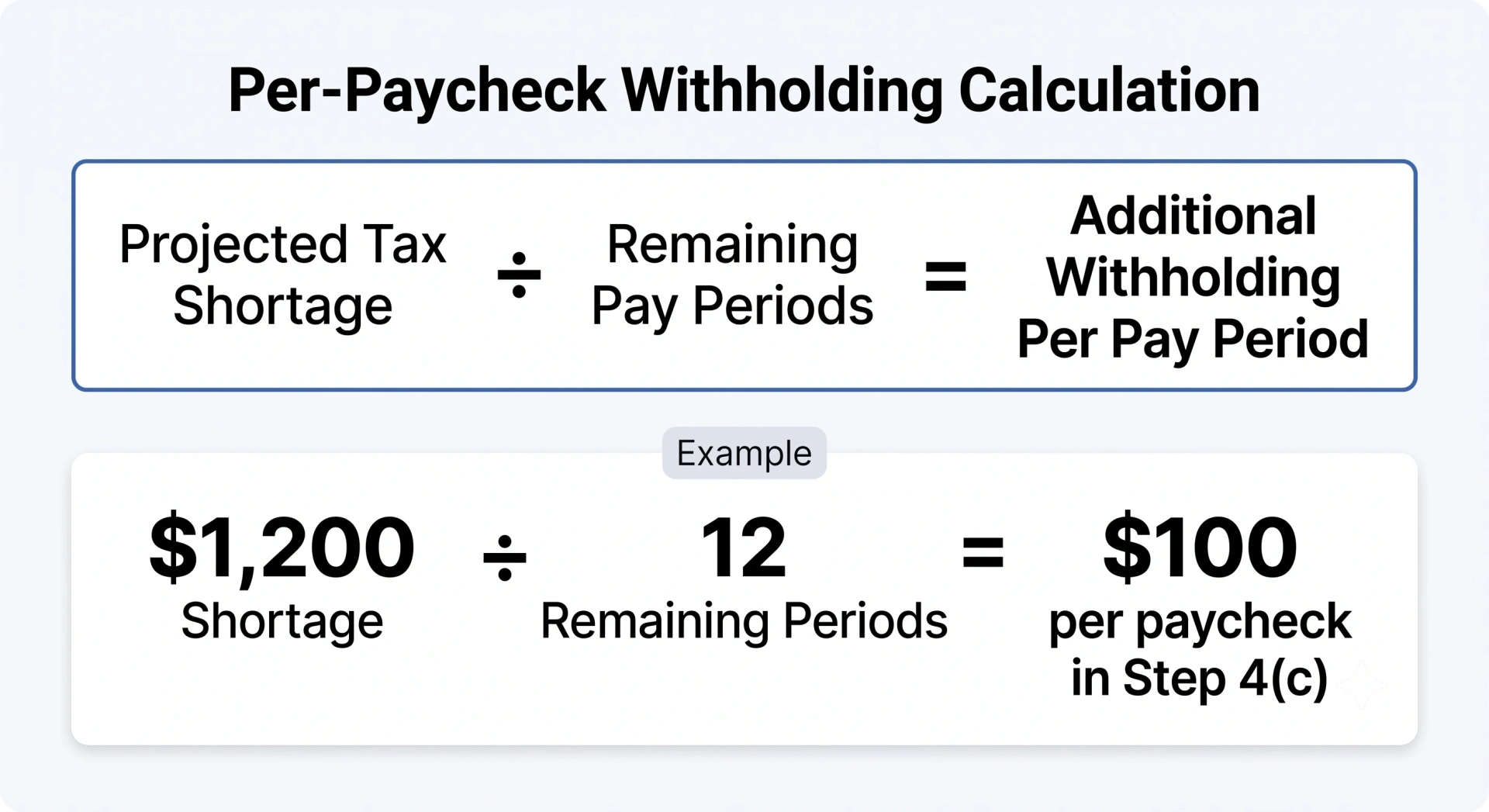
Projected withholding shortage ÷ remaining pay periods = additional withholding per pay period
Suppose your current projection shows a $1,200 withholding shortage and you have 12 pay periods remaining.
The calculation is:
$1,200 ÷ 12 = $100
You could therefore consider entering an additional $100 in Step 4(c).
Publication 505 uses the same basic logic when explaining how taxpayers can allocate a projected withholding shortage over the remaining paydays in the year.
This calculation is useful only after the expected shortage has been determined. It is not a substitute for estimating your full annual tax liability.
How to Adjust W-4 Withholding in the Middle of the Year
Mid-year adjustments require more information because part of the year's income and withholding has already occurred.
If you decide in September that you want $18,000 of total federal income tax paid through withholding, simply dividing $18,000 by your normal annual number of pay periods would ignore the tax already withheld from January through August.
A mid-year calculation should consider:
year-to-date taxable wages;
federal income tax already withheld;
projected wages for the rest of the year;
remaining pay periods;
a spouse's wages and withholding, if applicable;
other taxable income;
expected deductions;
expected tax credits;
estimated tax payments already made.
Conceptually:
Projected annual federal tax liability − tax payments already made or expected = remaining tax to cover
The remaining amount can then be allocated across the pay periods left in the year.
For more complicated cases, the IRS Tax Withholding Estimator or a complete tax projection is more appropriate than relying on a simple annualized formula.
For a professional workflow around this calculation, see CPA Pilot's guide to AI-assisted tax projections for CPAs, which covers year-to-date income, deductions, credits, estimated payments, withholding shortfalls, and scenario modeling.
Should You Increase or Decrease Your W-4 Withholding?
Whether withholding should increase or decrease depends on the relationship between your expected tax payments and your projected federal income tax liability.
When You May Need More Withholding
More withholding may be appropriate when current payments are projected to fall short because of circumstances such as:
multiple jobs;
a working spouse;
a substantial increase in wages;
bonuses;
taxable investment or retirement income;
other taxable income;
smaller-than-expected deductions or credits.
Step 4(a) can account for applicable other income, while Step 4(c) provides a direct way to request additional withholding.
When You May Need Less Withholding
If a projection indicates that significantly more federal income tax is being withheld than necessary, an updated W-4 may reduce withholding.
Potential adjustments include:
correctly reporting eligible credits in Step 3;
accounting for eligible deductions in Step 4(b);
reducing an unnecessary Step 4(c) amount;
updating Step 2 after a second job ends.
The goal should be appropriate withholding based on expected tax liability rather than simply maximizing take-home pay.
How to Adjust Your W-4 for a Bigger Tax Refund
If you intentionally want more federal income tax withheld, Step 4(c) is the clearest mechanism.
For example, requesting an additional $50 of withholding for 20 remaining pay periods creates approximately $1,000 of additional federal withholding during those periods.
Whether your eventual refund increases by the same amount depends on everything else reported on your tax return.
A tax refund generally occurs when tax payments and refundable credits exceed final tax liability.
Additional withholding increases the amount paid toward your taxes. It does not create an additional deduction or independently reduce the tax you owe.
For this reason, maximizing a refund is not necessarily the same as optimizing withholding. Greater withholding also means less take-home pay during the year.
How to Adjust Your W-4 for a Bigger Paycheck
Increasing take-home pay generally requires appropriately reducing federal income tax withholding.
Depending on your circumstances, that might involve:
correctly accounting for eligible credits in Step 3;
accounting for eligible deductions in Step 4(b);
reducing an unnecessary Step 4(c) amount;
updating Step 2 after household employment changes.
Do not enter unsupported credits, dependents, or deductions simply to reduce withholding.
Lower withholding does not eliminate the underlying tax liability. If too little is withheld, you could receive a smaller refund, owe tax at filing, or potentially incur an underpayment penalty.
What's New on Form W-4 for 2026?
Several changes make older W-4 guidance unreliable for 2026.
Step 3 Uses Updated Dependent-Credit Amounts
For taxpayers meeting the form's requirements, Line 3(a) uses $2,200 per qualifying child under age 17, while Line 3(b) uses $500 per other qualifying dependent.
The Standard Deduction Increased
For 2026, the standard deduction is:
$32,200 for Married filing jointly or Qualifying surviving spouse;
$24,150 for Head of household;
$16,100 for Single or Married filing separately.
Current Withholding Rules Reflect New Deductions
The 2026 withholding framework accounts for deductions involving qualified tips, qualified overtime compensation, qualified passenger vehicle loan interest, and the enhanced deduction for eligible seniors.
The 2026 SALT Deduction Limit Is $40,400
For 2026, the overall federal SALT deduction limit is $40,400, or $20,200 for married taxpayers filing separately, subject to the applicable modified adjusted gross income reduction.
Form W-4 Has a Dedicated Exemption Checkbox
The 2026 W-4 includes an “Exempt from withholding” checkbox below Step 4(c).
To qualify for exempt status, an employee generally must have had no federal income tax liability for the previous year and expect no federal income tax liability for the current year.
When claiming exemption, complete the required identifying information, check the exemption box, and sign the form. Do not complete Steps 2, 3, or 4.
An exemption from federal income tax withholding does not eliminate Social Security or Medicare taxes.
Exempt Status Must Generally Be Renewed Each Year
An exempt W-4 applies only for the calendar year in which it is furnished.
To continue exempt status for another year, an employee generally must give the employer a new exempt W-4 by February 15 of that year. If February 15 falls on a weekend or legal holiday, the deadline moves to the next business day.
If the renewal is submitted later, exempt treatment can apply to future wages, but the employer generally does not refund federal income tax already withheld while the exemption was not in effect.
What Happens If You Don't Submit a Form W-4?
If you do not provide a valid W-4, your employer generally calculates federal income tax withholding as though you selected Single or Married filing separately and made no entries in Steps 2, 3, or 4.
This is more accurate than saying the employer simply uses the “highest tax rate.”
Whether that default amount is appropriate depends on your actual tax circumstances.
How Long Does a New W-4 Take to Take Effect?
Employers can implement a revised W-4 sooner, but federal guidance provides an outside implementation period.
After submitting a new W-4, review an applicable paystub and verify:
taxable wages;
federal income tax withheld;
any requested Step 4(c) adjustment;
net pay.
If the expected change does not appear after the applicable payroll processing period, contact payroll or HR.
Federal W-4 vs. State Income Tax Withholding
Form W-4 controls federal income tax withholding. It does not automatically update state income tax withholding.
States may use separate:
employee withholding certificates;
allowances or adjustment systems;
exemption forms;
payroll elections;
calculation methods.
Changing Step 4(c) on a federal W-4 therefore does not necessarily change the state income tax withheld from your wages.
This becomes particularly important when an employee moves between states, works remotely across state lines, or lives in one state while working in another.
Updating Step 3 lets payroll withholding account for the expected credit during the year.
For 2026, Line 3(a) uses $2,200 per qualifying child under age 17, subject to the form's eligibility requirements.
Example 4: An Employee Has Significant Non-Wage Income
An employee receives wages but also expects taxable interest and dividend income without withholding.
Depending on the facts, Step 4(a) can allow wage withholding to account for applicable other income.
If the additional income is substantial or includes variable capital gains or self-employment income, a complete projection or estimated-tax analysis may be more appropriate.
Common W-4 Mistakes to Avoid
Mistake #1 - Treating a Bigger Refund as Extra Income
A refund generally represents tax payments that exceeded final liability, refundable credits, or both.
Increasing withholding may increase a future refund, but it reduces take-home pay during the year.
Mistake #2 - Guessing at Step 4(c)
If you know the projected withholding shortage, divide that amount across the remaining pay periods rather than choosing an arbitrary additional-withholding number.
Mistake #3 - Ignoring Year-to-Date Withholding
A mid-year adjustment should account for tax already withheld.
Ignoring earlier pay periods can create significant over- or under-withholding.
Mistake #4 - Checking Step 2(c) on Only One W-4
When using the Step 2(c) two-job method, the checkbox must be selected on both applicable forms.
Mistake #5 - Duplicating Credits Across Multiple W-4s
Steps 3 through 4(b) generally should be completed on only one W-4 in a multiple-job household.
Mistake #6 - Claiming Exempt While Completing Other Adjustment Steps
Employees claiming exemption should use the dedicated exemption checkbox and leave Steps 2 through 4 blank.
Mistake #7 - Confusing Federal and State Withholding
Federal Form W-4 does not automatically change state withholding.
Mistake #8 - Using an Outdated W-4 Guide
The form, dollar amounts, deduction limits, and withholding rules can change from year to year. Use guidance that reflects the current tax year.
When a W-4 Question Becomes a Tax Projection Question
Simple W-4 changes can often be handled using the form instructions and IRS estimator.
More complicated situations require a broader calculation.
A complete withholding analysis may connect:
year-to-date wages → withholding already paid → projected remaining income → non-wage income → deductions → credits → estimated payments → projected federal tax liability
This becomes especially important when the taxpayer has:
multiple jobs;
self-employment income;
large bonuses;
investment income;
substantial capital gains;
major deduction changes;
multiple tax credits;
significant year-to-year income changes.
For tax professionals, that means a client's question about what to put on Form W-4 may actually require a current-year projection before any withholding recommendation can be made.
CPA Pilot for tax professionals: CPA Pilot's AI Tax Projections lets CPAs and EAs model income and deduction changes, compare scenarios, estimate liabilities, and turn the result into client-ready planning guidance.
W-4 Withholding FAQs
How Much Extra Withholding Should I Put on My W-4?
If you already know your projected withholding shortage, divide the remaining amount by the number of pay periods left in the year.
For example, a $1,200 shortage with 12 pay periods remaining equals $100 of additional withholding per pay period.
For multiple jobs, variable income, or mid-year adjustments, use a complete tax projection or the IRS Tax Withholding Estimator.
Which Part of the W-4 Makes My Employer Withhold More Tax?
Step 4(c) is the most direct way to request additional federal income tax withholding.
Enter the additional dollar amount you want withheld each pay period.
Step 4(a) can also increase withholding by having payroll account for applicable non-job income.
How Do I Adjust My W-4 to Get More Money in My Paycheck?
You may be able to reduce withholding by accurately accounting for eligible credits in Step 3, deductions in Step 4(b), or reducing an unnecessary Step 4(c) amount.
Reducing withholding increases take-home pay but does not automatically reduce your final tax liability.
Can I Change My W-4 at Any Time?
Employees can generally submit a new W-4 when their withholding circumstances change.
In some situations where a change would otherwise cause insufficient withholding, IRS rules can require a new form within a specified period. Publication 505, for example, identifies certain changes requiring a new W-4 within 10 days when remaining withholding would not cover the year's expected liability.
Does Changing My W-4 Change How Much Tax I Owe?
Not by itself.
A W-4 primarily changes how much federal income tax is collected from wages during the year.
Your final tax liability depends on taxable income, filing status, deductions, credits, and other applicable tax rules.
Can I Use My W-4 to Cover Tax on Side Income?
Potentially.
Employees can sometimes use wage withholding to cover federal income tax generated by other income.
Step 4(a) can account for certain non-job income, while Step 4(c) can request additional withholding.
Substantial self-employment income may also require estimated tax payments and consideration of self-employment tax.
What Is the Difference Between W-4 Withholding and Estimated Tax Payments?
W-4 withholding is tax withheld from wages by an employer and paid to the IRS on the employee's behalf.
Estimated tax payments are generally paid directly by taxpayers whose income is not subject to sufficient withholding.
Some taxpayers use only withholding. Others use estimated payments or a combination of both.
IRS Publication 505 covers both pay-as-you-go methods.
Bottom Line
Adjusting Form W-4 is ultimately about bringing federal income tax withholding into reasonable alignment with expected tax liability.
If you need more federal income tax withheld, Step 4(c) provides a direct way to request an additional amount per pay period.
If too much is being withheld, accurately accounting for eligible credits, deductions, and changes in household or employment circumstances may reduce withholding.
Multiple-job households require additional care: when Step 2(c) is used, it applies to both applicable W-4s, while Steps 3 through 4(b) generally belong on only one form.
For 2026, taxpayers should also account for the updated $2,200 qualifying-child amount, higher standard deductions, the $40,400 SALT deduction limit before applicable income-based reductions, newer deduction provisions, and the annual exemption-renewal rules.
For straightforward situations, start with the current Form W-4 and IRS Tax Withholding Estimator.
For more complex situations, ask a broader question:
Based on expected 2026 income, deductions, credits, tax payments, and withholding to date, how much federal tax still needs to be covered?
That turns a W-4 adjustment from a guess into a tax-planning decision.
For CPAs, EAs, and tax firms: CPA Pilot AI Tax Projections can help model current-year scenarios, estimate tax liabilities, compare planning alternatives, and prepare client-ready projection reports.
This article provides general educational information and is not individualized tax, legal, or financial advice. Tax outcomes depend on the taxpayer's specific circumstances and applicable law.
Key Takeaways
4 essential insights
Submit a new Form W-4 to your employer to change withholding.
Use Step 4(c) to request additional federal tax withheld each paycheck.
Reduce withholding by entering eligible credits in Step 3 and deductions in 4(b).
Use the IRS Tax Withholding Estimator for multiple jobs or midyear changes.
I’m Harsh Mody, CPA, founder of CPA Pilot—an AI Tax Assistant for CPAs, Enrolled Agents, and U.S. tax firms. With 18+ years in accounting, tax auditing, consulting, and product management, I’ve seen how compliance-heavy work limits true advisory impact. I built CPA Pilot to change that—by applying AI-driven tax research, deduction optimization, and IRS/state code automation to help firms unlock tax savings and scale advisory services with speed and accuracy.