4How Form W-9 and LLC tax classification affect reporting, including single-member LLCs.
Have you tried to understand whether an LLC receives a 1099 simply because it is registered as a limited liability company? Not necessarily. LLC status alone does not create a federal information-reporting requirement. The payer must apply the relevant IRS information-return rules to the business payment before deciding whether a form is required.
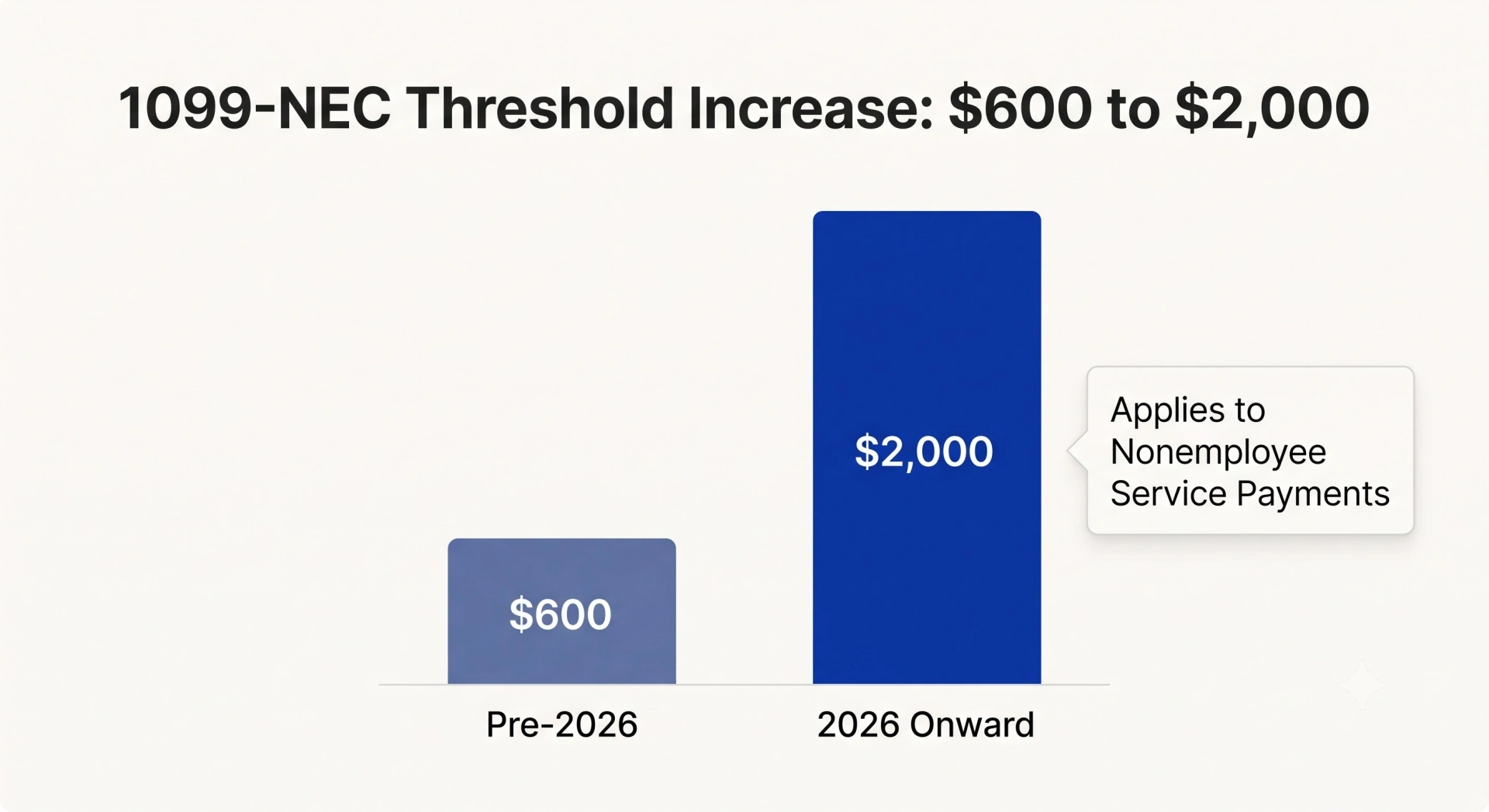
The payment year also matters. Under current IRS information-return guidance, the general Form 1099-NEC threshold increased from $600 for payments made before 2026 to $2,000 for qualifying payments made during 2026.
CPA Pilot helps CPAs, Enrolled Agents, and tax firms research LLC 1099 requirements, organize vendor facts, and prepare consistent review notes and client communications.
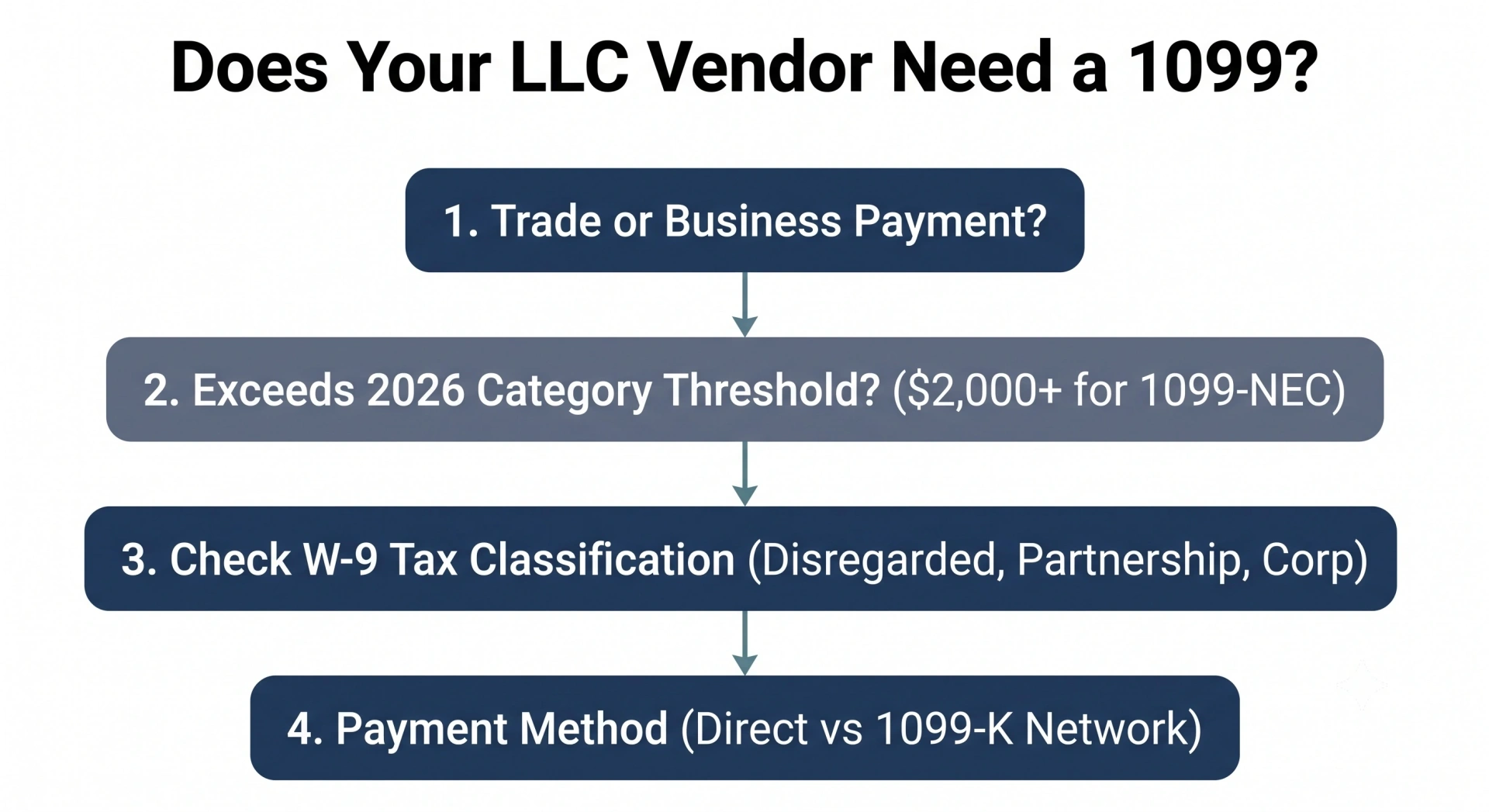
A payer should begin by confirming that the payment was made in the course of a trade or business. Payments for personal household services or other nonbusiness purposes generally fall outside the federal information-return requirements.
For a business payment, the payer should then determine:
Whether the payment represents services, rent, royalties, legal fees, healthcare services, or another reportable category.
Whether the total paid during the calendar year reached the threshold for that category.
Whether the payment was made directly or through a payment card or qualifying third-party network.
Whether an exemption or statutory exception applies to the payee.
The IRS information-return requirements make these tests cumulative. Reaching a dollar threshold does not create a filing obligation when the underlying payment is not reportable. Similarly, an otherwise exempt payee may still receive a form when the payment falls within a specific exception.
What is the 1099 Threshold for LLC Payments in 2026?
The new threshold must be applied according to the type of payment and the form used to report it. Qualifying nonemployee service payments are generally reported on Form 1099-NEC, Nonemployee Compensation. The reportable amount may include parts or materials supplied as part of the service when they are incidental to the work performed.
Payments reported on Form 1099-MISC, Miscellaneous Information, do not all follow one universal threshold. Rents, royalties, medical and healthcare payments, and gross proceeds paid to attorneys must be reviewed under the rule that applies to the specific payment category.
The payer must therefore identify the correct reporting category before testing the amount paid. Applying the Form 1099-NEC threshold to every payment made to an LLC can produce an incorrect filing decision.
A separate rule applies when federal income tax was withheld under the backup-withholding requirements. In that situation, an information return may be required even when the payment is below the normal reporting threshold.
How LLC Tax Classification and Form W-9 Determine 1099 Reporting?
An LLC’s federal tax classification identifies the payee the IRS recognizes for information reporting. The payer should use the classification, name, and taxpayer identification number certified on Form W-9, rather than relying on the LLC’s invoice, website, or state registration.
Does a Single-Member LLC Get a 1099?
A single-member LLC can receive a 1099 when it has not elected corporate treatment, and its owner is a reportable payee. For federal income tax purposes, the IRS generally treats this LLC as a disregarded entity, which means the reporting record follows the owner rather than the LLC as a separate taxpayer.
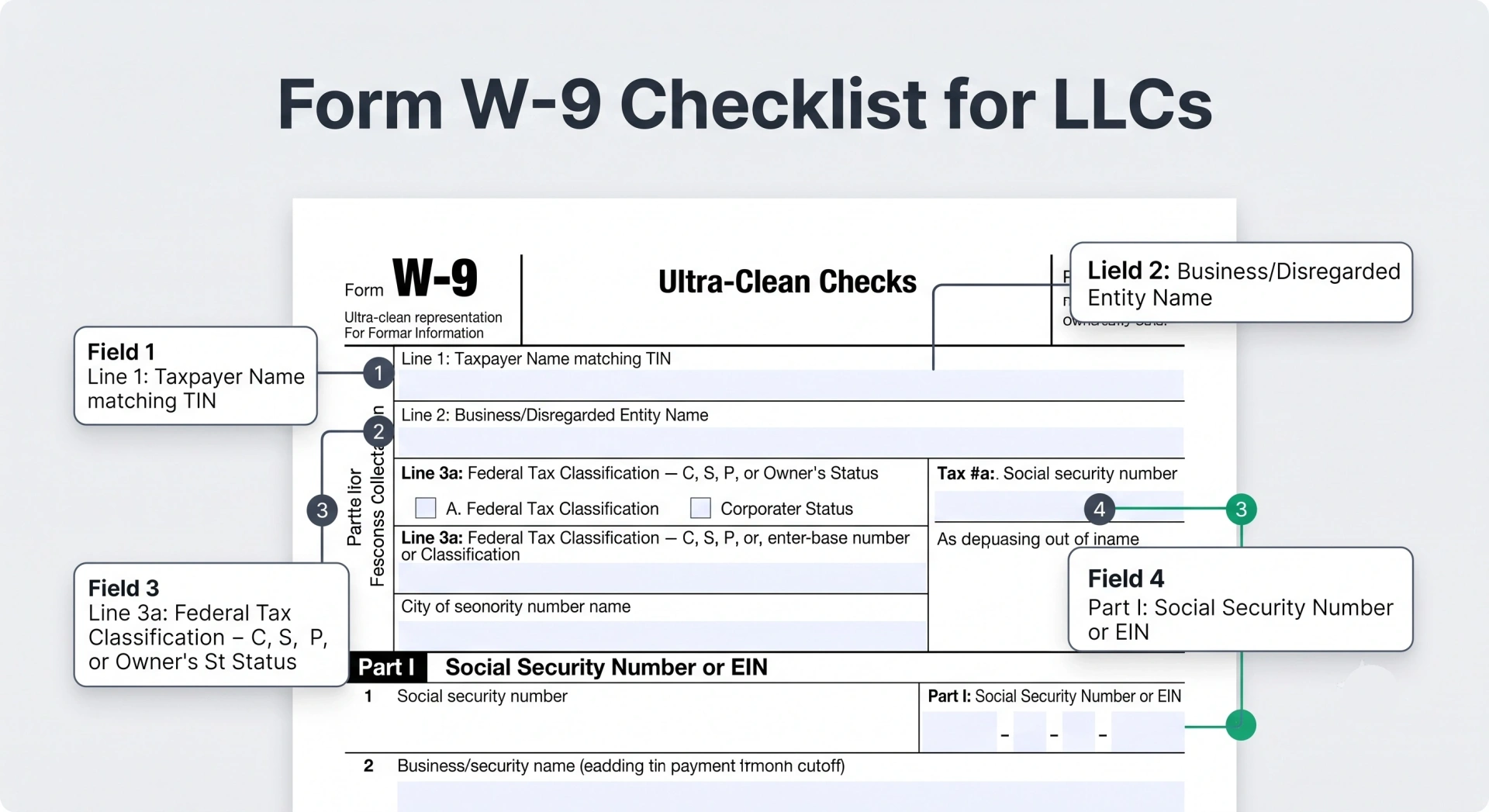
The completed Form W-9 should generally show:
The owner’s name on line 1.
The LLC’s business name on line 2.
The owner’s federal tax classification on line 3a.
The owner’s Social Security number or employer identification number in Part I.
A disregarded LLC generally uses the owner’s SSN or EIN, not the LLC’s separate EIN, for income-tax information reporting. An LLC EIN may still be used for employment taxes, excise taxes, banking, or other purposes, but those uses do not change the W-9 reporting rule.
The payer should also check who owns the single-member LLC. An LLC owned by an individual is evaluated using the owner’s individual classification, while one owned by a corporation follows the corporate owner’s classification.
Does a Multi-Member LLC Get a 1099?
A domestic LLC with at least two members is generally classified as a partnership unless it files Form 8832, Entity Classification Election, to elect corporate treatment. A partnership-classified LLC is not treated as a corporation merely because “LLC” appears in its legal name.
Its Form W-9 should normally identify:
The LLC’s legal name on line 1.
Any separate business or trade name on line 2.
“P” as the LLC classification on line 3a.
The LLC’s EIN in Part I.
If the LLC later elects corporate treatment, the payer should obtain an updated Form W-9 rather than continuing to rely on an older partnership classification.
Do LLCs Taxed as S Corps or C Corps Get 1099s?
An LLC that has elected taxation as an S corporation or C corporation generally follows the information-reporting treatment of that corporation. Its Form W-9 should identify the LLC as an “S” or “C” classification rather than as a disregarded entity or partnership.
For ordinary payments, the corporate classification may support an exemption from reporting. However, the payer should first verify that the election is reflected on the vendor’s current Form W-9. A vendor’s statement that it is “an LLC filing as an S corp” should not replace the signed tax form.
Payment categories that override the normal corporate treatment will be addressed separately in the form-selection section.
How to Review Form W-9 for an LLC?
The payer should read the first three lines as one connected record:
Form W-9 field
What the payer should confirm
Line 1
The name of the taxpayer whose TIN appears in Part I
Line 2
The LLC, trade, or disregarded-entity name, when different from line 1
Line 3a
The federal tax classification of the owner or non-disregarded LLC
Part I
The SSN or EIN that corresponds to the taxpayer named on line 1
Under the current Instructions for the Requester of Form W-9, a disregarded LLC checks the classification of its owner on line 3a. It should not use “D” as a standalone LLC classification. A non-disregarded LLC uses the LLC box and enters C, S, or P to identify its classification as a C corporation, S corporation, or partnership.
The name and TIN used on the information return should match the information supplied on Form W-9. The IRS instructs filers to report the full name and address provided by the payee and to use the name associated with the TIN shown on the form.
What Should You Do If an LLC’s Form W-9 Is Missing or Incorrect?
A payer should request a completed or corrected Form W-9 when:
Line 1 is blank or contains only the LLC’s trade name.
The tax classification is missing or unclear.
The TIN does not correspond with the taxpayer named on line 1.
A disregarded LLC provides only its separate LLC EIN.
The vendor reports a classification that conflicts with previously supplied information.
The payer should not guess the classification from the entity’s name or automatically mark every LLC as a partnership. A valid Form W-9 or acceptable substitute must contain the payee’s name and TIN and satisfy the IRS certification requirements.
Eligible filers can use the IRS Taxpayer Identification Number Matching service to compare the submitted name-TIN combination with IRS records before filing. The IRS states that pre-filing validation can reduce mismatch, backup-withholding, and penalty notices.
LLC 1099 Classification Summary
LLC status shown by the vendor
Federal classification
Name generally used for reporting
TIN generally used
Single-member LLC owned by an individual
Owner’s individual or sole-proprietor classification
Owner’s name
Owner’s SSN or EIN
Single-member LLC owned by another entity
Owner’s classification
Owner entity’s name
Owner entity’s TIN
Multi-member LLC without a corporate election
Partnership
LLC’s legal name
LLC’s EIN
LLC taxed as an S corporation
S corporation
LLC’s legal name
LLC’s EIN
LLC taxed as a C corporation
C corporation
LLC’s legal name
LLC’s EIN
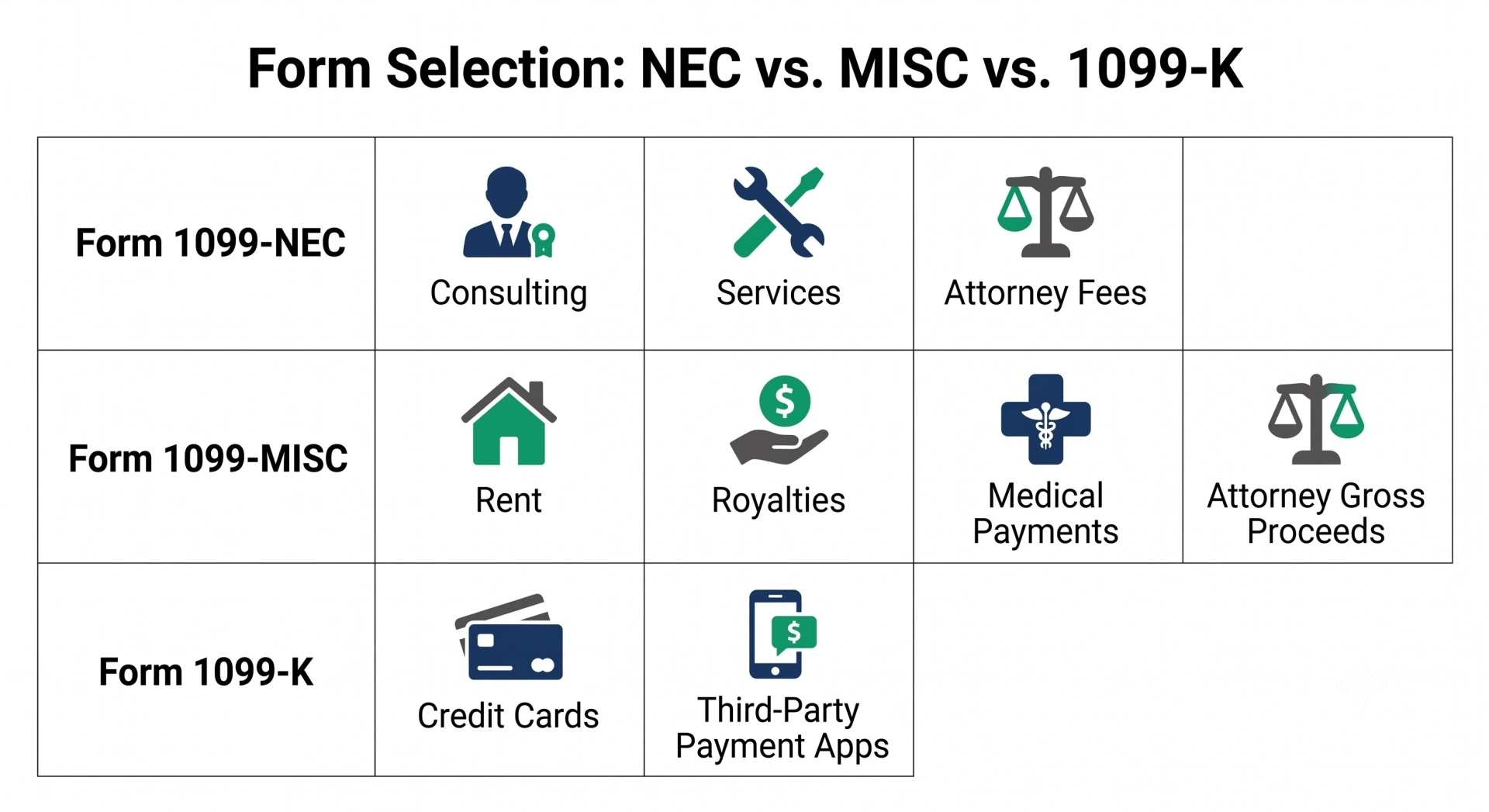
Once the payer has identified the correct taxpayer and classification, the next step is to determine which information return- Form 1099-NEC, Form 1099-MISC, or Form 1099-K—applies to the payment.
A payer generally uses Form 1099-NEC to report qualifying payments for services performed by a nonemployee. This can include consulting, bookkeeping, design, repair, professional fees, and materials incidental to the service.
Attorney service fees are also reported on Form 1099-NEC when they meet the applicable reporting threshold, even when the law firm is taxed as a corporation. The current requirements are explained in the Instructions for Forms 1099-MISC and 1099-NEC.
Form 1099-MISC for LLC Rent, Royalty, Medical, and Attorney Payments
Form 1099-MISC applies to specific payment categories, including:
Payment category
Form 1099-MISC box
2026 reporting level
Rents
Box 1
$2,000 or more
Royalties
Box 2
$10 or more
Other reportable income
Box 3
$2,000 or more
Medical and healthcare payments
Box 6
$2,000 or more
Gross proceeds paid to an attorney
Box 10
$600 or more
The payer should select the reporting box based on the nature of the payment, not merely the recipient’s LLC status.
When Does the Corporate 1099 Exemption Not Apply to an LLC?
Certain payments remain reportable even when the LLC is taxed as a corporation. Important exceptions include:
Attorney service fees
Gross proceeds paid to attorneys
Medical and healthcare payments
Cash payments for fish purchased for resale
Substitute payments instead of dividends or tax-exempt interest
Attorney fees belong on Form 1099-NEC, while qualifying gross proceeds paid to an attorney belong in box 10 of Form 1099-MISC.
When Does Form 1099-K Replace Form 1099-NEC or 1099-MISC?
Payments made through credit cards and qualifying third-party payment networks are generally reported by the payment settlement entity on Form 1099-K. The business payer should not duplicate those transactions on Form 1099-NEC or Form 1099-MISC.
Direct payments made by check or ACH remain subject to the applicable Form 1099-NEC or Form 1099-MISC rules.
Which LLC Payments Are Not Reportable on Form 1099?
Forms 1099-NEC and 1099-MISC generally do not apply to:
Merchandise-only purchases
Payments below the applicable threshold
Ordinary payments to exempt corporations
Credit card or qualifying network payments reported on Form 1099-K
Personal payments made outside a trade or business
The next section applies these form-selection rules to common LLC payment scenarios.
LLC 1099 Examples for 2026
Scenario
Reporting result
Single-member consulting LLC paid $2,500 by ACH
Issue Form 1099-NEC using the name and TIN shown on Form W-9.
Partnership-taxed LLC paid $1,800 for services
No Form 1099-NEC is generally required because the payment is below the 2026 threshold.
S-corporation LLC paid for ordinary marketing services
No Form 1099-NEC is generally required unless an exception applies.
Corporate medical-practice LLC paid $4,500
Report the payment on Form 1099-MISC.
Attorney LLC paid $3,000 for legal services
Report the fees on Form 1099-NEC.
Contractor LLC paid by credit card
The payer generally does not issue Form 1099-NEC; the processor handles any required Form 1099-K.
These examples show how the same LLC designation can produce different reporting results based on the payment facts and federal reporting rules.
LLC 1099 Filing Workflow for CPA Firms
Once the reporting decision has been made, the CPA firm should reconcile the payment data, file the required forms, correct errors, and retain evidence supporting the completed review.
Reconcile LLC Vendor Payments Before Filing 1099s
Before preparing information returns, compare the vendor ledger with the general ledger and payment records. Confirm:
Total calendar-year payments to each vendor
Duplicate, voided, refunded, or reclassified transactions
Adjustments entered after the initial vendor review
Vendors approved for filing
Vendors excluded from filing and the documented reason
A manager or reviewer should approve both lists before the forms are submitted.
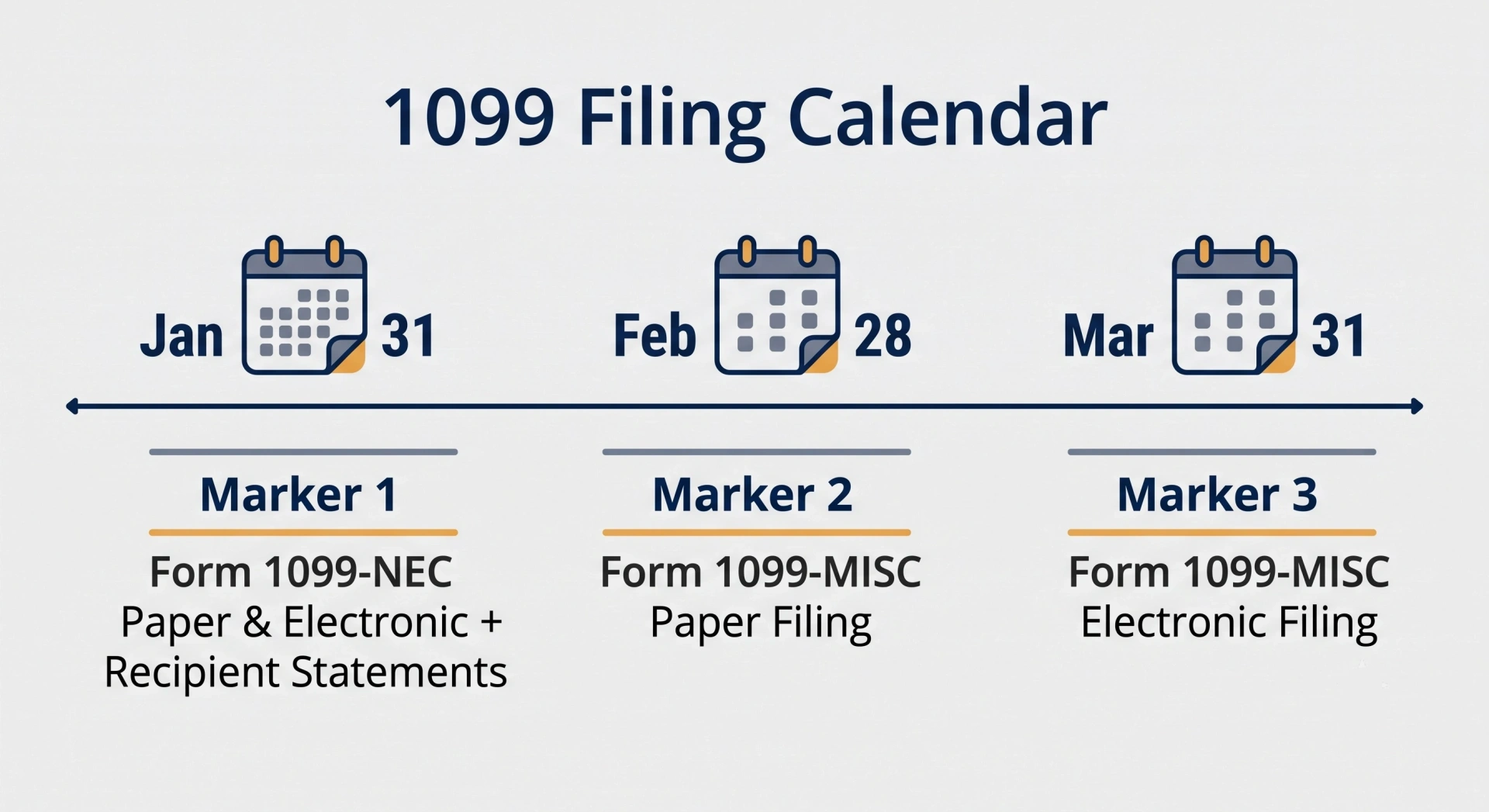
File and Furnish LLC 1099 Forms by the Correct Deadline
Form 1099-NEC: January 31, 2027, by paper or electronic filing
Form 1099-MISC filed on paper: February 28, 2027
Form 1099-MISC filed electronically: March 31, 2027
When a due date falls on a weekend or applicable legal holiday, the deadline moves to the next business day. Recipient statements must also be furnished by the date applicable to the form.
Businesses filing 10 or more information returns in aggregate must generally file electronically. Eligible forms can be submitted through the IRS Information Returns Intake System.
Correct LLC 1099 Filing Errors
A corrected return may be required when the firm discovers an incorrect:
Recipient name
Taxpayer identification number
Payment amount
Form type
Reporting box
The firm should follow the correction procedure in the current General Instructions for Certain Information Returns. A paper correction should not be marked “VOID,” because that box instructs IRS scanning equipment to disregard the form rather than process it as a correction. (irs.gov)
Retain LLC 1099 Filing Records
The final workpapers should contain:
The year-end payment reconciliation
The approved filing and exclusion lists
Copies of filed forms and recipient statements
Electronic-filing acceptance records
Corrected returns and related correspondence
The reviewer’s approval of the completed process
A complete filing record allows the firm to respond efficiently to client questions, IRS notices, or future-year reviews without rebuilding the analysis.
How CPA Pilot Helps Firms Review LLC 1099 Requirements
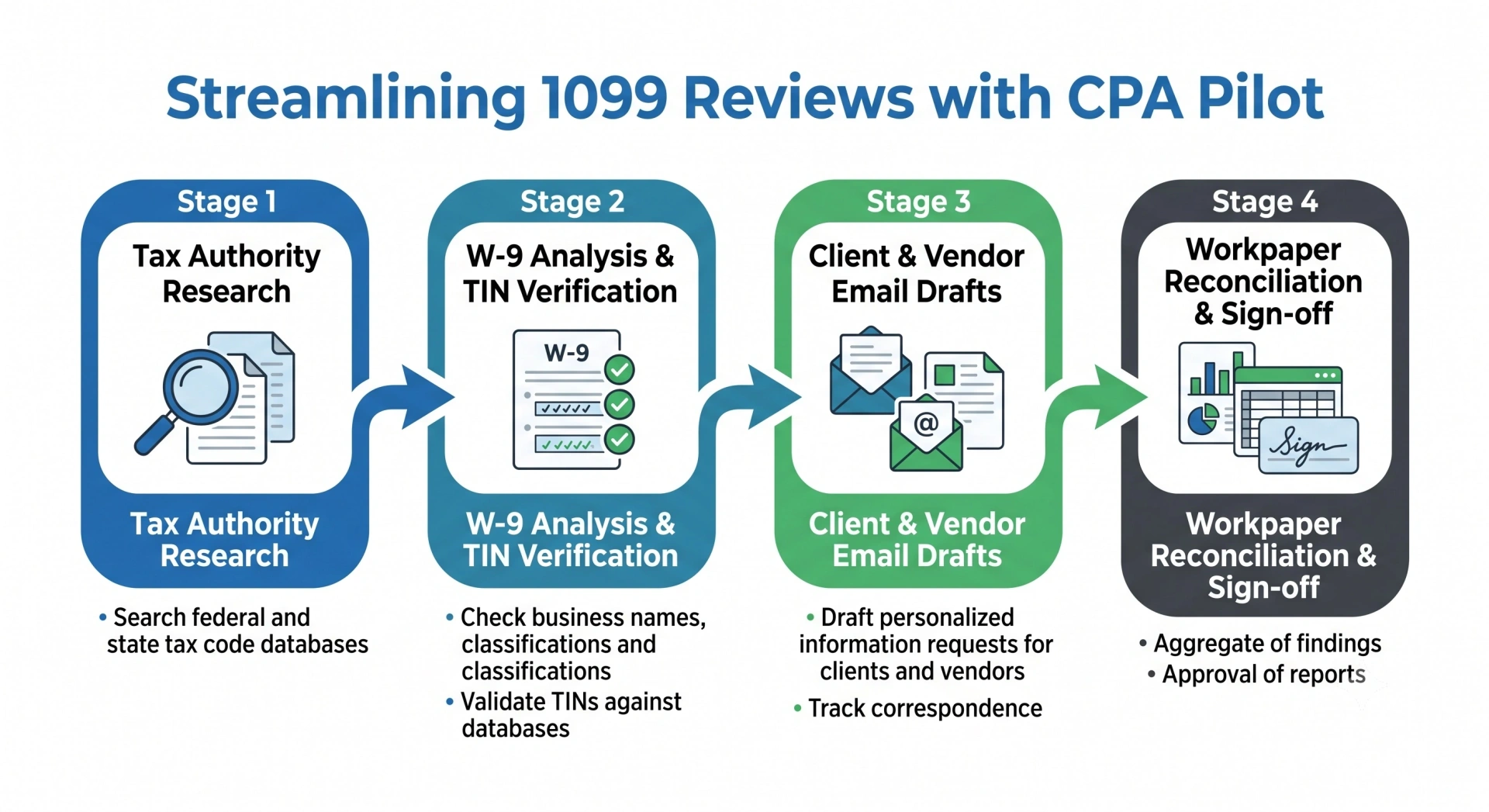
CPA Pilot helps CPAs, Enrolled Agents, and tax firms turn LLC 1099 requirements into a documented research and communication workflow. It supports the professional’s analysis without making the final filing decision.
Research LLC 1099 Rules and Organize Review Notes
The CPA Pilot Tax Research Assistant can research questions against relevant tax authorities and return structured notes with citations. For an LLC 1099 review, a professional can use it to locate and compare sources such as the Instructions for Form W-9, the information-return filing requirements, and the Instructions for Forms 1099-MISC and 1099-NEC.
The output can be organized around the client facts, supporting authority, unresolved questions, and recommended follow-up, giving the reviewer a clearer starting point for the workpaper.
CPA Pilot’s research workflow is designed to provide structured notes and citations for professional review.
Draft W-9 Requests, Review Notes, and Client Communications
The CPA Pilot AI Email Assistant can help draft communications when a firm needs additional information from a client or vendor. Examples include:
Requesting a missing or corrected Form W-9
Explaining why additional vendor details are needed
Summarizing the firm’s reporting conclusion for a client
Preparing a follow-up message before the filing deadline
Converting technical research into plain-language guidance
The draft should be reviewed, personalized, and approved by the tax professional before it is sent. CPA Pilot’s email workflow is built to generate tax-context-aware drafts that professionals can edit and finalize.
Support Professional Judgment Without Replacing the CPA
CPA Pilot can accelerate source retrieval, organize the analysis, and improve communication consistency. The CPA or tax professional remains responsible for verifying the authorities, evaluating the client’s facts, and approving the final reporting position.
This combination allows firms to use AI for research and workflow support while keeping professional judgment at the center of the LLC 1099 review.
So, what are you waiting for??? Try now and see the difference!!!
An LLC can receive both Form 1099-K and Form 1099-NEC when separate payments use different channels. Payment processors report card or platform payments on 1099-K. Businesses report direct ACH, check, or cash service payments on 1099-NEC.
Does an LLC need to report income if no 1099 is received?
An LLC must report taxable business income even when no 1099 is received. A missing 1099 does not remove income-tax reporting duties. The LLC should use invoices, bank deposits, accounting records, and payment statements to report income.
Should landlords send a 1099 to an LLC tenant or property manager?
A business landlord may need to send Form 1099-MISC to an LLC property manager for reportable service fees or rents paid in a trade or business. A landlord usually does not send a 1099 for personal rental activity outside business use.
Do foreign LLCs receive Form 1099?
A foreign LLC generally does not receive Form 1099 when the payer has valid foreign-status documentation. The payer should collect Form W-8, not Form W-9, and review whether Form 1042-S or withholding rules apply to U.S.-source payments.
What happens if a business sends a 1099 to an LLC by mistake?
A business should correct a mistaken 1099 when the form reports the wrong payee, amount, TIN, box, or form type. The LLC should contact the payer, request a corrected form, and keep records showing the correct income treatment.
Key Takeaways
4 essential insights
LLC status alone does not determine whether a 1099 is required.
For 2026, Form 1099-NEC reporting threshold generally increases to $2,000.
Verify payment type, business purpose, and exemptions before applying thresholds.
Use the payee's Form W-9 classification and TIN to decide reporting.
Was this article helpful?
Sorry about that. How can we improve?
Thanks for the feedback! It helps us improve.
Share
Harsh Mody
CPA & Founder of CPA Pilot
I’m Harsh Mody, CPA, founder of CPA Pilot—an AI Tax Assistant for CPAs, Enrolled Agents, and U.S. tax firms. With 18+ years in accounting, tax auditing, consulting, and product management, I’ve seen how compliance-heavy work limits true advisory impact. I built CPA Pilot to change that—by applying AI-driven tax research, deduction optimization, and IRS/state code automation to help firms unlock tax savings and scale advisory services with speed and accuracy.