

![Washington B&O Tax: Classification, Rates & Filing Guide [2026 Edition]](https://www.cpapilot.com/blog/wp-content/uploads/2026/05/Washington-BO-Tax-.png)

Nonprofit Tax Compliance – IRS Rules, Form 990 & UBIT Guide

[Last Updated on 2 months ago]
Why must nonprofit organizations submit detailed annual filings to maintain their tax-exempt status in the United States?
The answer lies in the compliance framework established by the Internal Revenue Service, which requires tax-exempt organizations to report their financial activity, governance structure, and operational transparency each year.
TL;DR – Nonprofit Tax Compliance
- Nonprofit tax compliance requires organizations to follow IRS regulations and maintain tax-exempt status under Section 501(c)(3).
- Most nonprofits must file annual informational returns such as Form 990, Form 990-EZ or Form 990-N.
- Nonprofits may owe tax on certain activities through Unrelated Business Income Tax (UBIT) reported on Form 990-T.
- Strong governance and board oversight help ensure financial transparency and regulatory accountability.
- Many states require charity registration and additional nonprofit reporting beyond federal filings.
- CPAs and accountants help manage financial records, compliance workflows, and regulatory reporting.
- AI tax tools such as CPA Pilot can assist professionals with tax research, compliance analysis, and documentation tasks.
Organizations that qualify under Section 501(c)(3) of the U.S. tax code receive significant tax advantages, including
- Exemption from federal income tax and
- The ability for donors to claim charitable deductions.
According to the research, Section 501(c)(3) allows qualifying nonprofit organizations to operate without paying federal income tax while encouraging charitable giving through tax-deductible donations.
To maintain this status, nonprofit organizations must submit annual informational returns such as Form 990, Form 990-EZ, or Form 990-N e-Postcard, depending on their annual gross receipts and operational size.
These filings disclose
- Financial statements,
- Executive compensation,
- Governance policies, and
- Program activities, allowing regulators, donors, and the public to evaluate how nonprofit funds are used and whether organizations remain compliant with federal regulations.
For accounting firms and tax professionals working with nonprofit clients, managing these reporting requirements can become complex, particularly when handling multiple filings, IRS regulations, and evolving compliance standards.
This is where intelligent tax research and workflow automation tools, such as CPA Pilot, support professionals by simplifying research, assisting with compliance analysis, and helping CPAs prepare accurate filings more efficiently.
Understanding how nonprofit reporting requirements work—and why these filings are essential for transparency and accountability—is the foundation of nonprofit tax compliance in the United States.
So, without any further ado, let’s start exploring!!!
Table of Contents
- What is Nonprofit Tax Compliance?
- IRS Requirements for Nonprofit Organizations
- Understanding Form 990: The Core Nonprofit Compliance Filing
- Unrelated Business Income Tax (UBIT) for Nonprofits
- Nonprofit Governance and Transparency Requirements
- State Compliance Requirements for Nonprofit Organizations
- State-Level Reporting and Filing Obligations
- How CPAs and Accountants Manage Nonprofit Compliance
- How AI Tools Improve Nonprofit Tax Compliance Workflows
- Common Nonprofit Compliance Challenges for Finance Teams
- Nonprofit Tax Compliance FAQs
What is Nonprofit Tax Compliance?
Nonprofit tax compliance refers to the legal and regulatory responsibilities that tax-exempt organizations must follow to operate within U.S. federal tax law. Organizations that qualify under Section 501(c)(3) of the U.S. tax code must ensure that their activities, governance practices, and financial operations remain aligned with the requirements established by the Internal Revenue Service.
In practical terms, compliance involves maintaining
- Accurate financial documentation,
- Transparent organizational governance, and
- Clear records of program activities that demonstrate the nonprofit continues to serve its approved charitable or educational purpose.
These responsibilities apply throughout the organization’s lifecycle and require consistent administrative oversight to ensure operations remain within federal guidelines.
IRS Oversight of Tax-Exempt Nonprofit Organizations
The Internal Revenue Service regulates nonprofit organizations through its Charities and Nonprofits program, which supervises whether organizations continue to operate within federal tax law.
This oversight framework ensures that organizations receiving tax-exempt recognition maintain proper governance practices and operate for approved charitable purposes.
IRS oversight includes reviewing nonprofit filings, examining organizational activities, and evaluating whether nonprofit resources are used appropriately. The agency also monitors compliance with federal restrictions related to private benefit, political activity, and financial transparency, all of which are key regulatory conditions for maintaining tax-exempt status.
Through this regulatory structure, the IRS helps ensure that organizations benefiting from federal tax privileges remain accountable to both the public and the legal standards governing nonprofit operations.
Why Tax Compliance Matters for Nonprofit Organizations?
Maintaining strong tax compliance practices helps nonprofit organizations protect their legal standing, financial stability, and public credibility. Regulatory compliance ensures that nonprofit funds are used for mission-driven activities and that organizations remain accountable to donors, regulators, and the communities they serve.
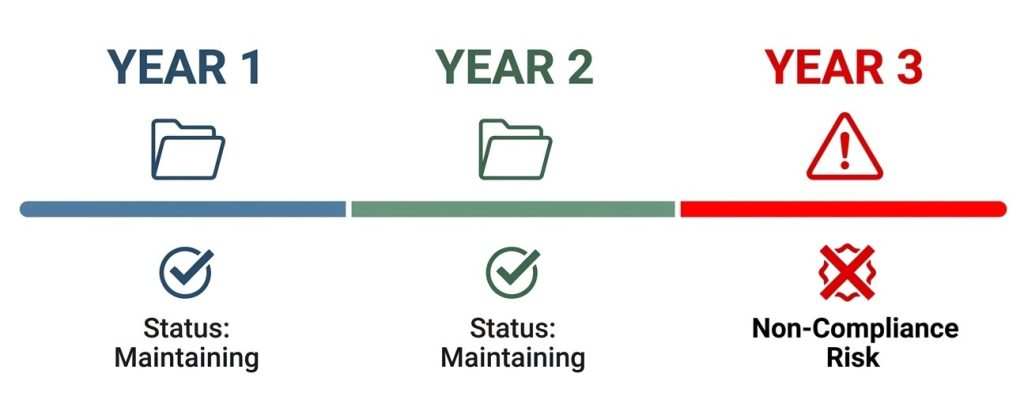
Failure to meet IRS filing requirements can have serious consequences. According to the Internal Revenue Service, organizations that fail to file required annual returns for three consecutive years automatically lose their tax-exempt status. (Source)
For nonprofit leadership teams and the tax professionals advising them, maintaining compliance safeguards the organization from regulatory penalties while reinforcing transparency and trust within the nonprofit sector.
Consistent oversight, accurate reporting, and proper documentation are therefore essential components of responsible nonprofit management.
Now that we understand why nonprofit tax compliance is essential, the next step is identifying the specific requirements organizations must follow to remain compliant with federal regulations.
IRS Requirements for Nonprofit Organizations
The key IRS requirements for nonprofit organizations include:
Maintaining eligibility under Section 501(c)(3), following restrictions on political and private benefit activities, and submitting annual informational filings such as
These requirements allow the Internal Revenue Service to verify that tax-exempt organizations continue operating within federal nonprofit regulations.
Among the various regulatory obligations nonprofits must follow, annual informational filings play a central role in federal oversight.
These filings provide regulators and stakeholders with a clear view of an organization’s financial activities, governance practices, and program operations.
The most important of these filings is Form 990, which serves as the primary compliance document used by the Internal Revenue Service to review nonprofit operations.
Understanding how this filing works, and what information organizations must report is essential for nonprofits and the tax professionals who support them.
Understanding Form 990: The Core Nonprofit Compliance Filing
Form 990 is the primary informational return used by the Internal Revenue Service to monitor nonprofit organizations that operate under federal tax-exempt status.
Rather than calculating tax liability, the form functions as a public disclosure document that provides detailed information about a nonprofit’s financial position, governance practices, executive compensation, and program activities. (Source)
Form 990 serves multiple purposes within the nonprofit regulatory framework. It allows the IRS to evaluate whether organizations continue to operate within federal nonprofit regulations, while also giving donors, regulators, and the public insight into how nonprofit resources are managed.
Because the filing becomes publicly accessible, it is often used by researchers, watchdog organizations, and grant providers to review the financial and operational practices of nonprofit entities.
For accounting professionals and nonprofit advisors, preparing Form 990 requires careful review of financial statements, governance disclosures, and organizational activities to ensure that the information reported aligns with IRS compliance standards.
Types of Form 990 Filings for Nonprofits
The IRS provides several versions of Form 990 to accommodate nonprofit organizations of different sizes. The filing requirement depends primarily on an organization’s annual gross receipts and total assets.
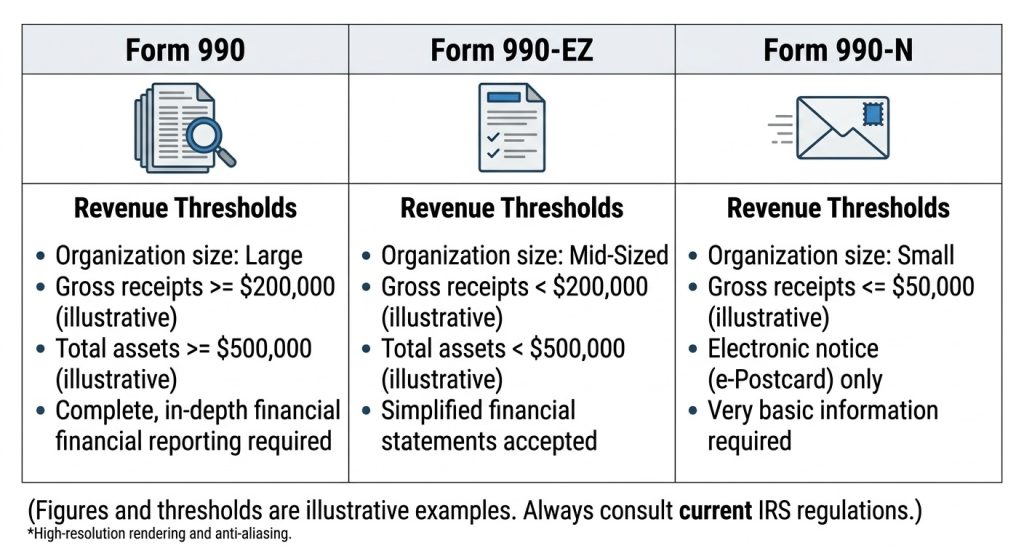
Common versions include:
- Form 990 – required for larger nonprofit organizations with higher revenue levels.
- Form 990-EZ – designed for mid-sized nonprofit organizations that fall within specific revenue thresholds.
- Form 990-N e-Postcard – a simplified electronic filing for very small nonprofits with limited annual gross receipts.
These filing variations ensure that reporting requirements remain proportional to the size and operational scale of the nonprofit organization.
Key Sections of Form 990 Nonprofits Must Report
Form 990 contains multiple sections that provide insight into a nonprofit’s operations and financial structure. Organizations preparing this filing typically report information related to:
- Organizational mission and major program activities
- Financial statements, including revenue, expenses, and assets
- Governance structure and board oversight practices
- Executive compensation and key employee disclosures
- Relationships with related organizations and transactions
These disclosures help regulators and stakeholders understand how nonprofit resources are used and whether the organization continues to operate in accordance with federal nonprofit regulations.
Common Form 990 Filing Mistakes Nonprofits Make
Preparing Form 990 requires careful coordination between nonprofit leadership, finance teams, and tax professionals. Errors in reporting can create compliance risks or trigger additional IRS scrutiny.
Common issues include:
- Incomplete financial disclosures or incorrect classification of revenue and expenses
- Failure to properly document governance policies and board oversight practices
- Inconsistencies between reported financial data and audited financial statements
- Missing schedules or attachments required for certain nonprofit activities
Because the filing contains extensive financial and governance information, tax professionals often rely on AI research tools to review IRS guidance, interpret compliance requirements, and ensure that Form 990 filings align with current nonprofit regulations.
While Form 990 focuses on financial transparency and governance reporting, nonprofits may still face tax obligations under certain circumstances. When a tax-exempt organization earns income from activities that are not substantially related to its charitable mission, those earnings may be subject to federal taxation under Unrelated Business Income Tax.
Understanding how unrelated income is defined and reported is essential for maintaining compliance with regulations enforced by the Internal Revenue Service.
Even though nonprofit organizations receive tax-exempt status under sections such as Section 501(c)(3), that exemption does not apply to all types of income. The IRS imposes Unrelated Business Income Tax when organizations generate revenue from activities that are unrelated to their primary charitable, educational, or religious purpose.
UBIT exists to prevent nonprofit organizations from competing unfairly with taxable businesses. If a nonprofit operates a commercial activity that resembles a regular business and is not substantially connected to its mission, the income generated from that activity may be taxable. (Source)
For nonprofit leaders and accounting professionals, identifying unrelated income sources early is important to ensure proper tax reporting and avoid regulatory penalties.
What Qualifies as Unrelated Business Income (UBI)?
The IRS evaluates unrelated income using three main criteria. Revenue may be considered unrelated business income if the activity:
- Involves a trade or business – meaning the organization sells goods or services with the intention of generating income.
- Is carried on regularly – the activity occurs frequently or operates in a manner similar to a commercial enterprise.
- Is not substantially related to the organization’s exempt purpose.
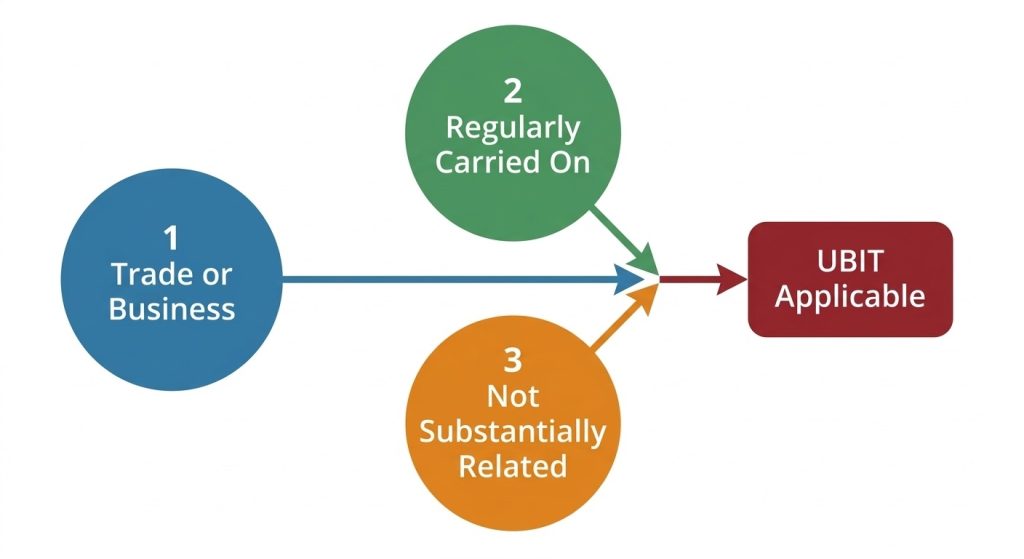
If all three conditions are met, the income may fall under Unrelated Business Income Tax.
Examples of potential unrelated income include:
- Advertising revenue from publications unrelated to the nonprofit’s mission
- Operating a commercial retail business unrelated to the organization’s charitable programs
- Renting property where substantial services are provided
However, some activities are specifically excluded from UBIT rules, including certain volunteer-run operations and qualified fundraising events.
How Nonprofits Report UBIT Using Form 990-T?
When a nonprofit earns taxable unrelated income, it must report that revenue using Form 990-T. This filing calculates the taxable income generated from unrelated business activities and determines the amount of tax owed.
The filing process typically involves:
- Identifying all revenue streams associated with unrelated business activities
- Subtracting allowable expenses directly connected to those activities
- Calculating taxable income after deductions
- Reporting the tax liability to the IRS
Because UBIT rules can be complex—particularly when nonprofits operate multiple revenue streams—accounting professionals often rely on AI-backed tax research tools such as CPA Pilot to interpret IRS guidance and review compliance requirements during the reporting process.
Nonprofit Governance and Transparency Requirements
Organizations operating under Section 501(c)(3) are expected to maintain governance structures that ensure responsible leadership, ethical management, and proper oversight of charitable resources.
Regulators review governance practices to confirm that nonprofit organizations operate in accordance with federal nonprofit regulations administered by the Internal Revenue Service.
Clear governance policies and oversight procedures help organizations maintain compliance while reinforcing credibility with donors, grant providers, and public stakeholders.
Nonprofit Board Oversight and Compliance Responsibilities
The governing board is responsible for supervising the organization’s strategic direction and ensuring that management decisions support the nonprofit’s exempt purpose.
Board oversight responsibilities commonly include:
- Reviewing and approving financial statements and annual budgets
- Monitoring adherence to nonprofit regulatory requirements
- Establishing policies related to conflicts of interest and ethical conduct
- Supervising executive leadership and evaluating organizational performance
Effective board oversight helps organizations maintain accountability and reduces the risk of compliance issues related to financial reporting or operational governance.
Public Disclosure Rules for Form 990 Filings
Federal nonprofit regulations require certain tax filings to be publicly available so that donors, regulators, and community stakeholders can review organizational activities.
Documents commonly subject to disclosure include:
- Form 990,
- Form 990-EZ,
- Form 990-T when applicable
These filings provide visibility into financial performance, executive compensation, and program spending, allowing stakeholders to evaluate how nonprofit resources are managed.
Regulatory compliance for nonprofits does not stop at federal oversight. In addition to meeting requirements set by the Internal Revenue Service, organizations must also follow reporting and registration obligations imposed by state authorities.
These rules ensure that nonprofits operating within a state remain accountable to local regulators and the communities they serve.
Understanding these state-level requirements is important because failure to comply can affect an organization’s ability to legally solicit donations or continue operating within certain jurisdictions.
State Compliance Requirements for Nonprofit Organizations
State regulations are typically enforced by offices such as the Attorney General, Secretary of State, or Charity Registration Divisions, which monitor nonprofit registration, fundraising compliance, and annual reporting.
For nonprofit organizations and the professionals who support them, understanding these state requirements is essential for maintaining legal authorization to operate and solicit charitable contributions.
State Charity Registration Requirements
Many states require nonprofit organizations to register before soliciting donations from residents. These registrations allow regulators to monitor fundraising activities and protect donors from fraudulent organizations.
State charity registration rules generally require organizations to submit:
- Organizational formation documents
- Proof of federal tax-exempt status
- Annual financial disclosures
- Copies of recent Form 990 filings
Once registered, nonprofits may need to renew their registration annually to remain authorized to conduct fundraising within the state.
State-Level Reporting and Filing Obligations
Beyond charity registration, nonprofits may also be required to submit periodic reports to state authorities. These filings help maintain accurate records of nonprofit activities and confirm that organizations continue to meet regulatory requirements.
State reporting obligations often include:
- Annual nonprofit corporate reports filed with the Secretary of State
- Charitable solicitation renewals required for fundraising authorization
- Financial reporting disclosures tied to state charity oversight programs
Because these requirements differ across jurisdictions, nonprofit organizations operating in multiple states must carefully track reporting deadlines and regulatory changes.
How CPAs and Accountants Manage Nonprofit Compliance
Nonprofit organizations often rely on financial professionals to coordinate regulatory reporting and maintain adherence to nonprofit tax rules.
Accountants and Certified Public Accountants support organizations by interpreting guidance issued by the Internal Revenue Service and organizing the financial information required for tax-exempt operations.
Their role typically includes
- Reviewing accounting records,
- Preparing required regulatory filings, and
- Ensuring that financial reporting practices align with nonprofit regulatory standards.
This oversight helps organizations maintain accurate documentation while reducing the likelihood of reporting errors.
Typical Nonprofit Tax Compliance Workflow
Managing nonprofit compliance usually follows a structured process throughout the fiscal year. Finance teams coordinate financial recordkeeping and regulatory reporting activities to prepare required filings.
A typical compliance workflow may include:
- Maintaining detailed financial records for grants, donations, and program expenditures
- Preparing financial statements used in regulatory reporting
- Assembling documentation required for Form 990 and related schedules
- Reviewing financial disclosures before submission to regulatory authorities
This process ensures that organizations maintain accurate records that support annual reporting requirements.
Common Nonprofit Compliance Challenges for Finance Teams
Even with structured workflows, nonprofit finance teams may encounter operational challenges when managing compliance responsibilities.
Common issues include:
- Tracking reporting deadlines across federal and state regulatory bodies
- Interpreting complex nonprofit tax rules related to program activities and revenue sources
- Ensuring consistent classification of donations, grants, and earned revenue
- Maintaining organized documentation for audits or regulatory reviews
To address these challenges, finance professionals frequently use AI-backed tax research tools such as CPA Pilot to review regulatory guidance and support accurate reporting decisions.
How AI Tools Improve Nonprofit Tax Compliance Workflows
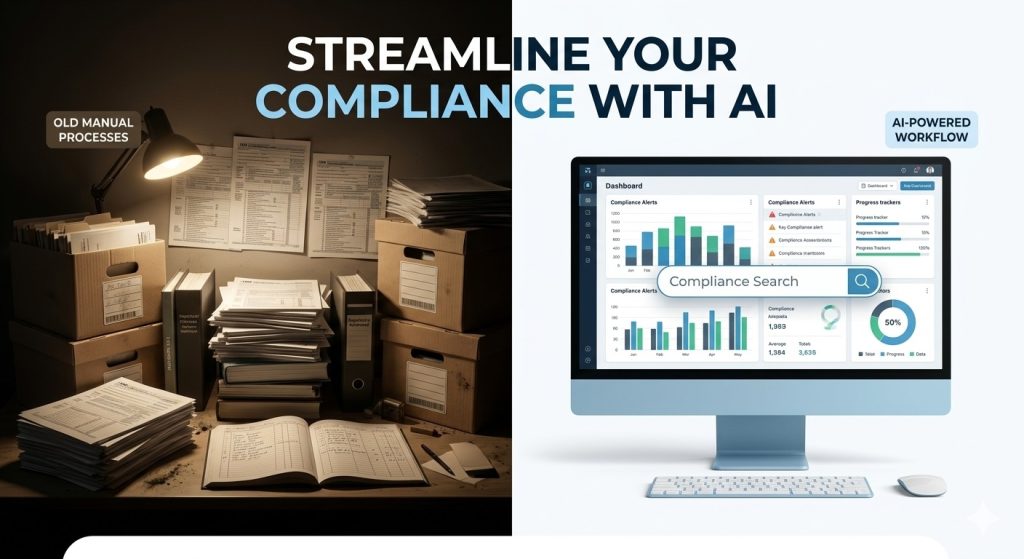
Artificial intelligence is increasingly being adopted by accounting professionals to support complex regulatory tasks. Tax compliance often requires reviewing detailed guidance issued by authorities such as
- The Internal Revenue Service,
- Interpreting regulatory changes, and
- Ensuring that reporting aligns with current requirements.
Top AI-powered tax tools assist professionals by analyzing large volumes of regulatory documentation and surfacing relevant information quickly.
This helps accountants and compliance teams reduce the time spent searching through lengthy guidance documents while maintaining accuracy in regulatory interpretation.
As compliance obligations grow across federal and state levels, AI systems are becoming useful resources for supporting financial research and documentation processes within accounting workflows.
Common Nonprofit Compliance Challenges for Finance Teams
AI-driven research tools help accountants analyze these materials by identifying relevant sections of tax guidance and summarizing regulatory information. Instead of manually reviewing multiple documents, professionals can use AI systems to locate specific rules, interpret regulatory updates, and verify compliance requirements more efficiently.
This capability is particularly useful when finance teams need to review evolving regulations, compare guidance across jurisdictions, or confirm reporting obligations tied to nonprofit operations.
Automating Tax Documentation and Client Communication
Beyond tax research, such AI tax tools are also being used to support documentation management and communication between accountants and their nonprofit clients.
These systems can assist professionals by:
- Organizing compliance documentation related to financial reporting
- Summarizing regulatory guidance for internal reference
- Generating explanations of tax requirements for clients
- Assisting with drafting responses to compliance-related questions
CPA Pilot are designed to support accounting professionals by helping them review tax guidance, analyze compliance scenarios, and generate structured explanations of regulatory requirements. By integrating these capabilities into daily workflows, accountants can spend more time focusing on advisory work while maintaining accurate compliance reporting.
AI-supported tools do not replace professional judgment, but they can streamline many of the research and documentation tasks that are traditionally time-consuming in tax compliance work.
So what are you waiting for???
See how faster tax research and compliance analysis works in practice, request a 30-minute demo of CPA Pilot today.
Nonprofit Tax Compliance FAQs
What happens if a nonprofit fails to file Form 990 for multiple years?
A nonprofit organization that fails to file Form 990 for three consecutive years automatically loses tax-exempt status under rules enforced by the Internal Revenue Service.
Do all nonprofit organizations need an annual financial audit?
A nonprofit organization is not always required to complete a financial audit; audit requirements depend on state regulations, grant agreements, and revenue thresholds, although many larger nonprofits conduct audits for transparency and governance oversight.
Can a nonprofit lose its tax-exempt status for compliance violations?
A nonprofit organization may lose tax-exempt status when it fails to meet regulatory obligations such as filing required tax returns, maintaining proper governance, or using funds for non-exempt purposes under federal nonprofit regulations.
How long must nonprofits keep financial and tax records?
A nonprofit organization should retain financial and tax records for at least three to seven years, depending on document type, to support filings, audits, and regulatory reviews required by the Internal Revenue Service.
How can accountants track nonprofit compliance requirements more efficiently?
Accounting professionals often use digital compliance tools such as CPA Pilot, which help analyze tax guidance, organize regulatory documentation, and support research related to nonprofit reporting obligations.
Disclaimer: This article is provided by CPA Pilot for educational purposes. While we may offer tax software/services, the information here is general and may not address your specific facts and circumstances. It does not constitute individual tax, legal, or accounting advice. U.S. federal and State Tax laws change frequently; please consult a qualified tax professional before acting on any information.

![Restaurant Tax Planning After OBBBA [2026]- FICA Tip and R&D Credits](https://www.cpapilot.com/blog/wp-content/uploads/2026/04/Restaurant-Tax-Planning-After-OBBBA-.png)