Best Juno Tax Alternative for CPAs – CPA Pilot vs Juno - CPA Pilot
AI Tax Tools Comparison
Best Juno Tax Alternative for CPAs – CPA Pilot vs Juno
CPA Pilot
Apr 28, 2026·12 min read
A Juno Tax alternative is worth considering when your firm needs AI support beyond tax preparation automation. Juno is commonly associated with tax prep automation, source-document workflows, review support, and advisory workflows for tax professionals. CPA Pilot is built for CPAs, Enrolled Agents, and U.S. tax firms that need support with tax research, 1040 planning, client communication, review notes, and staff productivity.
TL;DR – Juno Tax Alternative
CPA Pilot is a strong Juno Tax alternative for CPA firms that need AI support for tax research, 1040 planning, client communication, review notes, and advisory workflows.
Juno may be a better fit when the main bottleneck is tax prep automation, source-document handling, workpaper preparation, or first-pass return review.
Choose Juno if your firm needs AI inside the preparation and review workflow.
Choose CPA Pilot if your firm needs AI around research, planning logic, client-ready explanations, and advisory support.
Use both if your firm wants Juno for data prep and review automation and CPA Pilot for strategic advisory and client communication.
This comparison is not about choosing the “best AI tax tool” in general. It is about choosing the right tool for the workflow your firm needs to improve.
If your team is mainly trying to reduce manual work in tax preparation, document handling, or return review, Juno may be a better fit. If your firm needs help researching tax issues, explaining positions to clients, supporting planning work, documenting review logic, or turning tax questions into advisory conversations, CPA Pilot may be the stronger Juno Tax alternative.
For firms where research is the bigger bottleneck, CPA Pilot’s role is closer to an AI tax research workflow for CPAs than a pure prep automation tool.
The key difference is simple: Juno is more closely tied to tax prep automation, while CPA Pilot supports CPA tax research, planning, client communication, review documentation, and advisory workflows.
What is Juno Tax and Who Is It Built For?
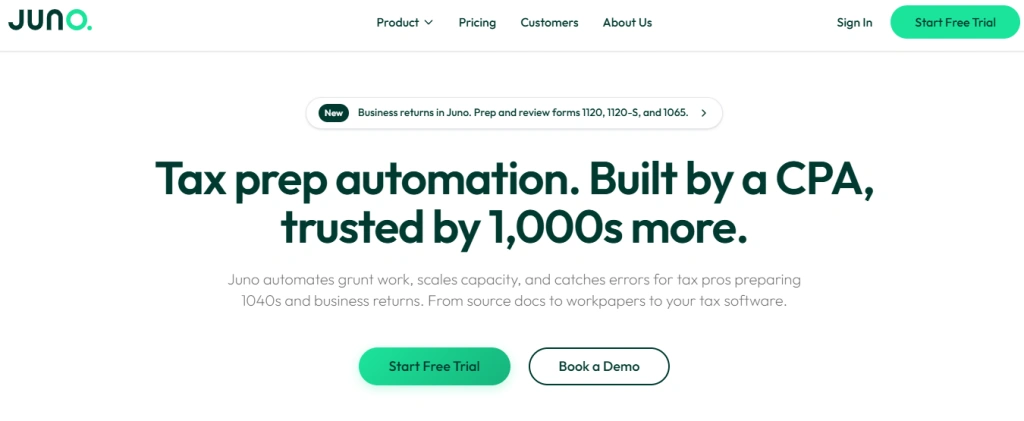
Juno Tax is an AI tax automation platform for tax professionals who want to reduce manual work across preparation, review, document workflows, and advisory support.
In practice, Juno is most relevant when a firm’s main bottleneck sits inside the return-preparation cycle. That may include reviewing source documents, checking prior-year returns, preparing workpapers, identifying missing information, and moving return data through the tax workflow.
Who Should Use Juno Tax?
Juno may fit firms focused on:
tax prep automation
source-document workflows
return review support
workpaper preparation
document-driven tax workflows
preparation efficiency
Why Do CPA Firms Compare Juno Tax Alternatives?
CPA firms usually look for a Juno Tax alternative when they need a different workflow fit. Some firms want deeper support for tax research, client explanations, planning notes, advisory documentation, or staff-facing research assistance.
That distinction matters because not every firm has the same bottleneck. One firm may need prep automation. Another may need faster research, clearer client communication, or stronger review documentation.
What is CPA Pilot and How Does It Support CPA Firms?
CPA Pilot is an AI tax planning assistant built for CPAs, Enrolled Agents, and U.S. tax firms. It supports work that often happens around the tax return, including tax research, 1040 planning, client emails, marketing content, and staff onboarding.
CPA Pilot is not positioned as a full tax filing platform. Its stronger role is helping tax professionals research issues faster, organize tax reasoning, draft client-ready explanations, and support advisory conversations.
CPA Pilot also supports firms that want to connect research with planning, especially when comparing current-year decisions against likely tax outcomes using AI tax projection.
How CPA Pilot Fits Into Tax Research, Planning and Advisory Workflows
CPA Pilot fits best in the research, planning, communication, and review-support layer of a tax firm’s workflow. It can support:
This matters when comparing CPA Pilot vs Juno because the tools solve different problems. Juno is closer to prep automation and review workflows. CPA Pilot is more focused on tax research, planning support, and client-facing communication.
CPA Pilot vs Juno Tax: Feature and Workflow Comparison
Tax research, planning, client communication, advisory support
Best-fit user
Firms focused on automating preparation and review tasks
CPAs, EAs, and tax firms that need research and communication support
Tax research
Relevant, but tied to broader automation workflow
Core use case for CPA-facing research and explanations
1040 planning
May support advisory scenarios
Strong fit for client-specific planning and 1040 research
Client communication
Not the main comparison angle
Useful for client explanations, summaries, and follow-ups
Review support
Stronger for return review and document checking
Stronger for review notes, research documentation, and issue explanations
Best use case
Reducing manual prep and review work
Helping CPAs research, explain, document, and advise faster
The main difference between CPA Pilot and Juno is workflow depth. Juno helps with the return preparation process. CPA Pilot helps around the professional reasoning layer: research, planning, interpretation, client explanation, and advisory documentation.
Juno vs CPA Pilot for Tax Research and Client Advisory
Tax research is where the difference becomes clearer. Juno is more closely connected to tax automation workflows, while CPA Pilot is designed to help CPAs research, interpret, explain, and document tax issues inside daily firm work.
For a CPA firm, tax research is rarely just about finding an answer. The firm also needs to understand how the answer applies to the client, explain the reasoning clearly, document the position, and communicate next steps.
The better question is:
Can the tool help the firm move from tax question to researched position, a reviewable explanation, and client-ready communication?
CPA Pilot is a stronger fit when the firm needs support around reasoning and communication. It can help with 1040 issues, planning opportunities, client emails, review comments, and staff research drafts.
Juno may fit better when research is closely tied to preparation automation, return review, or document-driven workflows.
Juno may be the better fit when your firm’s main bottleneck is tax preparation automation, not research or client communication.
Choose Juno if your firm needs help with:
source-document handling
workpaper preparation
return input checks
first-pass review
missing information detection
document-driven tax workflows
Juno may also make sense if your team already uses it successfully for prep and review. In that case, CPA Pilot may be evaluated separately for tax research, planning support, review notes, and client-facing communication.
CPA Pilot is the better Juno Tax alternative when your firm’s main bottleneck is not document handling or return preparation, but the work around tax decisions: research, explanation, planning, review notes, and client communication.
1. You Need AI Tax Research Support
CPA Pilot fits firms that need faster support for tax research questions, especially when staff or reviewers need to move from a client fact pattern to a clear explanation.
A CPA may need to research whether a client qualifies for a deduction, how a planning strategy affects a 1040 return, or how to explain a tax position before sending a recommendation.
2. You Need 1040 Planning Support
CPA Pilot is relevant for firms that handle individual tax planning and recurring 1040 questions. These scenarios often require judgment, comparison, and clear communication.
Firms focused on individual tax workflows can also review how AI fits into1040 tax preparation support before deciding whether they need prep automation, research support, or both.
3. You Need Client-Ready Tax Explanations
Many tax teams lose time turning technical answers into client-ready language. CPA Pilot helps support drafts for client emails, explanations, summaries, and follow-up messages.
This matters when a client asks questions like:
“Why do I owe more this year?”
“Should I make an estimated tax payment?”
“Can I deduct this expense?”
“How will this planning move affect my return?”
4. You Need Review Notes and Advisory Documentation
CPA Pilot can help firms document tax reasoning before review. This is useful when partners or managers need to understand why a position was taken, what assumptions were used, and what should be explained to the client.
5. You Need Staff to Handle Tax Questions Faster
CPA Pilot can support junior staff by helping them understand tax scenarios, organize questions, and prepare clearer drafts before escalation. It does not replace review. It improves what reaches review.
Juno Tax Alternative Cost: How CPA Firms Should Compare Value
The cost of a Juno Tax alternative is not only the software subscription. The real cost is whether the tool reduces the right type of work.
A lower-priced tool may still be expensive if it does not save time in the workflow that matters most. A higher-priced tool may be easier to justify if it reduces review friction, improves client response time, supports staff, or helps deliver more advisory work.
When comparing CPA Pilot vs Juno, evaluate:
implementation time
staff training effort
research time saved
Review bottlenecks reduced
quality of client communication
planning and advisory support
fit with the firm’s existing workflow
A practical test is to compare each tool against real firm scenarios:
Test Scenario
What to Check
Tax research question
Does it organize the answer clearly?
1040 planning case
Does it support client-specific planning logic?
Client email
Does it create a useful draft?
Review note
Does it document assumptions and reasoning?
Advisory scenario
Does it turn tax facts into a practical recommendation?
After comparing workflow value, firms should also review CPA Pilot pricing to understand whether the tool fits their team size and advisory goals.
The best evaluation question is:
Which tool removes the most expensive friction from our firm’s tax workflow?
CPA Pilot or Juno: Which AI Tax Tool Should Your Firm Choose?
The best choice depends on the workflow your firm needs to improve first.
Choose Juno if your firm is focused on source-document handling, tax prep automation, return review workflows, workpaper support, preparation efficiency, or document-driven tax workflow improvements.
Choose CPA Pilot if your firm needs help with tax research, 1040 planning support, client-ready explanations, review notes, advisory workflows, staff research assistance, or turning tax issues into planning conversations.
CPA Pilot is especially relevant when partners, managers, or reviewers spend too much time explaining tax issues, rewriting client responses, or helping staff work through recurring research questions.
For firms also comparing broader AI tools such as TaxGPT, ChatGPT, Claude, Black Ore, Blue J Tax, or TaxPlanIQ, the key is to separate three categories: general AI assistants, tax automation platforms, and CPA workflow tools. The CPA Pilot vs TaxGPT vs ChatGPT guide can help clarify that distinction.
Final Verdict: CPA Pilot, Juno, or Both?
CPA Pilot is a strong Juno Tax alternative for CPA firms that need AI support beyond preparation automation. It is best suited for firms that want to improve tax research, planning conversations, client communication, review documentation, and advisory workflows.
Juno may still be the better fit for firms primarily focused on preparation automation, source-document workflows, and return review efficiency.
For high-tech CPA firms, the choice may not be Juno or CPA Pilot. The stronger workflow may be Juno and CPA Pilot together:
Juno handles data prep, source-document workflows, and prep-review automation.
CPA Pilot supports tax research, planning logic, client-ready explanations, and strategic advisory.
For many firms, the real decision is where AI should create the most leverage: inside preparation workflows, around advisory workflows, or across both.
Try CPA Pilot for Tax Research, Planning, and Advisory Workflows
Looking for a Juno Tax alternative built around CPA tax research, planning, and advisory workflows?
Test CPA Pilot on a real tax scenario from your firm: a 1040 research question, client planning issue, review note, or client-ready explanation.
Book a CPA Pilot demo to compare the output against your current research, review, or client communication process.
FAQs About Juno Tax Alternatives
What is the best Juno Tax alternative for CPAs?
CPA Pilot is a strong Juno Tax alternative for CPAs who need AI support for tax research, 1040 planning, client explanations, review notes, and advisory workflow support.
Is CPA Pilot a replacement for Juno Tax?
CPA Pilot is not a direct Juno replacement for tax prep automation. It is a Juno Tax alternative when CPAs need support for research, planning, client explanations, and advisory workflows.
How much does Juno Tax cost?
Check Juno directly for current pricing. CPA firms should compare total value, including implementation time, workflow fit, research savings, review efficiency, and advisory support.
Can CPA Pilot and Juno be used together?
Yes. CPA Pilot supports tax research, planning, and client communication, while Juno supports tax prep and review automation. Some CPA firms may use both for different workflow stages.
Which tool is better for client advisory: CPA Pilot or Juno?
CPA Pilot is better suited for client advisory communication because it helps CPAs turn tax research, 1040 planning, and review notes into client-ready explanations and recommendations.
What should CPAs test before choosing a Juno Tax alternative?
CPAs should test one research question, one 1040 planning case, one client email, one review note, and one advisory scenario before choosing CPA Pilot, Juno, or another alternative.
Disclaimer: This article is provided by CPA Pilot for educational purposes. While we may offer tax software/services, the information here is general and may not address your specific facts and circumstances. It does not constitute individual tax, legal, or accounting advice. U.S. federal and State Tax laws change frequently; please consult a qualified tax professional before acting on any information.
I’m Harsh Mody, CPA, founder of CPA Pilot—an AI Tax Assistant for CPAs, Enrolled Agents, and U.S. tax firms. With 18+ years in accounting, tax auditing, consulting, and product management, I’ve seen how compliance-heavy work limits true advisory impact. I built CPA Pilot to change that—by applying AI-driven tax research, deduction optimization, and IRS/state code automation to help firms unlock tax savings and scale advisory services with speed and accuracy.