12 Best AI Tax Planning Tools for CPAs Compared in 2026 - CPA Pilot
AI Tax Tools Comparison
12 Best AI Tax Planning Tools for CPAs Compared in 2026
Compare 12 of the best AI tax software tools for CPAs in 2026, covering tax planning, research, return preparation, automation, pricing, and workflow fit for CPA firms.
CPA Pilot
Aug 19, 2026·17 min read
What You'll Learn
4 key concepts covered
1How AI tax tools now cover research, planning, prep automation, and agents.
2How to match tools by workflow focus, not marketing feature counts.
3Which platforms best fit planning, research-led, prep-heavy, or agentic needs.
4Key 2026 tool comparisons, pricing snapshots, and the guide’s evaluation criteria.
AI tax software is moving beyond simple question-and-answer tools.
CPA firms can now use AI to research tax issues, review returns, identify planning opportunities, model scenarios, automate parts of tax preparation and turn technical analysis into client-ready recommendations.
The challenge is that these products do not all perform the same job.
Some are designed primarily for proactive tax planning. Some are professional tax-research platforms. Others automate return preparation or attempt to connect several tax workflows through AI agents.
That distinction matters more than the number of AI features on a vendor's website.
Quick answer: CPA Pilot is a strong fit for firms that want tax research, return review, projections, planning and client-ready outputs in one CPA-focused workspace. TaxPlanIQ is more specialized around structured tax-planning engagements. Juno and Black Ore are stronger fits when tax preparation is the main bottleneck. Blue J, CoCounsel Tax, CCH AnswerConnect and Bloomberg Tax are primarily research-led platforms, while Instead represents the emerging shift toward broader agentic tax workflows.
Editorial disclosure: CPA Pilot publishes this comparison and is included in it. Product capabilities, prices and vendor claims were reviewed primarily against publicly available first-party documentation. Unless specifically stated otherwise, products were not independently benchmarked under controlled testing.
How we use “best”: Best-fit labels in this guide are editorial assessments based on each platform's primary workflow, target user and publicly documented capabilities. They are not independent performance ratings.
What Counts as AI Tax Planning Software?
AI tax planning software is different from simply asking a general-purpose chatbot a tax question.
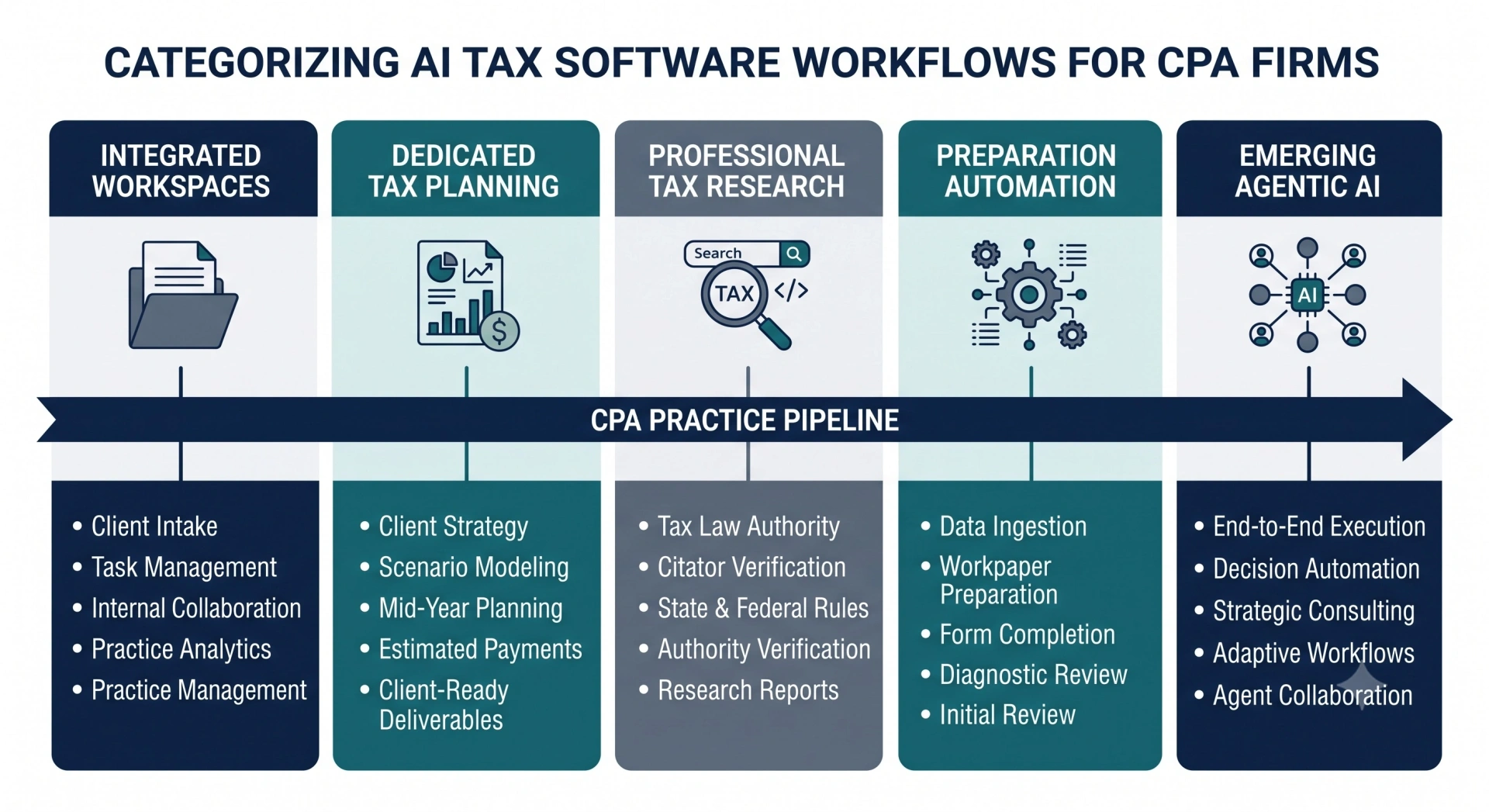
For CPA firms, the broader AI tax-software category now includes several distinct workflows:
Tax research answers: What does the tax law say?
Tax planning answers: Given this client's facts, what opportunities or decisions should we evaluate?
Tax preparation automation addresses: How can we move source documents into a reviewable return with less manual work?
Agentic tax software attempts to connect several steps - from documents and research through planning, preparation, filing or defense - inside a multi-step AI workflow.
That is why this comparison includes products that are not direct substitutes. CPA firms frequently evaluate them together when deciding where AI can create the most leverage across the practice.
Best AI Tax Software for CPAs - Quick Comparison Table
Tool
Primary category
Best fit
Planning
Research
Prep automation
Public pricing snapshot
CPA Pilot
Integrated CPA workflow
Firms combining research, review, projections and advisory
Core
Core
Supporting
From $29/month
TaxGPT
Integrated tax AI
Broad tax-specific AI workflows
Core
Core
Available
Plan-based
Juno
Prep + advisory
Firms with preparation capacity constraints
Available
Available
Core
See vendor
TaxPlanIQ
Tax planning
Structured planning and scenario modeling
Core
Supporting
Not primary
From $397/month
Hive Tax
Planning + research
Smaller firms wanting transparent pricing
Core
Core
Not primary
Research $79/month; planning from $699/year
Ready to Advise
Tax advisory
Firms scaling structured advisory
Core
Supporting
Not primary
Contact vendor
Blue J
Tax research
Research-heavy CPA firms
Supporting
Core
Not primary
Individual plan $1,498/year
CoCounsel Tax
Tax research
Thomson Reuters research users
Supporting
Core
Not primary
Contact vendor
CCH AnswerConnect
Tax research
Wolters Kluwer/CCH firms
Supporting
Core
Not primary
Contact vendor
Bloomberg Tax
Tax research
Complex and enterprise tax research
Supporting
Core
Not primary
Contact vendor
Black Ore
Tax preparation
High-volume return production
Not primary
Supporting
Core
Contact vendor
Instead
Agentic tax platform
Firms testing end-to-end tax agents
Core
Core
Core
See vendor
Pricing changes quickly. CPA Pilot currently lists plans from $29 per month; TaxPlanIQ currently lists a Basic plan at $397 per month; Hive lists research at $79 per month and its 50-plan planning tier at $699 per year; and Blue J lists an individual plan at $1,498 per year.
How We Evaluated the Best AI Tax Software
We evaluated each product based on the job it is currently designed to perform - not simply whether its website mentions artificial intelligence.
Tax research and source transparency: Professional tax work needs a verification path. We looked for platforms that connect material conclusions to primary authority, professional tax content or identifiable supporting sources.
Client-Specific Tax Planning : A useful planning workflow should help move from:
That is different from generating a generic list of possible tax strategies.
Tax Return and Document Analysis : We considered whether firms can use actual returns, source documents or client facts as inputs instead of manually recreating the client's situation inside every prompt.
Tax Scenario Modeling and Projections : Planning frequently requires comparing alternatives such as Roth conversion amounts, estimated payments, entity choices, income timing or multi-year scenarios.
Tax Preparation Automation : Document extraction, workpapers, data entry, return preparation and first-pass review were evaluated separately from proactive advisory.
Client-Ready Tax Deliverables : The value of tax AI often depends on what happens after the analysis. Useful outputs can include projections, memos, tax plans, emails, review notes or implementation steps.
Tax Data Security and Privacy : Firms should investigate encryption, access controls, retention, PII handling, model-training policies, subprocessors, audit logging and security documentation before uploading sensitive client information. The IRS recommends that tax professionals maintain formal safeguards for taxpayer information and points firms to Publication 4557 for security guidance.
Workflow Fit and Total Cost : Subscription price is only one component of cost. A low-priced system can create little value if practitioners still need to reconstruct its research, transfer data manually or rebuild every client-facing deliverable.
List of Best AI Tax Platforms for CPAs in 2026
1. CPA Pilot - Best for Integrated CPA Tax Workflows
CPA Pilot is designed around several recurring workflows performed by U.S. CPAs, EAs and tax firms rather than one isolated AI task.
CPA Pilot's primary advantage is therefore workflow breadth. It is most relevant when a firm's bottleneck is the number of disconnected steps between reviewing a client's information, researching the issue, modeling the result and communicating the recommendation. CPA Pilot's current site positions the product around return review, research, projections and client-ready planning from one workspace.
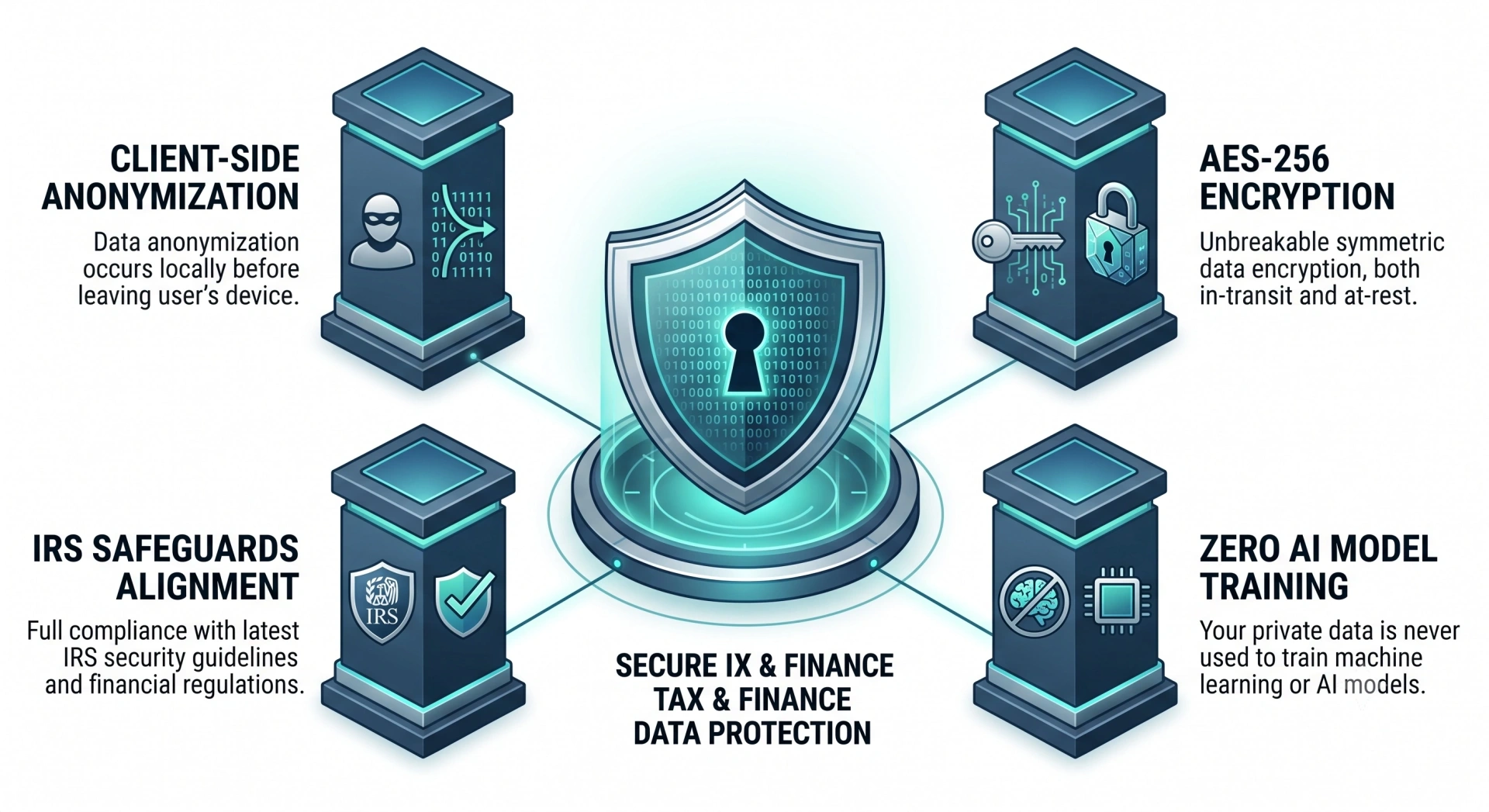
On security, CPA Pilot states that client-identifying data is anonymized on the user's computer before transmission, that data is protected with TLS in transit and AES-256 encryption at rest, and that client documents, prompts and outputs are not used for AI-model training. Firms can review the full CPA Pilot security framework as part of vendor due diligence.
CPA Pilot's current published plans begin at $29 per month.
It is a stronger fit for firms building recurring planning and advisory workflows than for organizations whose main requirement is highly specialized international research or autonomous high-volume tax-return production.
Want to evaluate cost before testing the workflow? Review the current CPA Pilot plans.
2. TaxGPT
TaxGPT has moved well beyond being a tax-focused chatbot.
Its current product environment includes cited tax research, writing, document analysis, return review, client management and tax-preparation functionality. TaxGPT's Cowork product goes further by allowing firms to assign multi-step workflows to agents rather than managing every individual task manually.
TaxGPT says Cowork currently supports workflows that include individual and business return preparation, tax planning, entity-structure reviews, projections, R&D studies and bookkeeping.
That makes TaxGPT relevant to firms looking for broad tax-specific AI assistance across several functions rather than research alone.
The main purchasing question is how those workflows fit the firm's existing preparation, review and document controls, and which capabilities are included in the plan being evaluated.
For a closer look at how a specialist tax AI compares with both CPA Pilot and a general-purpose model, read CPA Pilot vs. TaxGPT vs. ChatGPT.
3. Juno
Juno is particularly relevant to firms where source-document handling and tax preparation consume substantial staff capacity.
Its preparation platform focuses on automating production work, while Juno Advisor expands the product into client-specific planning.
Juno says Advisor can provide cited answers to complex tax questions, create and compare planning scenarios from actual client data, generate projections, and prepare client-ready emails, summaries and presentation decks.
That makes Juno more difficult to classify as a prep-only product than it was previously. Its strongest distinction remains the connection between production automation and a growing advisory layer.
A firm whose biggest constraint is document-to-return production may therefore evaluate Juno differently from a firm whose primary goal is building a standalone planning service.
TaxPlanIQ is centered on structured tax-planning engagements.
Its current platform allows an accountant to upload 1040 information, surface potential strategies, model outcomes and turn selected opportunities into a quantified client plan.
TaxPlanIQ currently advertises 130+ CPA-selected tax strategies and public pricing beginning at $397 per month for its Basic plan. The key question is whether the firm needs a specialized planning engine or a broader platform that also handles research, return review and downstream client communication.
If TaxPlanIQ is already on your shortlist, our TaxPlanIQ alternative guide compares the workflow emphasis of the two approaches.
5. Hive Tax
Hive Tax combines AI tax research with a separate planning workflow and is one of the more transparent providers on public pricing.
Its current research plan is listed at $79 per month, while its planning Starter package includes 50 plans for $699 per year. Hive also advertises 100+ curated tax strategies, tax-return analysis, personalized recommendations, federal and state research data, inline citations and automatic redaction.
That combination makes Hive particularly relevant to solo practitioners and smaller firms that want both research and planning without starting with an enterprise research contract.
Strategy count should not be treated as a proxy for quality, however. Firms should test the platform against the actual entity types, jurisdictions and client complexity they serve.
Ready to Advise is Thomson Reuters' AI-powered tax-planning advisory platform.
The product is positioned around helping firms identify planning opportunities, standardize advisory processes across staff and turn seasonal compliance relationships into ongoing advisory engagements. Its current feature set emphasizes client analysis, strategy tools, communication and reporting.
The platform is particularly relevant to firms already operating inside the Thomson Reuters ecosystem, where integration and familiarity may matter alongside pure planning functionality.
Firms comparing Thomson Reuters' broader professional research stack with newer AI-first workflows may also find our Checkpoint alternative analysis useful.
Blue J is a research-first AI platform built around producing tax answers with verifiable supporting sources.
Its positioning is especially relevant for tax professionals whose main bottleneck is finding, synthesizing and validating authority rather than preparing returns or producing a full planning engagement.
Blue J currently lists its individual U.S. plan at $1,498 per year and advertises a seven-day free trial. Its site also says the platform is used by more than 4,000 firms; that adoption figure is vendor-reported.
For practitioners, the more meaningful test is whether the platform reduces research time on the difficult questions their firm actually encounters while preserving a clear path back to source material.
Our Blue J Tax alternative comparison looks more closely at the difference between research-first software and a broader CPA workflow assistant.
8. CoCounsel Tax
CoCounsel Tax combines generative AI with Thomson Reuters' professional tax-research ecosystem.
Thomson Reuters says the platform can research using sources such as the Internal Revenue Code and Checkpoint Catalyst, analyze complex scenarios including entity and pass-through taxation, and identify potential tax-saving opportunities.
That makes CoCounsel Tax especially relevant when the central requirement is authoritative research and technical analysis rather than tax-return automation.
For firms already invested in Checkpoint, the content ecosystem itself may be a major reason to choose CoCounsel.
CCH AnswerConnect is Wolters Kluwer's professional tax and accounting research platform with increasingly integrated AI functionality.
Its current product allows users to upload returns, agreements and other client files and ask questions about the facts in those documents. Wolters Kluwer also describes its Document Analysis functionality as using Expert AI to identify areas of a return that may deserve additional review.
The product is consequently broader than conventional keyword-based tax research, but professional research remains its central role.
CCH firms deciding whether they need a traditional research ecosystem or a newer workflow-oriented assistant can continue with our CCH AnswerConnect alternative guide.
10. Bloomberg Tax
Bloomberg Tax is best aligned with firms and corporate tax departments that need deep professional research across complex federal, state or international issues.
Bloomberg says its AI research tools allow users to ask simple or complex questions conversationally while working from authoritative Bloomberg Tax content.
That depth can be valuable for research-intensive teams, but it may be more than a smaller 1040-focused practice needs for routine planning work.
The strategic distinction is therefore not simply which platform has AI. It is whether the firm primarily needs depth of research or a system designed to move research into downstream planning and client work.
Black Ore is an enterprise-grade AI tax automation platform built for CPA firms. Its Tax Autopilot system automates large portions of the tax preparation workflow and is already used by a significant share of top CPA firms for high-volume, complex return processing.
Black Ore is strongest for firms that want to maximize touchless preparation and scale production across many returns
Instead represents one of the clearest examples of the industry's move toward agentic tax software.
The company currently describes its platform as one AI agent spanning tax research, planning, filing and defense. It is building workflows that analyze documents, reason through tax scenarios, prepare workpapers, plan taxes and support return production.
Instead's entity-specific product pages also show workflows for corporate tax plans, quarterly estimates, tax strategy implementation, workpapers, preparation and return review, although availability varies by entity and workflow.
That makes Instead worth watching for firms interested in moving from AI-assisted individual tasks toward multi-step agent execution.
Because agentic products are changing quickly, firms should verify that the exact forms, entities, states, integrations and workflows they require are live - not simply announced - before adopting the platform for production work.
What Changed in AI Tax Software in 2026?
The most important shift is from AI answers to AI workflows.
Earlier tax AI products often followed a simple pattern:
question → answer → professional completes the real work elsewhere
Current products increasingly attempt to connect more of the process.
TaxGPT now offers agentic workflows through Cowork. Juno has expanded from preparation into client-specific planning. CCH AnswerConnect can analyze uploaded client documents. Instead is explicitly positioning itself across research, planning, filing and defense.
The buying question for a CPA firm is therefore changing from:
“Which AI gives the best answer?”
to:
“Which parts of our workflow can this software move from client data to a reviewable professional result?”
That is a more useful standard because it accounts for what happens before and after the AI response.
Can CPAs Use ChatGPT, Claude, or Gemini for Tax Work?
Yes, but general-purpose AI and professional tax software should not automatically be treated as equivalent.
ChatGPT, Claude and Gemini can be useful for tasks such as:
Brainstorming
Drafting
Summarizing
Rewriting technical concepts in plain English
Creating checklists
Organizing information
Preparing first-pass client communications
Professional tax work can require something more specific: a clear path back to Internal Revenue Code provisions, Treasury Regulations, IRS guidance, court decisions, state authority or professional tax commentary.
The distinction is therefore less about whether general AI is “good” or “bad” and more about workflow and verification requirements.
Before uploading client information to any general-purpose AI product, verify the privacy, retention and model-training terms for the exact commercial plan your firm intends to use.
How to Choose AI Tax Software for a CPA Firm
A product demo should answer more than “What can the AI do?”
1. Check the Tax Research Sources
Determine whether practitioners can inspect underlying authority and whether the product distinguishes primary authority from secondary commentary.
2. Verify AI Tax Outputs Efficiently
An AI response that takes longer to validate than traditional research may create little real productivity gain.
For material tax positions, review the underlying facts, assumptions, calculations and authority rather than relying on fluency or confidence.
3. Test Client Data and Document Support
Test whether it can work from prior-year returns, current-year information, entity details and client documents rather than requiring staff to manually rebuild context.
4. Test Tax Scenario Modeling
For planning, ask the system to compare actual alternatives: different Roth conversion amounts, S corporation scenarios, estimated payments, timing choices or entity structures.
5. Review Client-Ready Deliverables
The useful endpoint may be a projection, tax plan, memo, email, presentation or implementation list - not an AI chat transcript.
6. Review Taxpayer Data Security
Request documentation covering encryption, data retention, access, deletion, PII handling, model training and subprocessors.
Tax professionals have significant responsibilities around protecting taxpayer information, and IRS guidance recommends formal information-security safeguards for firms.
7. Check Tax Software Integrations and Workflow Fit
Map what happens before and after the AI step. If staff still need to copy information among the tax package, document system, portal and CRM, part of the promised efficiency may disappear.
8. Compare AI Tax Software Pricing
Compare per-user, per-return, per-plan and usage-based pricing against actual firm volume.
A $50 subscription that saves almost no professional time may be more expensive in practice than a $500 workflow that replaces many hours of repetitive work.
Practical evaluation: Bring one real, appropriately sanitized client scenario to a CPA Pilot demo and compare the same task across the two or three platforms on your shortlist. Score the result on source quality, professional edit time, workflow steps and usefulness of the final deliverable.
How to Calculate ROI From AI Tax Software
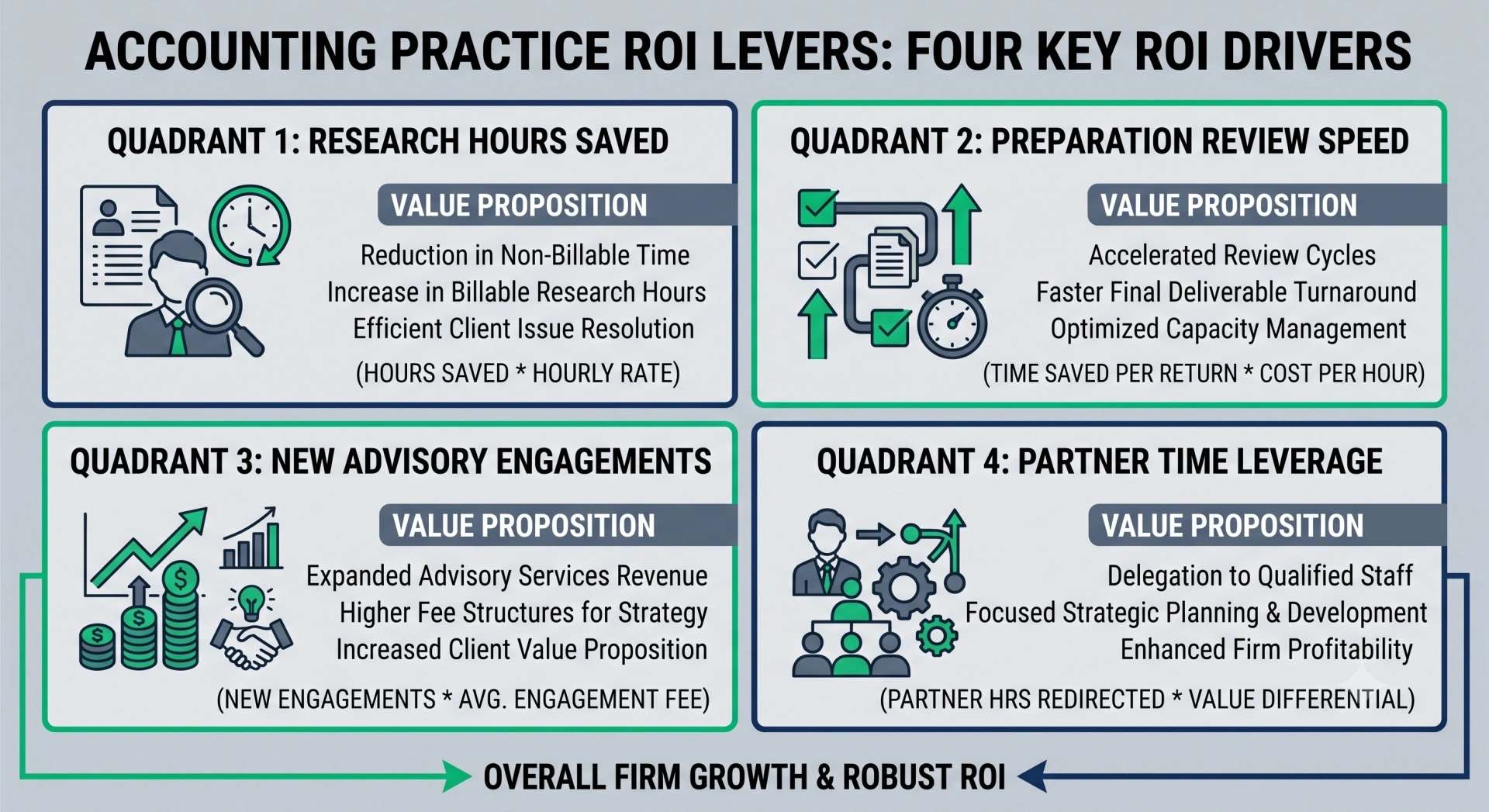
The return on AI software should be measured against the work it changes.
For research:
Research hours saved × loaded staff cost
For review:
Number of returns × average review time saved
For planning:
Additional advisory engagements × average planning fee
For capacity:
Additional clients served without equivalent additional hiring
For partner leverage:
Reduction in partner-level research, drafting and review time
The most important variable is often not raw AI speed but professional edit time.
A system that generates an answer in ten seconds but requires thirty minutes of reconstruction may create less value than a slower workflow that produces a documented, reviewable result.
AI Tax Software FAQs
What is the best AI tax planning tool for CPAs?
There is no single best platform for every CPA firm.
CPA Pilot is a strong fit for integrated research, return review, projections and planning. TaxPlanIQ is more specialized around dedicated planning engagements. Juno and Black Ore are stronger fits for preparation automation, while Blue J, CoCounsel Tax, CCH AnswerConnect and Bloomberg Tax are primarily research-led.
The right choice depends on the firm's main workflow bottleneck.
Can AI actually do tax planning?
Yes. AI can assist with analyzing client information, researching tax issues, identifying planning opportunities, modeling scenarios and drafting recommendations.
Professional review remains necessary for material assumptions, calculations and tax positions.
How is AI tax planning different from tax preparation software?
Tax preparation software primarily helps calculate, produce and file a tax return.
Tax-planning software focuses on decisions that can affect the client's future tax outcome - such as entity structure, estimated payments, income timing, deductions, credits and year-end strategies.
Some platforms now support both workflows.
Which AI tax tools provide citations?
Source-backed research is central to products such as Blue J, CoCounsel Tax, CCH AnswerConnect and Bloomberg Tax. TaxGPT and Juno Advisor also advertise cited tax research, while other planning platforms incorporate supporting tax data or authority into their workflows.
Citation availability alone is not enough. Firms should test whether the cited material actually supports the conclusion and whether staff can verify it efficiently.
How accurate are AI tax planning tools?
There is no meaningful universal accuracy percentage for every tax question, client and workflow.
Accuracy depends on source coverage, fact completeness, calculations, question type and implementation.
For that reason, firms should focus on whether qualified practitioners can efficiently verify the facts, assumptions, authority and final recommendation.
Are AI-generated tax plans audit-ready?
Not automatically. An AI-generated plan is only as defensible as the client facts, calculations, supporting authority and professional review behind it.
AI can help create documentation, but the practitioner remains responsible for evaluating the recommendation before relying on it.
Can AI tax software handle state taxes?
Some platforms support federal and state research or planning, but depth varies by vendor and jurisdiction.
A firm with substantial SALT work should test the specific states and fact patterns that matter to its clients rather than relying on a generic “state tax supported” statement.
Can a CPA firm use more than one AI tax tool?
Yes. A firm could use one product for research, another for return preparation and another for advisory.
The trade-off is additional subscription cost, training, data movement, security review and vendor management.
For some firms, specialization will justify that complexity. For others, reducing the number of disconnected tools will create more value.
Which AI tax software makes the most sense for a small CPA firm?
Small firms should prioritize workflow coverage, source quality, security, implementation effort and predictable cost.
A solo CPA performing both compliance and advisory work may get more leverage from a broader platform than from maintaining separate applications for research, projections, drafting and planning.
Are AI tax planning tools useful outside tax season?
AI is more likely to change the mix of work performed by tax professionals than eliminate the need for professional judgment. Research, document processing, calculations and drafting can increasingly be accelerated by software. Understanding client facts, evaluating risk, validating positions and deciding what advice is appropriate remain professional responsibilities.
The more useful question for firms is not whether AI will replace the CPA, but which repetitive steps can be automated so the CPA spends more time on judgment and advisory work.
Final Takeaway: Choose the Workflow Before the Tool
The AI tax-software market is no longer one category.
CPA firms are choosing among:
Integrated CPA workflow platforms
Dedicated tax-planning systems
Professional tax-research tools
Tax-preparation automation
Emerging tax agents
Start with the task consuming the most professional time.
If the problem is deep technical research, evaluate a research-first system.
If the problem is return-production capacity, test preparation automation.
If the goal is building a recurring advisory service, prioritize client-specific planning, projections and usable deliverables.
If the problem is fragmentation across several of those steps, evaluate whether a broader CPA workflow can reduce handoffs.
Most importantly, test the software on realistic scenarios, verify its sources, review its security controls and measure the amount of professional editing required to reach a usable result.
For firms that want to connect return review, tax research, projections, planning and client-ready advisory work in one CPA-focused workspace, explore CPA Pilot and compare the workflow against the other tools on your shortlist.
Editor's note: Product capabilities, pricing and availability change frequently. Vendor statistics are identified as vendor-reported where relevant. Confirm current pricing, plan limitations, integrations, security documentation and supported workflows directly with each provider before purchasing.
Key Takeaways
4 essential insights
Choose tools by primary workflow, not by vendor AI feature counts.
CPA Pilot suits firms needing research, review, projections, and client-ready outputs.
TaxPlanIQ fits structured tax-planning engagements and scenario modeling, not prep automation.
Use Juno or Black Ore when tax preparation throughput is the main bottleneck.
I’m Harsh Mody, CPA, founder of CPA Pilot—an AI Tax Assistant for CPAs, Enrolled Agents, and U.S. tax firms. With 18+ years in accounting, tax auditing, consulting, and product management, I’ve seen how compliance-heavy work limits true advisory impact. I built CPA Pilot to change that—by applying AI-driven tax research, deduction optimization, and IRS/state code automation to help firms unlock tax savings and scale advisory services with speed and accuracy.