

How Can CPA Firms Use AI for Tax Return Review to Improve QA?

[Last Updated on 2 months ago]
What is an AI Tax Return Review and Why Does It Matter Now?
AI tax return review is the use of software to check a prepared return for inconsistencies, missing carryforwards, math errors, and cross-form mismatches before a human signs off.
TL;DR – Using AI for Tax Return Review
- AI tax return review works best as a pre-filing QA layer, not as a replacement for CPA judgment.
- It is strongest at catching K-1 mismatches, missing carryforwards, basis issues, and state follow-up flags.
- It helps firms reduce repetitive tie-out work so reviewers can focus on technical judgment, exposure, and planning.
- It does not replace Circular 230 due diligence or the preparer’s responsibility under IRC §6694.
- CPA Pilot supports AI tax return review QA CPA workflows by helping firms identify review flags before final human sign-off.
It is not the same as preparing a return with AI, and it is not the same as doing tax research with AI.
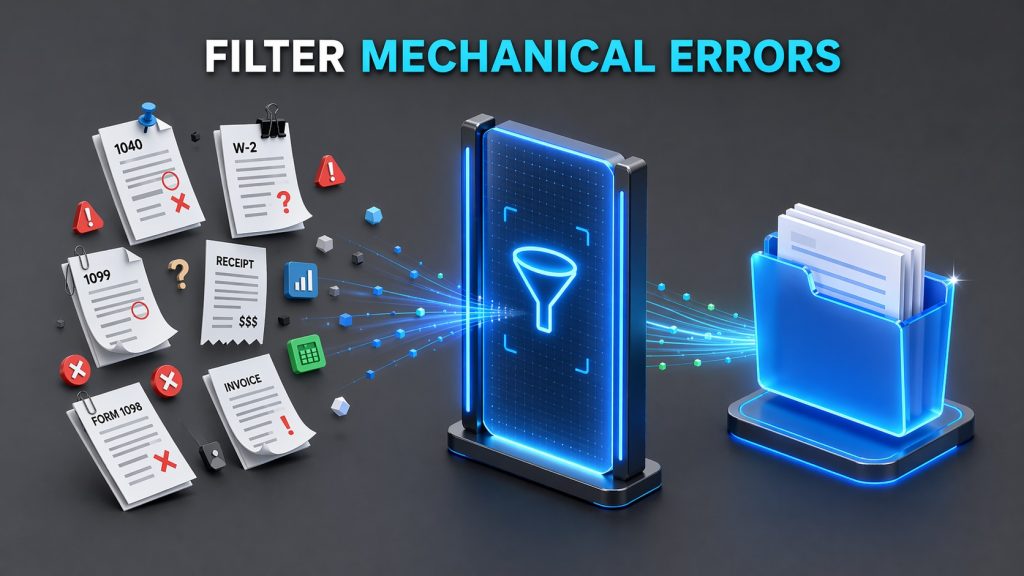
Its job is narrower: it acts as a pre-filing quality-control layer.
That distinction matters because review problems usually happen in repetitive verification work, not in the final technical judgment call.
During the 2026 filing season, the IRS had already received 88.4 million returns and 86.8 million e-file returns by March 27, 2026. (Source)
This volume shows the speed and filing pressure firms are working under. Moreover, AICPA reported that tax practitioners entering the 2025 season identified workload compression, IRS communication friction, and client-expectation pressure as leading concerns.
That is where the AI tax return review workflow matters. It is built for firms that want cleaner returns before partner or senior sign-off.
Table of Contents
- Why Manual Tax Return Review Breaks Down During Busy Season?
- What AI Tax Return Review Catches Best?
- AI Tax Review vs. Manual Tax Review: An Honest Comparison
- Where AI Tax Return Review Fits in a CPA Firm Workflow?
- What AI Tax Return Review Cannot Decide?
- Which Returns Benefit Most From AI for Tax Return Review?
- How CPA Firms Should Evaluate an AI Tax Review Tool?
- When CPA Firms Should Use CPA Pilot for Tax Return Review & QA
- FAQs About AI for Tax Return Review & QA
Why Manual Tax Return Review Breaks Down During Busy Season?
Most firms already have a review checklist. The issue is not whether a checklist exists. The issue is whether a reviewer can execute every tie-out step accurately across a heavy workload without shortening or assuming part of the process.
A human reviewer can absolutely identify basis issues, K-1 mismatches, and missing carryforwards.
The problem is that these checks often require switching between current-year returns, prior-year returns, workpapers, and state filings. As volume rises, repetitive tie-out work becomes the first thing most likely to be rushed.
That is what makes internal QA so important. The IRS Data Book shows how limited formal examination coverage is across filed returns. That does not reduce the firm’s quality burden. It increases the value of having a consistent internal process that catches issues before filing.
Manual review is strongest when it is reserved for judgment, exposure, and planning. It is weakest when it spends too much of its time on mechanical verification.
What AI Tax Return Review Catches Best?
The practical value of AI review comes from identifying issues that are structured, document-driven, and repeatable.
1. K-1 mismatches
Pass-through work often breaks when K-1 data does not reconcile to the recipient return. This can happen because of imports, overrides, corrected K-1s, or late edits. AI review helps by comparing the entity return and recipient return faster than a reviewer working line by line.
2. Missing carryforwards
Carry-forward continuity is one of the easiest places for a return to break across years. Capital loss, NOL, charitable, and passive activity amounts can all disappear or flow incorrectly when files change systems, firms, or staff. A review tool helps by comparing the prior-year return to the current-year return and flagging inconsistencies.
3. Basis inconsistencies
Basis review takes time because it requires sequencing and support. AI can help surface situations where deductions appear larger than available support or where distributions and losses do not line up with the underlying schedule.
4. State conformity flags
Federal accuracy does not always transfer to state accuracy. Review tools are useful when they flag federal items that should trigger a state-specific follow-up, especially around bonus depreciation, PTET treatment, or other conformity differences. For firms reviewing returns across multiple jurisdictions, our guide on federal vs. state tax differences helps frame why federal accuracy does not always mean state accuracy.
AI Tax Review vs. Manual Tax Review: An Honest Comparison
| Review Area | Manual Tax Review | AI Tax Review | Best Use in Practice |
|---|---|---|---|
| K-1 matching | Can catch mismatches, but requires line-by-line checking across returns and schedules | Quickly flags inconsistencies across the entity and recipient returns | Use AI first to surface mismatches, then let the reviewer confirm the cause and correction |
| Carryforward continuity | Effective, but often slow because it depends on prior-year return comparison | Efficient at spotting missing or inconsistent carry-forward treatment across years | Use AI to identify continuity issues before senior review |
| Basis support | Strong when handled by an experienced reviewer, but time-intensive | Useful for flagging deductions or distributions that appear inconsistent with basis support | Use AI to surface basis-related review points, then let a CPA validate the conclusion |
| State conformity follow-up | Can identify state-specific issues, but requires manual awareness of conformity differences | Helpful for flagging federal items that may need state-level follow-up | Use AI as an alert layer, with human review making the final state treatment decision |
| Technical judgment | Strongest area for human reviewers | Limited, especially where facts-and-circumstances analysis is required | Keep judgment-heavy decisions fully with the CPA or senior reviewer |
| Consistency under workload | Can decline when volume, deadlines, and reviewer fatigue increase | More consistent on repeatable checks across a large return volume | Use AI to reduce repetitive tie-out work during the busy season |
| Speed on repetitive checks | Slower, especially on complex files with multiple source documents | Faster on structured verification tasks | Use AI to shorten the pre-review QA stage |
| Final sign-off value | Essential for reasonableness, defensibility, and professional responsibility | Cannot replace the reviewer’s responsibility | Use AI as support, not as the final authority |
The clearest takeaway is that AI tax review works best as a structured QA layer, while manual review remains essential for judgment, technical analysis, and final sign-off.
Now, the next question is how to place that review step in a CPA firm’s workflow so the right issues get flagged before senior sign-off.
Where AI Tax Return Review Fits in a CPA Firm Workflow?
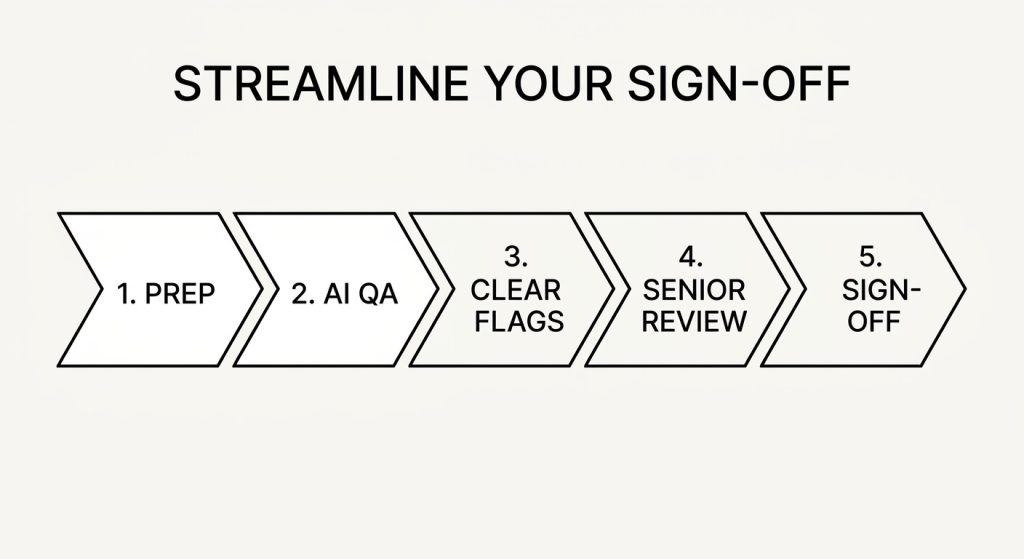
The cleanest model is to use AI after preparation is complete, but before senior review begins.
Step 1: Complete Return Preparation
The return is drafted, source documents are attached, and the file is ready to move into review.
Step 2: Run the AI QA Review
The system checks for mismatches, carry-forward gaps, basis concerns, and other structured inconsistencies. This creates a flagged review file rather than forcing the reviewer to start from zero.
Step 3: Clear Factual Review Flags
If an amount does not tie or a carryforward appears missing, the preparer should resolve or explain that issue before it reaches the reviewer.
Step 4: Focus Human Review on Judgment
Once the repetitive checks are reduced, the reviewer can spend more time evaluating support, technical reasonableness, exposure, and missed planning opportunities.
Step 5: Keep Final Sign-Off Human
That point should not become blurry. The practitioner still owns due diligence and the final filing decision. This review workflow begins only after preparation is complete, so it works well alongside a separate process to automate 1040 tax preparation using AI.
Once AI tax review is positioned in the workflow, the next step is setting clear boundaries around it.
A firm gets the most value from the tool when it knows what the system can flag and what it should never be trusted to decide on its own.
What AI Tax Return Review Cannot Decide?
AI review should not be treated as the decision-maker for positions that depend on facts, authority, or professional judgment.
It should not be the sole basis for deciding:
- Whether a position is supportable,
- Whether compensation is reasonable,
- Whether an activity is an SSTB, or
- Whether a multi-entity structure changes the reporting conclusion.
All of these are reviewer decisions, not software decisions.
That boundary matters because Circular 230 still requires due diligence, and preparer penalty exposure still belongs to the human preparer.
So the right mindset is simple: AI review can help a firm find what deserves attention, but it does not remove the reviewer’s obligation to determine whether the return position itself is supportable.
Which Returns Benefit Most From AI for Tax Return Review?
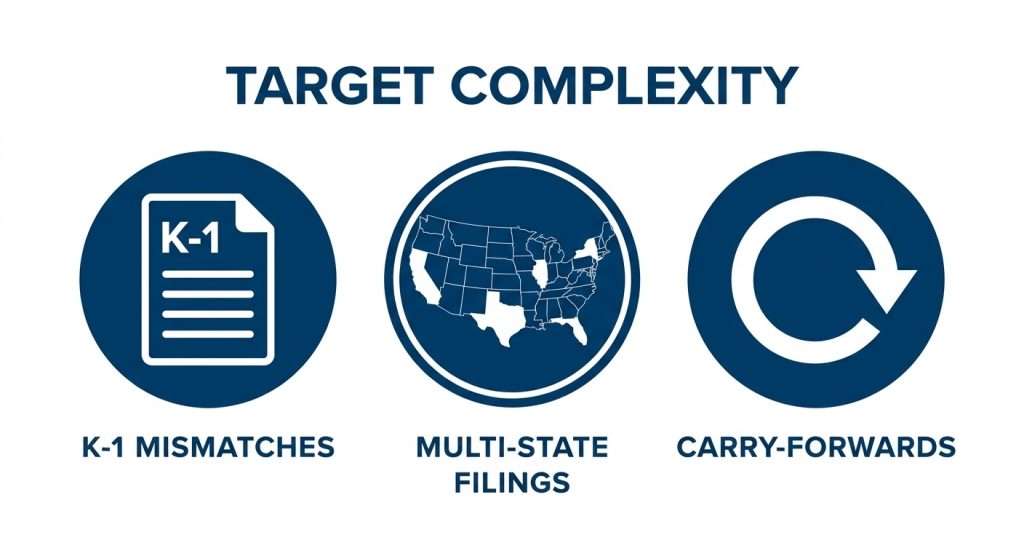
Not every return benefits equally from the same review layer. The biggest gains usually come from returns where repetitive verification risk is high, and the file has enough structure to compare documents meaningfully.
The strongest candidates are
- K-1-heavy individual returns,
- Pass-through entity returns,
- Multi-state returns, and
- Returns with active carryforwards.
These files contain the exact kinds of continuity, tie-out, and state-follow-up issues that are easy to miss manually.
Very simple returns may not justify the extra step. First-year clients can also be harder to review through automation when prior-year comparisons are missing.
Firms looking to reduce review bottlenecks may also want to compare this process with other time-saving tax workflows for CPAs.
How CPA Firms Should Evaluate an AI Tax Review Tool?
A firm should evaluate an AI tax review platform the same way it would evaluate any service provider that handles taxpayer data.
Start with workflow fit. The tool should reduce manual checking and improve the clarity of the review path.
Then evaluate security and governance. A firm should understand how files are transmitted, where data is stored, how long it is retained, whether customer data is trained, which subprocessors are involved, and how access controls work.
The best rollout model is a parallel test. Run the tool on a defined return set, compare what it catches versus what human reviewers catch, and measure whether the flagged issues are actually helpful.
When CPA Firms Should Use CPA Pilot for Tax Return Review & QA
Tax return review is no longer just about catching errors before filing. It is about building a review process that helps firms move faster, reduce avoidable misses, and free up senior reviewers for the issues that actually require judgment.
From K-1 mismatches and carry-forward gaps to basis support and state follow-up items, the difference between a rushed review and a dependable QA workflow comes down to consistency, visibility, and the right technology.
Stop relying on manual tie-outs, reviewer fatigue, and last-minute catches. Start giving your team a cleaner file to review before the final human sign-off.
Try CPA Pilot Free Today and see how structured AI-powered tax review support can strengthen your firm’s tax return review and QA workflow:
- Flag mechanical mismatches before senior review, including K-1 inconsistencies, missing carryforwards, and basis-related issues
- Add a structured QA layer that improves review consistency across complex returns
- Reduce repetitive manual checking so reviewers can focus on judgment, technical positions, and planning opportunities
- Support AI tax return review, QA, and CPA workflows with a cleaner, more efficient pre-filing process
- Extend the same structured approach into year-round advisory with tools like AI for tax projection
Join forward-thinking CPA firms already using CPA Pilot to improve review quality, reduce friction in the workflow, and create more capacity for high-value client work. Book a 30-Minute Demo Today!!!
Your reviewers should spend less time chasing mechanical issues and more time making better tax decisions. Don’t let avoidable review bottlenecks slow your firm down.
FAQs About AI for Tax Return Review & QA
Which firms benefit most from AI-assisted QA?
Firms handling high volumes of pass-through returns, K-1-heavy 1040s, multi-state filings, and returns with active carryforwards usually benefit the most.
Does AI tax return review integrate with tax software and document management systems?
AI tax return review integrates with tax software and document systems when the platform supports imports, return data mapping, and workflow syncing. Integration reduces manual review steps and speeds QA.
How accurate is AI tax return review compared with manual review?
AI tax return review is accurate for repeatable checks like mismatches, carryforwards, and missing data. Manual review remains stronger for judgment, tax positions, and fact-specific conclusions.
Is taxpayer data secure in AI tax return review software?
AI tax return review software is secure when the provider uses encryption, access controls, retention limits, audit logs, and clear data-processing terms. Firms should verify security before adoption.
Can an AI tax return review help reduce review turnaround time during the busy season?
AI tax return review reduces turnaround time by flagging mechanical issues before senior review. Faster QA helps CPA firms review more returns, cut rework, and focus on technical judgment.