1Understand the 2026 no-tax-due threshold, rates, and key deduction limits.
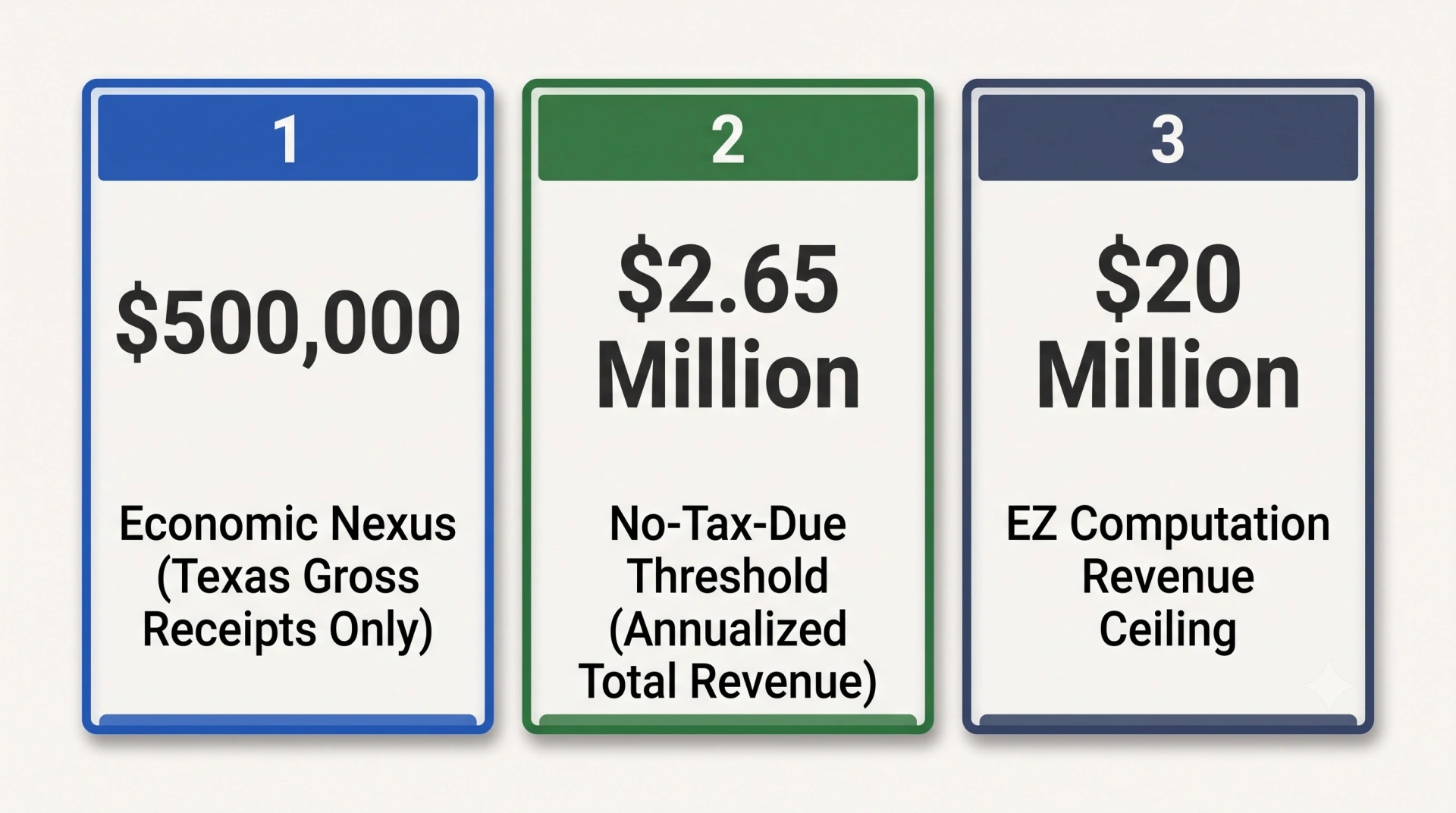
2Learn how economic nexus works for out-of-state entities at $500,000 receipts.
3Compare standard margin tax, retail and wholesale rate, and EZ Computation option.
4Follow the correct filing sequence from entity status through apportionment and payment rules.
Texas does not impose a traditional corporate income tax, but it does impose a franchise tax—a privilege tax on taxable entities formed in Texas or doing business in the state.
For the 2026 report year, the Texas Comptroller lists a $2.65 million no-tax-due threshold, a standard tax rate of 0.75%, a 0.375% rate for qualifying retail and wholesale businesses, and a $480,000 per-person compensation deduction limit. Eligible entities with annualized total revenue of $20 million or less may also use the 0.331% EZ Computation method.
Those numbers answer different questions. A foreign taxable entity can establish economic nexus with $500,000 or more of Texas gross receipts, while an entity already within the franchise tax system may owe no tax because its annualized revenue is at or below $2.65 million or because its calculated tax is less than $1,000.
This guide explains each step using the rules relevant to the 2026 Texas franchise tax report.
Quick Answer - Texas Franchise Tax Threshold 2026
For 2026, the Texas franchise tax no-tax-due threshold is $2.65 million in annualized total revenue. Most taxable entities above that threshold calculate franchise tax using taxable margin, Texas apportionment, and either the 0.75% standard rate or 0.375% qualifying retail/wholesale rate. Eligible entities with $20 million or less in annualized revenue may use the 0.331% EZ Computation method.
Out-of-state entities can establish Texas economic nexus with $500,000 or more in Texas gross receipts. A business with calculated tax below $1,000 may owe no payment but can still have a filing obligation. Most entities below the $2.65 million threshold still need the appropriate PIR or OIR, unless an exception applies.
What are the Texas Franchise Tax Rates and Thresholds for 2026?
The no-tax-due threshold increased from $2.47 million for 2024 and 2025 to $2.65 million for 2026 and 2027. The compensation limit also increased from $450,000 to $480,000 per person for the applicable 2026–2027 period.
Do not treat these figures as interchangeable thresholds.
The $2.65 million threshold is primarily a revenue test for determining whether an entity falls within the no-tax-due rules.
The $20 million amount determines eligibility for EZ Computation.
The $1,000 rule determines whether a calculated franchise tax liability requires payment.
The separate $500,000 Texas gross receipts threshold concerns economic nexus for certain foreign taxable entities. It is not a tax-payment threshold.
What is the Texas Franchise Tax?
The Texas franchise tax is a privilege tax imposed on taxable entities formed, organized, or doing business in Texas under Texas Tax Code Chapter 171.
Unlike a conventional corporate income tax, the Texas franchise tax does not simply apply a rate to federal taxable income.
For many entities using the standard calculation, the tax follows this sequence:
A business can therefore have low federal taxable income and still have a Texas franchise tax obligation. Conversely, a business can generate significant gross revenue but owe no payment because it falls within the no-tax-due rules or calculates less than $1,000 of franchise tax.
The Texas Comptroller identifies corporations, LLCs, S corporations, partnerships, trusts, professional associations, business associations, joint ventures, and other legal entities among organizations potentially subject to franchise tax.
For businesses operating in several jurisdictions, Texas should be evaluated within a broader state and multistate tax planning framework because entity classification, nexus, sourcing, and apportionment can operate differently from traditional state income-tax systems.
Who Pays the Texas Franchise Tax?
A business generally enters the Texas franchise tax system when it is both a taxable entity and sufficiently connected with Texas.
Taxable entities can include:
corporations;
limited liability companies;
S corporations;
limited partnerships;
professional associations;
trusts;
business associations;
other legal entities covered by Texas Tax Code Chapter 171.
Federal tax classification does not automatically determine Texas treatment.
For example, the Texas Comptroller confirms that a single-member LLC disregarded for federal income-tax purposes can still be a taxable entity for Texas franchise tax purposes.
Not every business structure is subject to the tax. Certain sole proprietorships and qualifying general partnerships owned entirely by natural persons can fall outside the definition of a taxable entity. Statutory exemptions or special treatment can also apply to qualifying nonprofits, passive entities, new veteran-owned businesses, and other specifically defined organizations.
The analysis should therefore start with: Is this organization a Texas taxable entity?
Only then should the practitioner move to nexus, annualized revenue, margin, apportionment, and filing requirements.
What is the Texas Franchise Tax Economic Nexus Threshold?
An out-of-state taxable entity does not necessarily need a Texas office, employee, or physical property to enter the Texas franchise tax system.
Under Texas's economic-nexus rules, a foreign taxable entity can establish nexus when it has $500,000 or more of gross receipts from business done in Texas during its federal income-tax accounting period.
The $500,000 test is a nexus test, not a no-tax-due or payment threshold.
Texas gross receipts must be determined under the state's applicable sourcing rules. Practitioners should verify how each category of receipt is sourced before concluding that an out-of-state entity has—or does not have—economic nexus.
Physical presence can independently establish nexus through activities such as maintaining a Texas business location, owning or leasing property, or conducting business through personnel in the state.
The practical analysis for a foreign entity is: Does physical nexus exist? If not, do Texas-sourced gross receipts meet or exceed $500,000?
Once nexus exists, the entity must separately determine whether its annualized total revenue falls within the $2.65 million no-tax-due threshold.
What is the Texas Franchise Tax Threshold for 2026?
The Texas franchise tax no-tax-due threshold is $2.65 million of annualized total revenue for the 2026 and 2027 report years.
However, being below the threshold does not universally eliminate all reporting requirements.
Most taxable entities at or below the threshold still file either Form 05-102, Public Information Report (PIR) or Form 05-167, Ownership Information Report (OIR), depending on legal entity type.
Important exceptions exist. Passive entities and qualifying new veteran-owned businesses can follow different reporting rules, so the PIR/OIR statement should not be treated as universal.
Where annualization is required, the general concept is:
Total revenue ÷ number of days in the accounting period × 365.
Do You Have to File Texas Franchise Tax if You Owe Less Than $1,000?
Yes, in some cases.
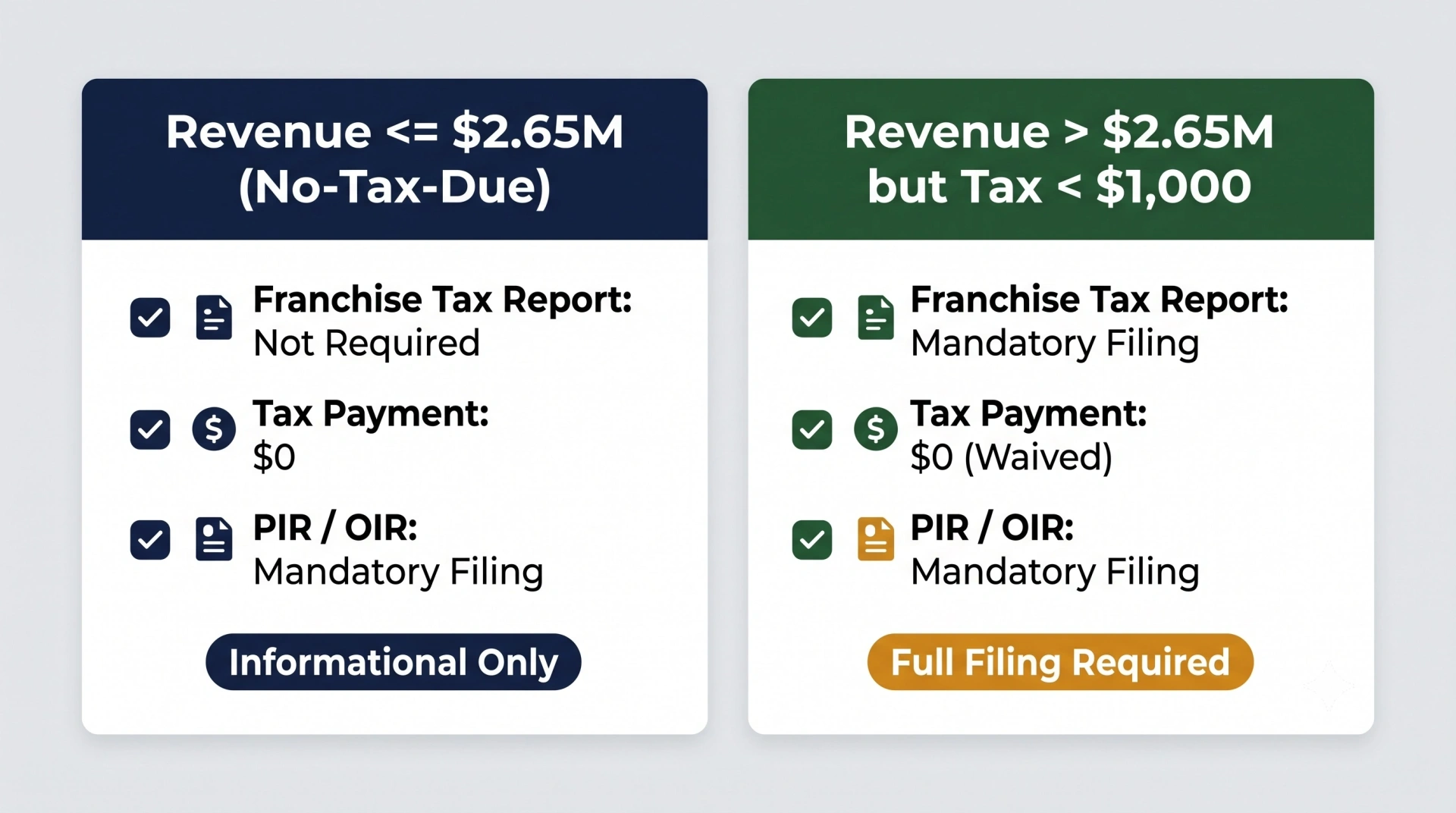
The Texas Comptroller distinguishes between an entity below the $2.65 million no-tax-due threshold and an entity whose revenue exceeds that threshold but whose calculated franchise tax is less than $1,000.
If annualized total revenue exceeds $2.65 million but calculated tax is below $1,000, the entity generally must still file the applicable franchise tax report showing the calculation.
No franchise tax payment is due in that situation.
Below the revenue threshold: generally no franchise tax report and no franchise tax payment.
Above the threshold but calculated tax under $1,000: franchise tax report required, but no tax payment.
What Changed for Texas Franchise Tax in 2026?
The 2026 report year changed how Texas determines certain amounts taken from federal income-tax returns.
Under the Comptroller's IRC conformity guidance , amounts taken from a federal return for the 2026 franchise tax report are generally determined under the federal law applicable to that federal tax year.
Where a Texas statute or rule specifically references the Internal Revenue Code, the relevant Texas provision can still require application of the 2007 IRC.
How Did Bonus Depreciation and Texas COGS Change for 2026?
Beginning with the 2026 report, depreciation reported on a federal tax return can affect Texas COGS when the underlying asset otherwise qualifies under the Texas cost-of-goods-sold rules.
The critical limitation is that the asset must be associated with and necessary for the production of goods.
The Comptroller's 2026 conformity guidance also provides for a one-time net depreciation adjustment for qualifying assets.
Businesses with manufacturing, inventory production, equipment, or other substantial production assets should therefore revisit prior Texas depreciation treatment rather than automatically carrying forward the same COGS workpaper.
How Do You Calculate Texas Franchise Tax?
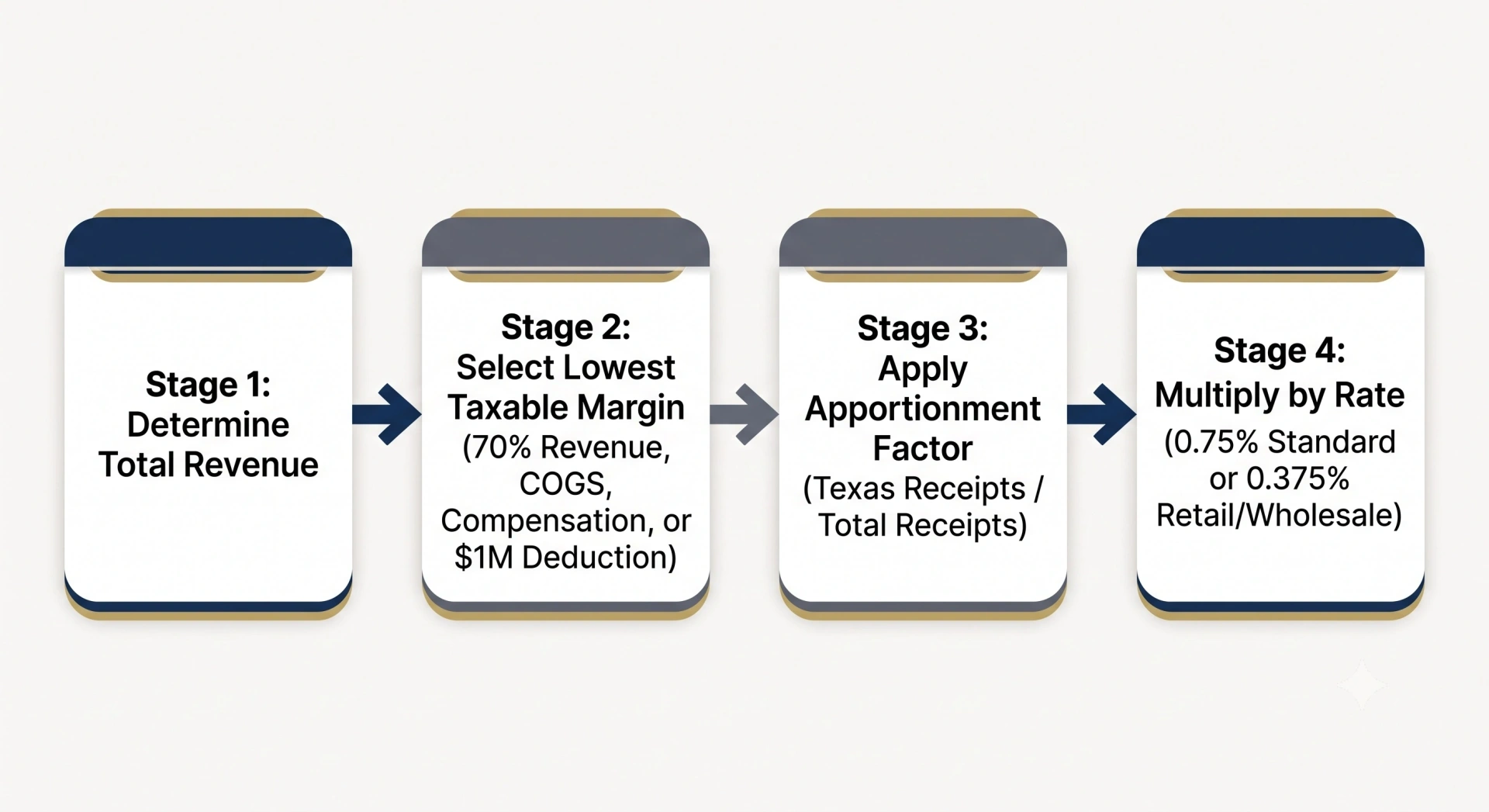
For a taxable entity above the no-tax-due threshold using the standard calculation, the Texas franchise tax generally follows four stages.
1. Determine total revenue.
2. Calculate the permitted taxable margin alternatives:
70% of total revenue;
total revenue minus cost of goods sold;
total revenue minus compensation;
total revenue minus $1 million.
The business generally uses the lowest permitted margin result.
3. Determine the Texas apportionment factor.
4. Apply the applicable tax rate to Texas-apportioned margin.
Most entities use the 0.75% rate. The 0.375% rate applies only when the entity satisfies Texas's requirements for qualifying retail or wholesale treatment.
What is the Texas Franchise Tax Compensation Deduction Limit for 2026?
The compensation deduction limit for reports due in 2026 and 2027 is $480,000 per person, subject to the rules for the applicable accounting period.
Texas compensation can include qualifying wages and cash compensation as well as certain benefits allowed under the franchise tax rules.
The Texas Comptroller's compensation guidance distinguishes qualifying compensation from items such as employer payroll taxes and nonemployee compensation that do not receive identical treatment.
For businesses with significant payroll, the correct analysis is: Identify qualifying persons → determine qualifying compensation → apply the applicable per-person limit → compare the resulting margin with the other statutory methods.
The Texas EZ Computation is an alternative filing method available to a taxable entity or combined group with annualized total revenue of $20 million or less.
Total revenue × Texas apportionment factor × 0.331%
An entity using EZ Computation cannot use the standard COGS deduction, compensation deduction, or other normal margin deductions, and the election generally prevents the use of franchise tax credits.
A lower tax rate therefore does not necessarily mean a lower tax liability.
The appropriate decision is:
Calculate the standard method → calculate EZ if eligible → compare final liability.
How Much Texas Franchise Tax Would a $4 Million Business Owe?
Assume a Texas consulting company has:
$4,000,000 of total revenue
$2,000,000 of qualifying compensation
$3,000,000 of Texas gross receipts
$4,000,000 of gross receipts everywhere
no material qualifying COGS
Assume the entity qualifies for the standard 0.75% rate.
Standard franchise tax: $1,500,000 × 0.75% = $11,250
EZ Computation: $4,000,000 × 75% × 0.331% = $9,930
In this simplified example, EZ Computation produces the lower result. A business with larger COGS or compensation deductions may produce the opposite result.
Need to document a Texas tax position? CPA Pilot's AI Tax Research Assistant helps tax professionals research technical issues, organize supporting authority, and prepare reviewable workpapers for questions involving nexus, state conformity, apportionment, and tax calculations.
Which Texas Franchise Tax Forms Do You File in 2026?
Form selection depends on annualized revenue, tax-computation method, entity type, and whether special reporting rules apply.
An entity with annualized total revenue at or below $2.65 million generally does not file the former No Tax Due Report.
Most such taxable entities still file the applicable PIR or OIR, although passive entities, qualified new veteran-owned businesses, and other special situations can follow different requirements.
A taxable entity above the threshold using EZ Computation generally files Form 05-169, Texas Franchise Tax EZ Computation Report.
An entity using the standard method generally files the applicable Texas Franchise Tax Report forms, including Forms 05-158-A and 05-158-B, as required.
The Public Information Report, Form 05-102, generally applies to entity types including corporations, LLCs, professional associations, limited partnerships, and certain financial institutions.
The Ownership Information Report, Form 05-167, generally applies to certain other taxable entities.
When Is the Texas Franchise Tax Due in 2026?
Texas franchise tax reports are generally due May 15.
For the 2026 report year, the original due date was May 15, 2026.
Accordingly, the 2026 extended due date should be stated as November 15, 2026.
Extension payment requirements depend on the taxpayer's circumstances.
Payment can generally involve:
at least 90% of the current-year tax expected to be due; or
100% of prior-year tax, when the taxpayer satisfies the conditions for using that prior-year option.
Texas does not require quarterly estimated franchise tax payments.
Do LLCs Pay Texas Franchise Tax?
Yes. An LLC formed in Texas or otherwise within the Texas franchise tax system is generally a taxable entity unless a specific exclusion or exemption applies.
That includes a single-member LLC that is disregarded for federal income-tax purposes.
For closely held businesses, these issues fit naturally within a broader small-business tax planning process rather than being reviewed only when the May filing deadline approaches.
Do S Corporations Pay Texas Franchise Tax?
Yes. Federal S corporation status does not itself exempt a legal entity from Texas franchise tax.
An S corporation can remain a Texas taxable entity even though its income generally passes through to shareholders for federal income-tax purposes.
An S corporation must separately determine Texas nexus, annualized revenue, margin, apportionment, and filing requirements.
How Does Texas Franchise Tax Combined Reporting Work?
Texas combined reporting can apply when entities are part of an affiliated group, satisfy the applicable ownership tests, and conduct a unitary business.
When the combined-reporting rules apply, the combined group—not each member independently—is generally the relevant reporting unit for total revenue and threshold testing.
Under the applicable Texas combined-reporting rules, a qualifying affiliate may also be included in a combined report even when that member does not independently have Texas nexus.
Inclusion in the combined group does not by itself mean the member independently has Texas nexus or separately owes Texas franchise tax.
What are the Most Common Texas Franchise Tax Mistakes?
Using the old $2.47 million threshold: The no-tax-due threshold for 2026 and 2027 is $2.65 million.
Treating $500,000 as the payment threshold: The $500,000 amount is an economic-nexus test for relevant foreign entities.
Assuming no tax means no filing: Most entities below the threshold still file a PIR or OIR unless an exception applies.
Choosing EZ because the rate is lower: EZ Computation does not permit the normal COGS, compensation, or other margin deductions.
Applying the 0.375% rate too broadly: The reduced rate applies only to qualifying retail and wholesale entities.
Using federal taxable income as the Texas tax base: Texas uses its own total-revenue and margin framework.
Ignoring receipt-sourcing rules: Apportionment depends on the nature and source of receipts.
Carrying forward old depreciation treatment: The 2026 conformity changes can affect qualifying COGS depreciation.
Testing related entities separately: Required combined groups generally perform threshold and revenue analysis at the group level.
What are the Texas Franchise Tax Penalties for Filing or Paying Late?
Texas imposes consequences for both late reporting and late payment.
A $50 penalty can apply to a required franchise tax report filed after its due date, even when no tax payment is due.
For unpaid tax:
a 5% penalty generally applies when payment is 1–30 days late;
the penalty generally increases to 10% after more than 30 days;
interest generally begins accruing on the 61st day after the due date.
Continued noncompliance can also create entity-status consequences, including forfeiture procedures.
Reinstatement can require:
filing outstanding franchise tax reports;
filing missing PIRs or OIRs;
paying outstanding tax, penalties, and interest;
obtaining applicable tax-clearance documentation;
completing the required reinstatement process.
How Should CPAs Review Texas Franchise Tax for 2026?
A Texas franchise tax review is more reliable when the practitioner follows the tax's decision sequence rather than starting with a form.
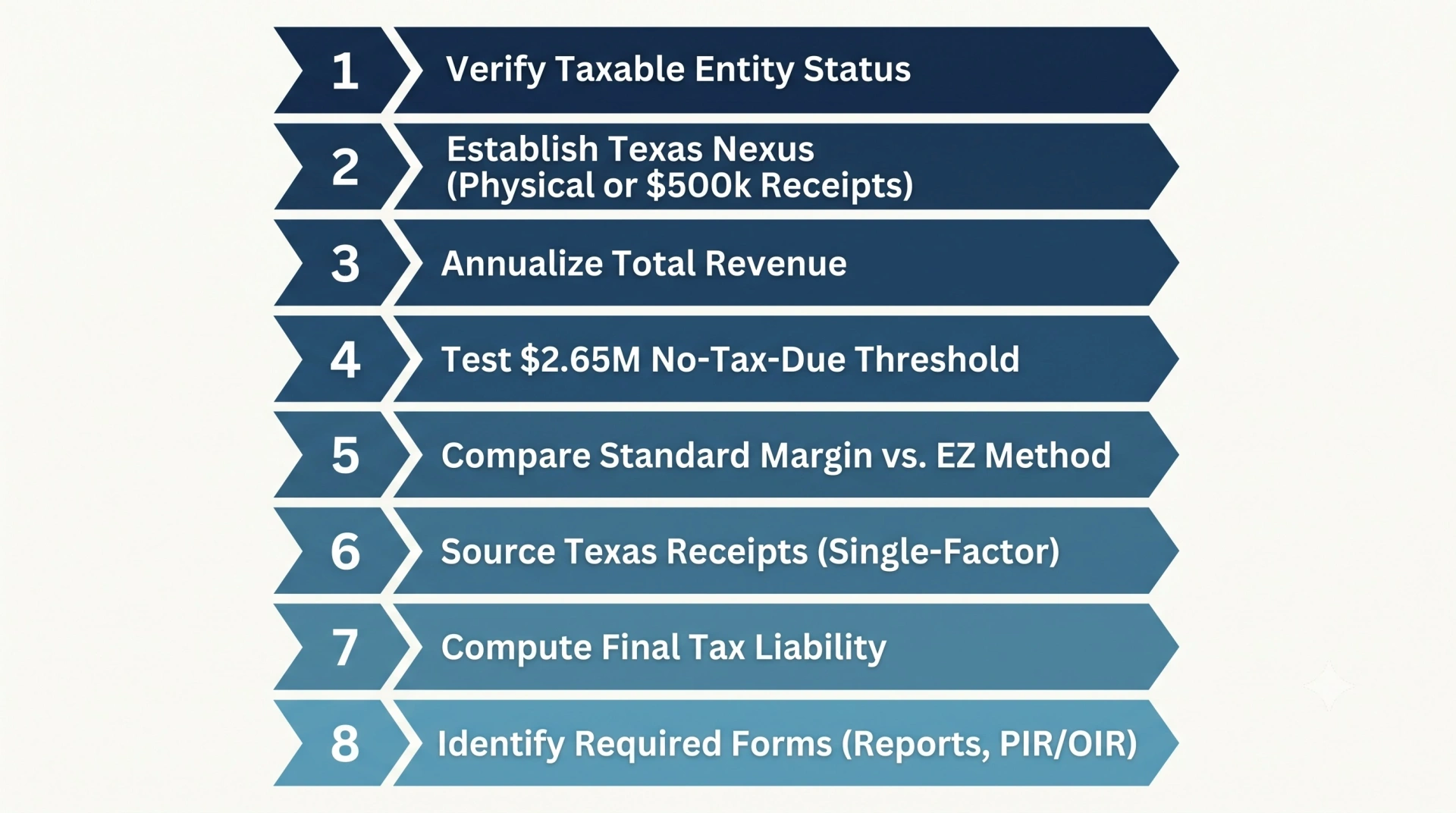
Determine taxable entity status → establish Texas nexus → annualize total revenue → test the $2.65 million threshold → compare standard margin methods and EZ Computation → source Texas receipts → calculate liability → identify required reports → document technical positions → monitor account status
Following that sequence helps prevent the most common errors: confusing nexus with liability thresholds, choosing EZ Computation solely because its rate is lower, applying the retail/wholesale rate without qualification, overlooking combined reporting, or assuming zero tax means zero filing obligations.
How Is the Texas Franchise Tax Report Year Determined?
A Texas franchise tax report generally uses the accounting period prescribed by the Texas reporting rules and tied to the entity's federal accounting period. Practitioners should verify the dates applicable to the specific report rather than assuming a calendar-year period.
Does a New Texas Business File Franchise Tax in Its First Year?
A new taxable entity can have Texas franchise tax filing obligations after formation or establishing nexus. Its first reporting period depends on its formation date and applicable Texas reporting rules, and short-period revenue may require annualization.
Can You Amend a Texas Franchise Tax Report?
Yes. A taxable entity can file an amended franchise tax report to correct revenue, deductions, apportionment, or tax. The correction can increase tax due or support an overpayment or refund claim, subject to applicable Texas procedures and limitation periods.
How Do You Close a Texas Franchise Tax Account?
A terminating or withdrawing business generally must resolve required final reports, tax, penalties, and interest and satisfy applicable Texas Comptroller clearance requirements before completing the relevant termination or withdrawal process.
Is Texas Franchise Tax Deductible on a Federal Tax Return?
Texas franchise tax may be deductible for federal tax purposes in appropriate circumstances, but deductibility depends on the applicable federal rules, taxpayer status, nature of the expense, and accounting method. A federal deduction does not reduce the Texas franchise tax calculation itself.
I’m Harsh Mody, CPA, founder of CPA Pilot—an AI Tax Assistant for CPAs, Enrolled Agents, and U.S. tax firms. With 18+ years in accounting, tax auditing, consulting, and product management, I’ve seen how compliance-heavy work limits true advisory impact. I built CPA Pilot to change that—by applying AI-driven tax research, deduction optimization, and IRS/state code automation to help firms unlock tax savings and scale advisory services with speed and accuracy.