Circular 230 Compliance for CPA Firms: 8 Requirements You Need to Follow - CPA Pilot
federal tax automation
Circular 230 Compliance for CPA Firms: 8 Requirements You Need to Follow
Circular 230 is not just ethics, it shapes daily tax work. Learn 8 firm-level requirements for research, written advice, supervision, documentation, and responsible AI use.
2Which activities count as practice before the IRS for tax professionals.
3How competence, due diligence, and review standards apply to tax advice.
4How to use AI responsibly while retaining practitioner oversight and documentation.
Are Circular 230 requirements only an IRS ethics issue, or do they affect how CPA firms manage daily tax work?
For CPA firms, Circular 230 is more than a professional conduct rule. It shapes how CPAs, enrolled agents, tax preparers, reviewers, and firm leaders handle tax research, written advice, IRS representation, client communication, staff supervision, and documentation.
According to the IRS, Circular 230 governs practice before the IRS and sets standards for competence, diligence, ethical conduct, and disciplinary action for tax professionals.
That matters even more as firms use AI tax research, client email automation, and faster advisory workflows. A CPA may use technology to save time, but the practitioner still needs to verify facts, apply tax law, review assumptions, and approve the final advice before it reaches the client.
This is where CPA Pilot fits naturally into the conversation. CPA Pilot helps U.S. tax firms organize research, draft client communication, and streamline planning workflows, while the Circular 230 requirements still place final responsibility on the CPA, EA, or qualified tax practitioner.
The goal is not to replace professional judgment. The goal is to help firms build a cleaner, more consistent workflow around IRS-facing tax advice, client communication, and review standards.
In this guide, we’ll break Circular 230 down into practical firm-level controls: who must follow it, what counts as practice before the IRS, how competence and due diligence apply to tax advice, how written advice should be reviewed, and how CPA firms can use AI responsibly without weakening professional standards.
So, without any further ado, let’s start exploring!!!
What Does Circular 230 Mean for CPA Firms?
It means the firm needs a repeatable control system for federal tax work. A CPA firm should know which client matters require practitioner review, which communications need approval, when staff work must be escalated, and how final tax conclusions are saved in the client file.
For a firm, Circular 230 should be translated into operating standards. That includes assigning complex tax questions to qualified reviewers, documenting the basis for advice, checking whether client facts are complete, and creating a clear approval path before advice is sent.
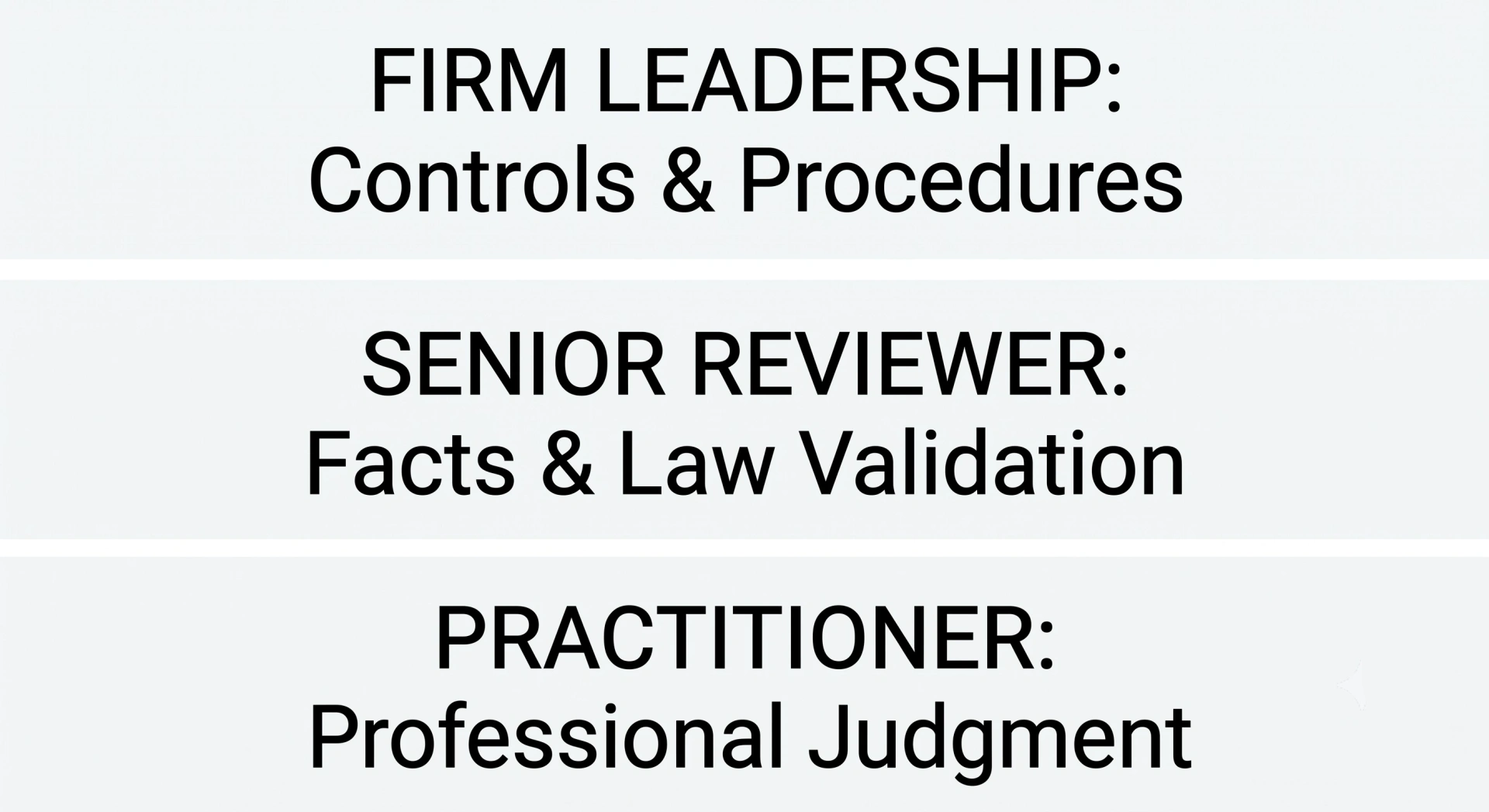
A practical way to understand this is to separate three levels of responsibility inside the firm:
Circular 230 Responsibilities by Firm Level
Circular 230 Meaning
Practitioner Responsibilities
The CPA, EA, or attorney must use professional judgment before giving tax advice or representing a taxpayer.
Reviewer Responsibilities
A senior reviewer should confirm that facts, assumptions, tax law, and client instructions support the conclusion.
Firm Leadership Responsibilities
The firm should maintain procedures for supervision, documentation, conflict checks, and consistent client communication.
Circular 230 directly regulates practitioners, but CPA firms still need internal procedures because the practitioner’s work is shaped by staff preparation, review systems, client intake, documentation, and approval workflows.
That is why the better firm-level question is not only, “Who is covered?” The better question is, “Can the firm show that tax advice was reviewed before it was delivered?”
This connects naturally with stronger review systems, better client records, and more consistent tax research workflows.
Once the firm understands Circular 230 as an internal control framework, the next step is to break down the specific requirements CPA firms should build into their tax workflows.
8 Core Circular 230 Requirements for CPA Firms
Before applying Circular 230 requirements, CPA firms should translate the rules into clear review actions that fit daily tax work. The points below explain how each requirement connects to practitioner judgment, client facts, IRS-facing work, and firm-level quality control.
1. Confirm competence before assigning the matter
The practitioner handling the issue should have the technical knowledge, preparation, and experience needed for the federal tax matter.
For CPAs and enrolled agents, this means matching work to the right reviewer when the issue involves entity structuring, penalty relief, amended returns, IRS notices, multi-state implications, or complex individual planning.
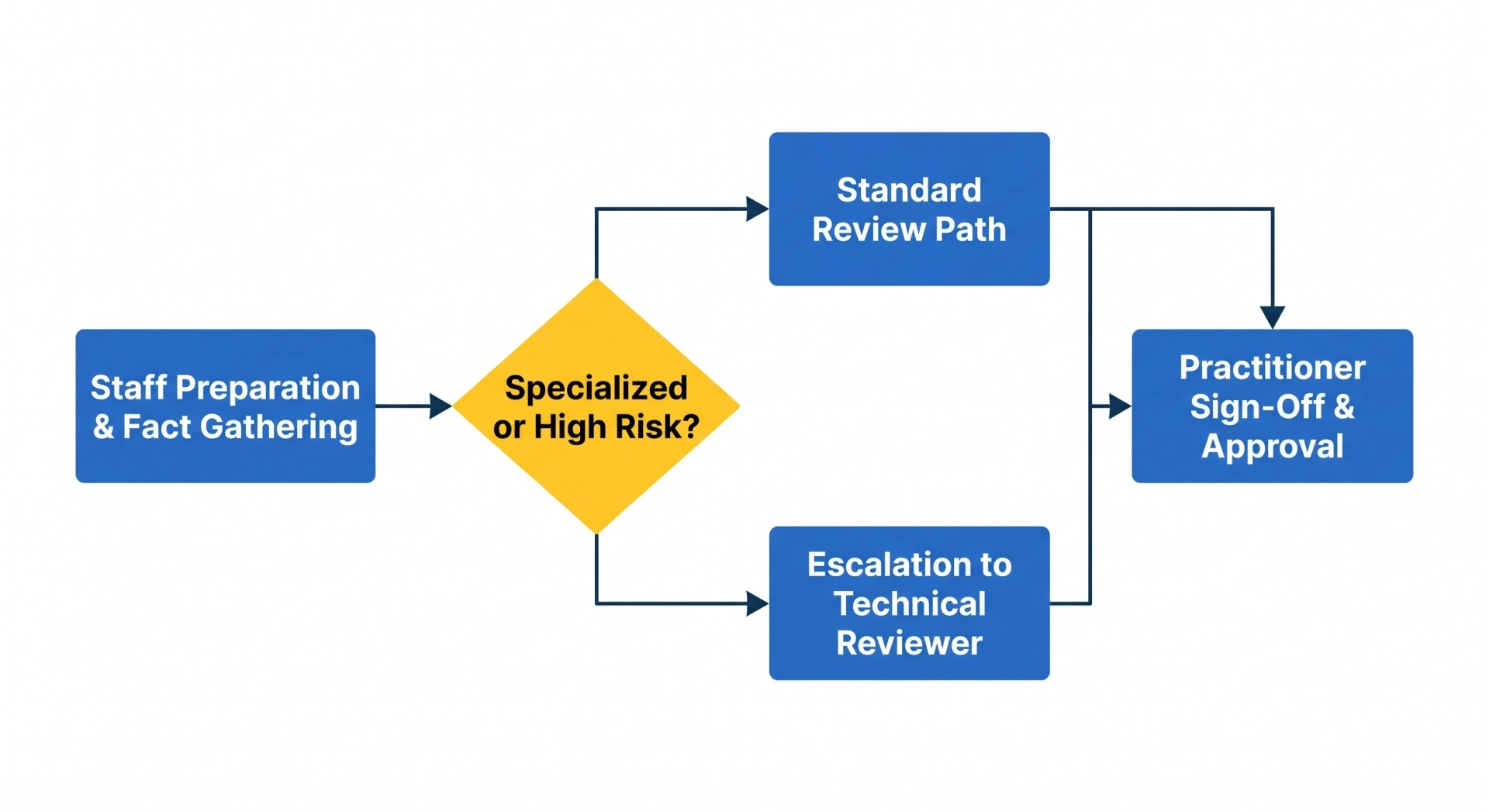
If the matter falls outside the practitioner’s normal experience, the firm should involve a specialist, perform additional research, or escalate the file before giving a final answer.
2. Apply due diligence to tax positions and client statements
Due diligence is not limited to return preparation.
It also applies when the firm prepares or approves IRS-related documents, communicates with clients about federal tax matters, or makes representations to the Treasury Department.
CPAs should check whether client-provided information is complete, consistent, and reasonable before relying on it.
If the facts appear incomplete or contradictory, the firm should ask follow-up questions before forming a tax conclusion.
3. Connect written advice to facts, assumptions, and authority
Written advice should not read like a general tax explanation when the client needs a specific answer.
For CPA firms, advisory emails, planning memos, research summaries, and portal responses should connect the applicable rule to the client’s facts.
The final advice should make clear which assumptions were used, which facts were confirmed, and whether the conclusion depends on timing, documentation, filing status, entity type, ownership, or IRS interpretation.
4. Maintain procedures for federal tax practice
Firm procedures should explain how federal tax work moves from intake to review to final communication.
This includes routing complex questions to the right reviewer, setting approval thresholds for IRS-facing matters, defining when associates can draft but not finalize advice, and keeping source notes tied to the client file.
For firm leaders, the technical issue is not only whether the final answer is correct, but whether the firm had a reasonable process for producing and approving it.
5. Identify conflicts before representation becomes limited
Conflicts can appear in tax work before a formal dispute exists. CPA firms should check for conflicts when representing spouses, business partners, entity owners, buyers and sellers, family members, or related entities.
The technical concern is whether the practitioner’s judgment could be materially limited by duties to another client, former client, third party, or the practitioner’s own interest. If objectivity may be affected, the firm should pause before continuing the engagement.
CPA firms should distinguish between records the client needs for federal tax compliance and internal workpapers created by the firm.
Client records may include source documents, prior-year tax information, forms, schedules, or materials needed to meet tax obligations.
Firm-created analysis, review notes, and internal planning documents may require separate handling based on the engagement terms. A clear record policy helps avoid confusion when clients request files, change firms, or respond to IRS notices.
7. Review fee structures and promotional claims for tax-risk language
Fee and marketing controls should focus on how the firm describes outcomes.
CPAs should avoid language that makes tax savings, refund results, penalty outcomes, or IRS resolutions sound guaranteed when they depend on facts, documentation, law, or agency review.
This applies to engagement letters, service pages, paid ads, email campaigns, and advisory packages. A safer approach is to describe the process, review standard, and planning support instead of promising a specific tax result.
8. Understand sanctions as a professional-practice risk
Circular 230 sanctions are not only about intentional misconduct. They can arise from patterns of poor practice, unsupported advice, inadequate procedures, careless representations, or failure to meet practitioner standards.
For CPA firms, the technical lesson is that compliance should be visible in the file: who handled the issue, what facts were reviewed, what authority supported the conclusion, what assumptions were made, and who approved the final advice
Together, these requirements help CPA firms move from rule awareness to practical compliance. When each tax matter is assigned, reviewed, documented, and communicated through a clear process, the firm is better positioned to protect clients and maintain consistent federal tax practice.
How Should CPA Firms Apply Circular 230 Competence and Due Diligence Standards?
A CPA firm should confirm that the right person is handling the tax issue, the client facts are complete enough to support the conclusion, and the final advice has been reviewed before it is sent. This is the practical connection between competence, due diligence, and tax advice review.
Under § 10.35 on competence, a practitioner must have the needed knowledge, skill, thoroughness, and preparation for the matter.
In a CPA firm, that means complex federal tax questions should not be assigned only by availability. They should be assigned by technical fit, reviewer access, client risk, and the level of judgment required.
If the issue involves a specialized tax area, the firm should either involve a qualified reviewer or require additional research before the answer becomes client-facing advice.
Due diligence adds the second layer. § 10.22 on diligence as to accuracy requires care when preparing, approving, and filing IRS-related documents, and when making oral or written statements to clients or the Treasury Department.
Client Errors and Omissions Under Section 10.21. When a practitioner knows a client has not complied with revenue laws or has made an error or omission in a return, document, or affidavit, the practitioner must advise the client promptly of the noncompliance, error, or omission
For CPA firms, this means staff should have a clear escalation path when they discover a client mistake, and the firm should document that the client was advised.
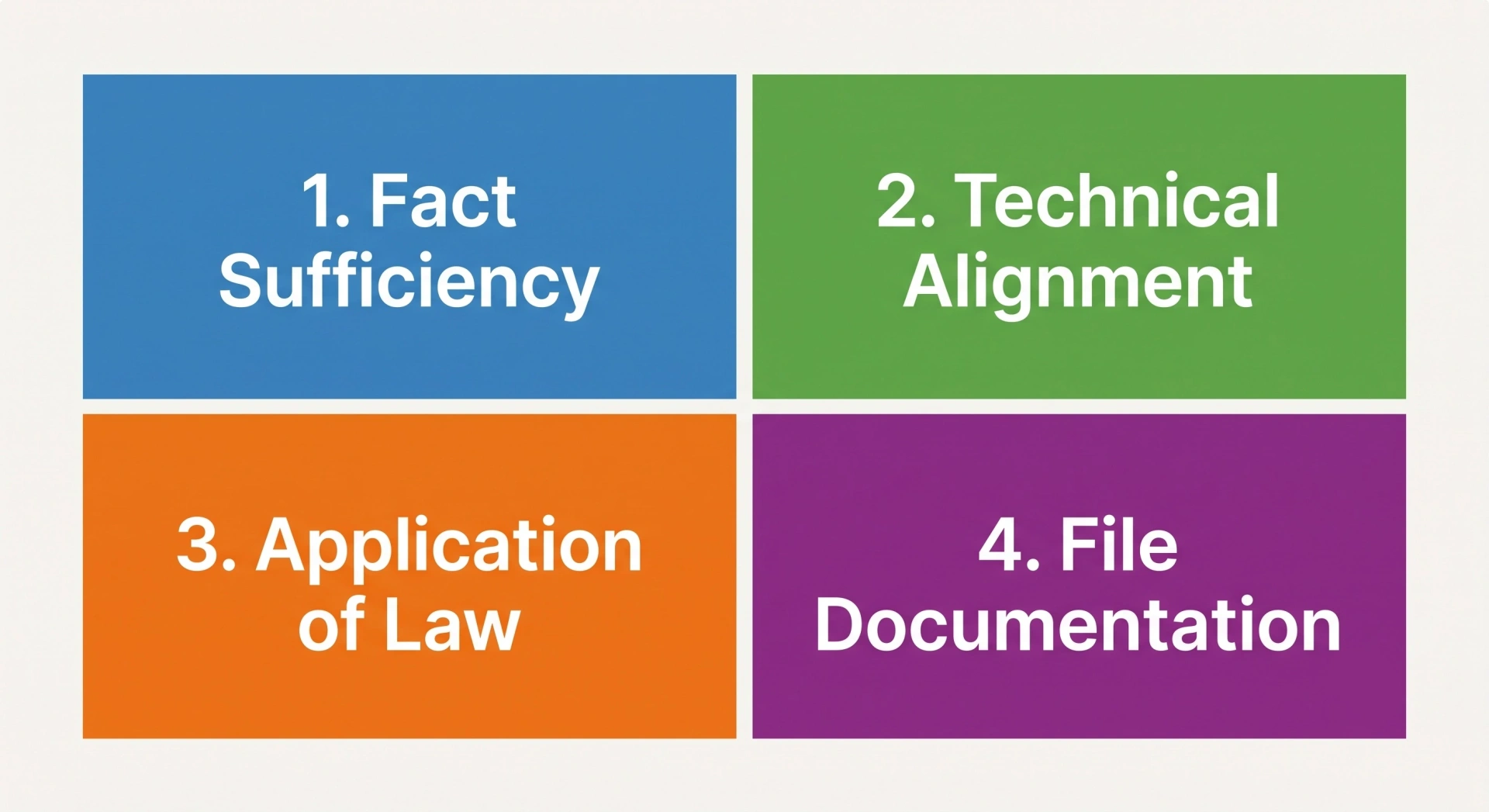
Four Questions to Review Before Delivering Tax Advice
Review Question
Why It Matters
Do we have enough client facts?
Advice can change when income, entity type, filing status, ownership, timing, or documentation changes.
Is the tax issue assigned to the right person?
Competence depends on the practitioner’s preparation and technical fit for the matter.
Has the law been applied to the facts?
Tax advice should connect the rule to the client’s actual situation, not just summarize general guidance.
Is the final answer ready for the client file?
A saved record helps show what was reviewed, approved, and communicated.
Written advice needs an additional layer of care because it becomes part of the client record. Under § 10.37 on written advice, a practitioner must consider relevant facts, use reasonable assumptions, make reasonable efforts to identify facts, and relate the law to those facts.
This is why client emails, advisory memos, research summaries, and planning recommendations should not be treated as casual messages when they include a federal tax conclusion.
A simple rule works well for CPA firms: Research can start broadly, but advice must end specifically. The final answer should show what facts were used, what assumptions were made, what rule was applied, and who approved the conclusion.
Once the firm has a review standard for human-prepared tax advice, the next step is to apply the same professional responsibility to AI-assisted tax research and client communication.
Can CPA Firms Use AI While Complying With Circular 230?
Yes. AI can support tax research, client communication, planning workflows, and staff productivity when the firm uses it within a clear professional review process.
For CPA firms, the goal is not to remove practitioner judgment. The goal is to make research, drafting, documentation, and review more consistent.
Responsible Uses of AI in CPA Firm Tax Workflows
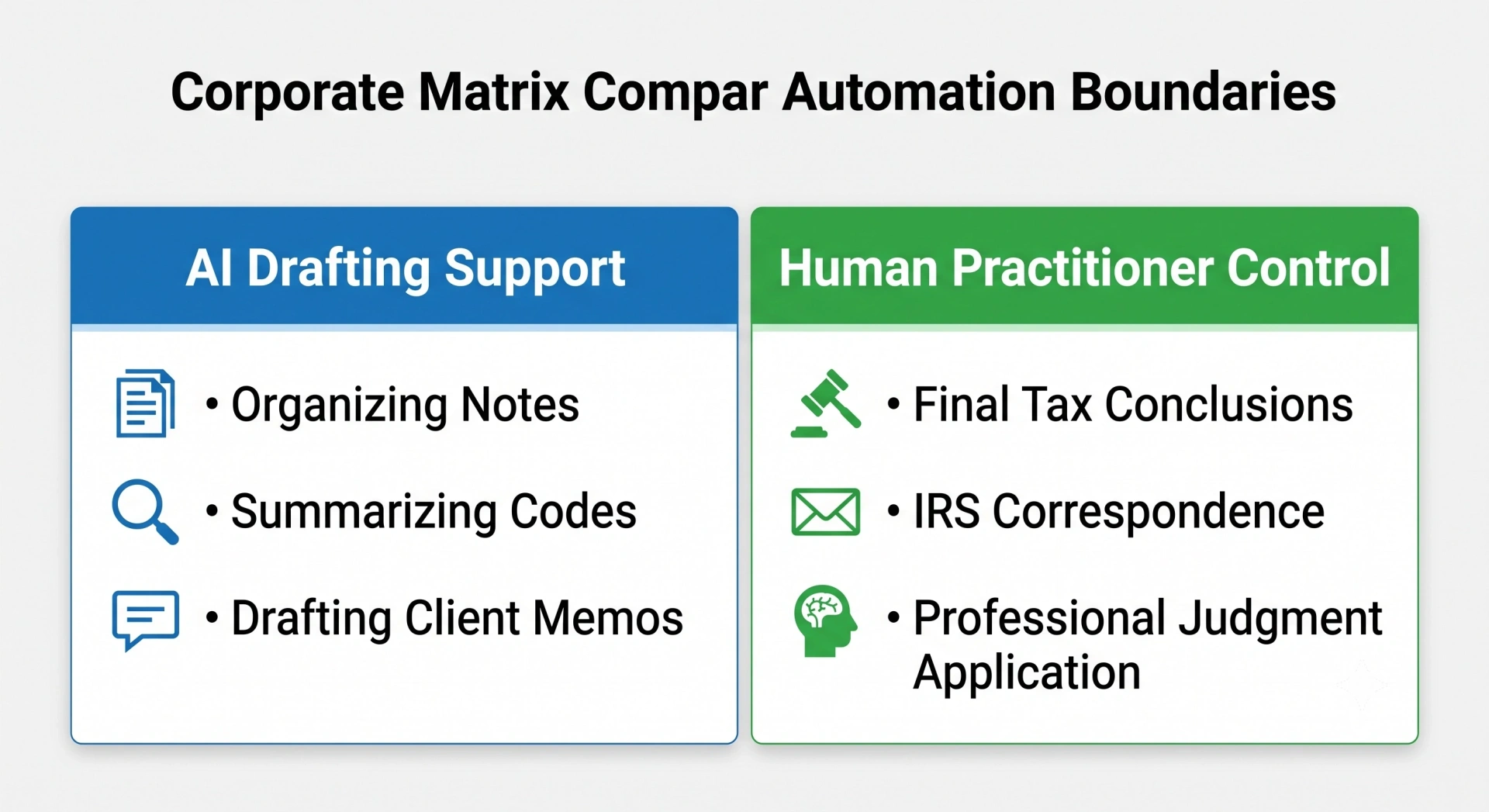
AI is most valuable when it helps the tax team move faster through structured work. It can organize client questions, summarize research issues, prepare first-draft client communication, compare planning options, and help staff understand complex tax topics more quickly.
Three Levels of AI-Assisted Tax Work
For CPA firms, AI-assisted tax work can be organized into three practical levels:
AI Use Category
How CPA Firms Can Use It Responsibly
Workflow support
Organizing notes, summarizing client questions, preparing task lists, and structuring research issues.
Drafting support
Creating first drafts of client emails, research summaries, tax planning notes, and IRS response outlines.
Practitioner-led advice
Final tax conclusions, client-facing recommendations, IRS communications, and judgment-based advice remain under practitioner control.
This distinction is important because it positions AI as a productivity and consistency tool, not a replacement for the CPA, EA, or tax professional.
A platform like CPA Pilot can help firms streamline research, draft client communication, and organize tax planning workflows, while the firm keeps final review and approval with the responsible practitioner.
Source Verification Standards for AI-Assisted Tax Research
Tax teams should connect conclusions to official tax authority, client facts, and the applicable tax year.
Data handling should also be part of the firm’s AI policy. The IRS reminds tax professionals thatprotecting client data is required, so firms should define who can access client information, where work product is stored, and how client-facing outputs are approved.
Five Questions Every CPA Firm AI Policy Should Answer
A practical AI policy for CPA firms can answer five simple questions:
Policy Question
Purpose
What types of work can AI assist with?
Keeps AI use tied to approved workflows.
Who can use AI for client-related tasks?
Ensures staff use the tool within firm standards.
Which outputs need practitioner approval?
Keeps final advice under professional control.
What sources should support conclusions?
Connects research to official tax authority and client facts.
How should outputs be saved?
Supports documentation and consistency across the firm.
The practical takeaway is simple: AI can improve the speed and quality of tax workflows when it is used with professional oversight. CPA Pilot supports that model by helping CPA firms organize research, draft communication, and structure planning work while keeping final judgment with the practitioner.
Once the firm defines how AI should support tax work, the next step is to assign responsibility for supervision, staff review, and internal procedures across the team.
Who is Responsible for Circular 230 Compliance in a CPA Firm?
Responsibility starts with the practitioner handling the matter, but firm leaders also need procedures that guide how federal tax work is assigned, reviewed, and approved. Under § 10.36 on procedures to ensure compliance, individuals with principal authority over a firm’s tax practice must take reasonable steps to ensure adequate procedures for members, associates, and employees.
For CPA firms, this means supervision should be part of the workflow, not an after-the-fact correction. The firm should define which matters require partner review, which can be handled by managers, what staff may draft, and when a tax question must be escalated. This helps prevent loose or undocumented federal tax practice while still allowing work to move efficiently.
Firm Role
Supervision Responsibility
Partner or principal
Sets review standards and approves high-risk positions.
Tax manager or reviewer
Checks technical accuracy, client facts, and final communication quality.
Staff preparer or associate
Gathers information, prepares drafts, and flags missing facts.
Administrative or intake team
Routes documents, tracks deadlines, and supports complete files.
Essential Controls for Circular 230 Supervision and Review
A practical review system should include matter routing, escalation rules, documentation standards, approval checkpoints, and staff training.
These controls are especially important for firms improving time-saving tax workflows for CPAs, where speed should support review quality rather than replace it.
The takeaway is simple: Supervision is not only about checking final work. It is about making sure the right person reviews the right issue at the right time, so the firm can protect clients, train staff, and keep federal tax practice consistent.
Which Circular 230 Rules Create Client-Facing Risk?
The main risks usually come from conflicts of interest, client record requests, fee arrangements, and public-facing claims. These areas need simple controls because they affect trust, objectivity, and how clients understand the firm’s services.
Check Conflicts before Representation or Advisory Work: Under § 10.29 on conflicting interests, a practitioner may not represent a client before the IRS if the work is directly adverse to another client or materially limited by duties to another client, former client, third person, or the practitioner’s own interest. CPA firms should run conflict checks in matters involving spouses, business partners, entity owners, family businesses, or multi-party tax planning.
Return Client Records as Required Under Section 10.28: § 10.28 on return of client records requires practitioners to return client records when they are needed for the client to meet federal tax obligations. A firm should track record requests, identify client-owned documents, separate them from internal workpapers, and document what was returned.
Review Fee Arrangements Under Section 10.27: § 10.27 on fees addresses restrictions on certain fee arrangements. CPA firms should review fee structures before tying compensation to sensitive tax outcomes, especially where the result depends on IRS review, client facts, or uncertain tax treatment.
Avoid Misleading Marketing and Tax-Savings Claims: § 10.30 on solicitation addresses advertising and solicitation standards. CPA firms should avoid unsupported guarantees, exaggerated IRS representation claims, or promotional language that makes tax savings sound automatic.
Client-facing Circular 230 controls should help the firm stay objective, return records properly, structure fees carefully, and describe tax services accurately.
What are the Penalties for Violating Circular 230?
A Circular 230 violation can lead to IRS Office of Professional Responsibility discipline, including censure, suspension from practice before the IRS, disbarment from practice before the IRS, monetary penalties, or appraiser disqualification.
For CPA firms, the risk is usually not one isolated mistake. The larger concern is a pattern that shows weak controls, unsupported conclusions, poor documentation, or client communications that go beyond what the facts support. The IRS says OPR administers and enforces the standards of practice under Circular 230, which means disciplinary issues are reviewed through a professional responsibility lens, not only a tax-technical lens.
Common Circular 230 compliance risks include:
Unsupported Tax Positions: A client-facing recommendation can create risk when the firm cannot show the facts, authority, assumptions, or reasoning behind the position.
Inaccurate or Careless IRS Communications: Responses to IRS notices, penalty matters, or representation issues should be reviewed before submission because they may affect the client’s federal tax position.
Incomplete Tax Advice Documentation: If the firm cannot show what was reviewed, who approved it, or which facts were used, it becomes harder to defend the quality of the work.
Unmanaged Conflicts of Interest: Multi-client matters can become risky when the firm continues work even though objectivity or loyalty is limited.
Misleading Tax Service Claims: Marketing language around guaranteed savings, guaranteed IRS outcomes, or automatic deductions can create avoidable risk when results depend on client facts and tax law.
Weak Review and Escalation Procedures: Complex matters should not stay at the preparer level when they require senior judgment, specialized research, or representation experience.
These risks connect directly to how a firm handles advisory work, IRS notices, and client communication.
In simple terms, circular 230 sanctions are not just penalties after something goes wrong. They are a signal that CPA firms need strong documentation, clear review paths, accurate client communication, and disciplined escalation before risk reaches the client or the IRS.
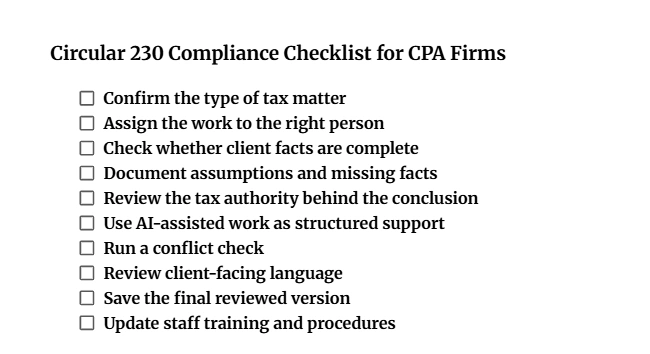
Circular 230 Compliance Checklist for CPA Firms
How CPA Pilot Supports Circular 230-Compliant Tax Workflows
CPA Pilot supports this workflow by helping CPA firms structure tax research, draft client communication, organize planning notes, and move routine tax work through a more consistent process. The platform is built for CPAs, enrolled agents, and U.S. tax firms that want to save time without losing control over the professional review process.
CPA Pilot can support Circular 230-aligned workflows in four practical ways:
Draft Clear Client Communications for Practitioner Review: CPA Pilot can help prepare first-draft client emails and explanations, so practitioners can focus on reviewing accuracy, tone, assumptions, and client-specific details before anything is sent.
Standardize Tax Advice Documentation: A consistent workflow helps firms keep track of client facts, research notes, planning assumptions, and final recommendations.
Support Staff Training and Reviewer Approval
CPA Pilot can help newer team members understand tax issues faster, follow structured workflows, and prepare cleaner drafts for reviewer approval. This supports firms that want to improve time-saving tax workflows for CPAs without weakening internal review standards.
Under § 10.36 procedures to ensure compliance, firm leaders need adequate procedures for members, associates, and employees involved in federal tax practice. CPA Pilot can help make those procedures easier to follow by giving the team a more organized way to research, draft, document, and review tax work.
For CPA firms, the value is not just speed. The value is a cleaner process: fewer scattered notes, fewer disconnected client emails, fewer unsupported drafts, and more consistent review before advice becomes final.
If your firm wants a more structured way to manage tax research, client communication, and review workflows, book a CPA Pilot demo and see how AI can support your team’s tax planning process while keeping practitioner judgment at the center.
Using AI for Circular 230 FAQs
Can a CPA rely on information provided by a client under Circular 230?
A CPA may rely on client information unless it appears incorrect, incomplete, or inconsistent. The practitioner must ask follow-up questions when facts create doubt and must verify the information before using it in tax advice or an IRS filing.
Does Circular 230 apply to emails, website content, and social media tax advice?
Circular 230 can apply to electronic written tax advice, including emails and digital communications. A practitioner must use reasonable facts, assumptions, and legal analysis before publishing or sending advice that addresses a federal tax matter.
How does Circular 230 differ from AICPA tax standards?
Circular 230 governs practice before the IRS, while AICPA standards govern professional tax services for AICPA members. CPA firms may also follow state board rules, tax preparer laws, and firm policies when those standards impose additional duties.
Does Circular 230 require a specific document retention period?
Circular 230 does not create one universal retention period for all tax advice. CPA firms should follow federal tax rules, state board requirements, engagement terms, insurer guidance, and firm policies when retaining research, approvals, and client communications.
What must a CPA tell a client about tax return penalties?
A CPA must advise the client when a reported position may trigger penalties and explain available disclosure or compliance options. The practitioner should document the warning, the relevant tax position, and the client’s decision before filing or giving final advice.
Key Takeaways
4 essential insights
Build repeatable controls for tax research, advice, documentation, and approval workflows.
Ensure practitioners verify facts, apply tax law, and approve final advice.
Implement senior review to confirm facts, assumptions, and client instructions support conclusions.
Use AI to streamline work, but maintain documented professional judgment and supervision.
Was this article helpful?
Sorry about that. How can we improve?
Thanks for the feedback! It helps us improve.
Share
Harsh Mody
CPA & Founder of CPA Pilot
I’m Harsh Mody, CPA, founder of CPA Pilot—an AI Tax Assistant for CPAs, Enrolled Agents, and U.S. tax firms. With 18+ years in accounting, tax auditing, consulting, and product management, I’ve seen how compliance-heavy work limits true advisory impact. I built CPA Pilot to change that—by applying AI-driven tax research, deduction optimization, and IRS/state code automation to help firms unlock tax savings and scale advisory services with speed and accuracy.