California tax planning is uniquely complex because the state does not fully conform to federal tax law and enforces rules independently through the California Franchise Tax Board (FTB).
Federal-first tax strategies often fail in California, especially for depreciation, net operating losses, pass-through income, residency, and sourcing.
Entity-level taxes create exposure regardless of profitability, affecting LLCs, S corporations, and multistate businesses.
Residency and income sourcing drive the highest audit risk, particularly for high-income individuals, executives, remote workers, and business owners.
California PTE tax elections are conditional, not automatic benefits, and depend on timing, ownership, and multistate impact.
Most California tax failures are workflow failures, caused by late identification, inconsistent interpretation, and weak documentation.
AI supports California tax planning best when used for research, consistency, and early risk detection, not for final judgment or audit decisions.
Effective California tax planning requires early reconciliation, parallel federal–state analysis, and defensible documentation.
Unlike most states, California introduces planning risk through:
Selective and delayed conformity to federal changes
Entity-level taxes that apply regardless of profitability
Aggressive enforcement of residency, sourcing, and nexus
Planning positions that remain exposed even when federally sound
For CPAs advising individuals or businesses with California exposure, tax planning is not a federal-first exercise with minor state adjustments. California tax planning requires parallel evaluation, separate documentation, and early workflow integration to avoid rework, compliance failures, and client disputes.
Multistate businesses with California customers or employees
Clients relying on federal planning assumptions without state reconciliation
California’s divergence from federal rules affects core planning areas such as depreciation, net operating losses, pass-through taxation, residency, and income sourcing. As a result, positions that appear complete under IRS guidance can still create exposure when reviewed through an FTB lens.
CPAs who treat California as a routine state overlay often encounter:
Late-stage adjustments
Amended filings
Missed elections
Inconsistent outcomes across similar clients
This is why effective California tax planning depends on early identification of state-specific issues, not post-federal cleanup.
So, without any further ado, let’s start!!!
Why California Tax Planning Is Uniquely Challenging for CPA Firms?
The challenge for CPAs is not simply that California applies different tax rules; it’s that those differences surface mid-workflow, often after federal positions appear settled.
Planning decisions that seem complete at the federal level frequently need to be revisited once California-specific adjustments are applied, disrupting timelines and review sequencing.
California Non-Conformity Disrupts Federal-First Planning Workflows:
One of the most persistent friction points is non-conformity timing. California selectively adopts federal provisions and often does so on a delayed or modified basis.
This creates planning scenarios where depreciation schedules, loss utilization, or credit eligibility must be tracked separately for federal and California purposes.
For CPA firms handling volume work, this split treatment introduces parallel calculations that increase the likelihood of inconsistency across engagements, especially within broader state and multistate tax planningworkflows.
2. Entity-Level Rules Increase Late-Stage Planning Risk: Entity-level divergence adds further pressure. Minimum franchise taxes, gross-receipts-based LLC fees, and California-specific limitations can materially affect structures that appear tax-efficient under federal analysis.
These issues often emerge late in the planning process, particularly for entities operating across multiple states or ownership tiers, increasing review complexity and documentation burden.
Operationally, California also amplifies staff interpretation risk. Junior preparers may apply federal guidance correctly while overlooking California-specific thresholds or exceptions. Senior reviewers then inherit reconciliations that are harder to validate under time pressure.
Over time, this pattern mirrors many of the common tax research mistakes seen in complex jurisdictions, where state-level nuances are identified too late to be addressed cleanly.
These challenges explain why California tax planning requires more than awareness of the rules.
It demands:
Intentional workflow design,
Consistent internal interpretation, and
Early identification of state-level adjustments, before federal positions are finalized.
To see where these adjustments originate, the next section focuses on the specific federal and California tax rule differences that most often force CPAs to revisit planning decisions.
Federal vs. California Tax Rules Require Active Reconciliation by CPAs
CPAs must actively reconcile federal and California tax rules because California does not automatically adopt federal changes and applies independent conformity, timing, and enforcement standards.
Federal conclusions cannot be treated as final when California exposure exists.
Where reconciliation is most critical
California divergence concentrates in planning areas that directly affect projections, estimates, and elections:
California selectively adopts changes, sometimes years later.
Result: CPAs must track federal and California rules in parallel rather than sequentially.
6. Enforcement Authority
Federal tax law is administered by the IRS.
California tax law is enforced independently by the California Franchise Tax Board.
Result: IRS guidance does not guarantee FTB acceptance.
Why reconciliation must happen early
If California reconciliation occurs after federal positions are finalized, CPA firms often face:
Revised depreciation and NOL schedules
Recalculated estimated payments
Late identification of non-conforming elections
Increased review and documentation burden
Effective California tax planning treats federal and state analysis as concurrent, not sequential.
Federal vs. California Tax Rule Differences — CPA Planning Reference
Planning Area
Federal Treatment
California Treatment
Planning Impact
Depreciation
Bonus and accelerated depreciation allowed
No full bonus conformity
Separate asset schedules required
NOLs
Broad carryforward usage
Suspensions and percentage caps
Alters income smoothing
Pass-through income
Flows directly to owners
Modified by entity-level rules
Owner outcomes change
SALT deductions
Subject to federal cap
Interacts with entity taxes
Federal benefit may differ
Conformity timing
Immediate adoption
Selective and delayed
Parallel tracking required
Enforcement
IRS-administered
FTB-administered
Federal guidance not controlling
This reconciliation burden is not theoretical. It directly shapes individual client risk—especially when residency, sourcing, and compensation structures are involved.
The next section focuses on California personal income tax planning and the high-risk areas that most often create exposure for CPA firms.
California Personal Income Tax Planning: High-Risk Areas for CPAs
California personal income tax planning creates outsized risk because multiple fact-based determinations—residency, sourcing, and compensation—interact simultaneously. Errors rarely stem from a single rule; they arise when assumptions overlap without coordinated analysis.
California Residency Relies on Facts and Circumstances
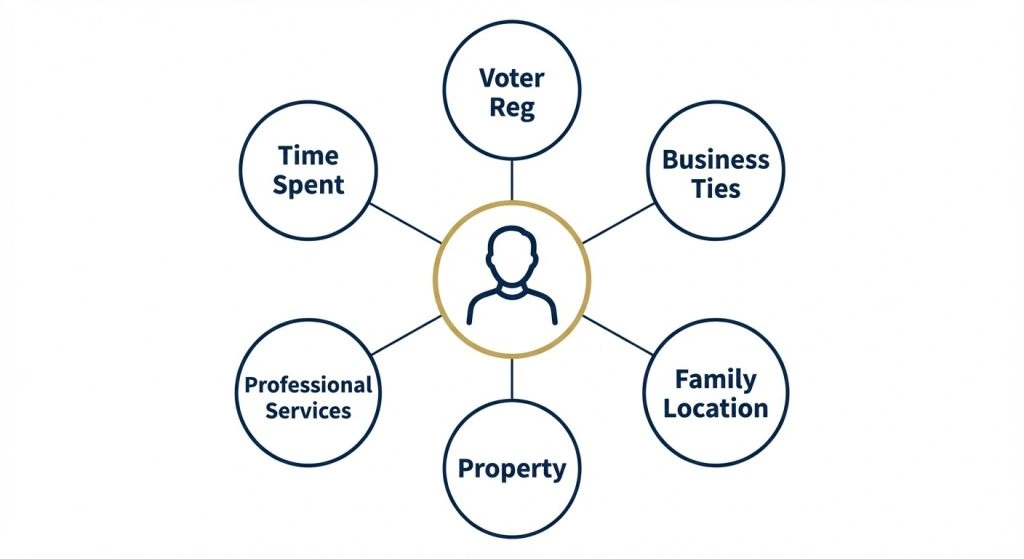
California residency is determined by the “totality of ties,” not just a calendar.
California does not use a mechanical day-count test. Residency is determined by the totality of facts, including:
Domicile intent
Location of family and personal ties
Business activity and economic connections
Duration and purpose of time spent in and out of California
Taxpayers who believe they have exited California often retain audit exposure when ties are reduced informally rather than clearly severed. Residency positions must be documented contemporaneously to withstand FTB scrutiny. (See related guidance on [California residency tax rules].)
Income Sourcing Drives Executive and Founder Exposure
California applies state-specific sourcing rules to:
Wages and bonuses
Deferred compensation
Performance-based pay
For executives and founders, sourcing assumptions often determine whether large portions of income remain taxable after relocation.
Stock options and restricted stock units introduce heightened risk because California sourcing depends on:
Grant date
Vesting period
Services performed during vesting
Federal equity compensation treatment does not resolve California sourcing. Misaligned assumptions frequently surface during audit, not filing.
Remote Work Continues to Trigger California Taxability
California scrutinizes individuals who live outside the state but earn income connected to California-based employers or businesses. Compensation tied to California services may remain taxable even when work is performed remotely. This issue often intersects with broader remote work tax exposure and multistate planning.
Documentation Determines Audit Outcomes
California personal income tax audits emphasize:
Written residency narratives
Sourcing methodology
Consistency across years
When residency or sourcing positions are challenged, assessments often span multiple tax years and include penalties and interest. Early documentation is critical to risk control.
Operationally, these issues tend to surface late—after federal returns are substantially complete—forcing revisions under deadline pressure.
The next section shifts from individual risk to business structures, where California entity-level taxes introduce a different class of planning exposure for CPA firms.
California Business and Entity-Level Tax Planning Considerations
California business tax planning introduces risk at the entity level, often independent of profitability. Unlike federal planning, California exposure is driven by structure, sourcing, and filing position, making early entity analysis essential.
C-Corporations Face Market-Based Sourcing and Apportionment Risk
California applies market-based sourcing for many categories of income. Revenue may be sourced to California based on customer location, not physical presence.
This creates exposure when:
Customers are located in California
Intellectual property is monetized nationwide
Operations span multiple states
As a result, California can represent a disproportionate share of total tax liability even when in-state operations appear limited. These outcomes often differ from federal allocation assumptions and must be evaluated early in multistate planning.
S-Corporations Trigger Entity-Level Taxes and Compensation Scrutiny
While S-corporations simplify federal pass-through analysis, California imposes:
An entity-level franchise tax
Heightened scrutiny of shareholder-employee compensation
Planning decisions around wages, payroll taxes, and distributions often require recalibration once California rules are applied. These adjustments affect both entity-level liability and individual income tax exposure.
California LLC Gross Receipts Fees Apply Regardless of Profitability
California imposes an annual franchise tax and an additional LLC fee based on California-source gross receipts, not net income.
This structure means:
Early-stage or loss-generating LLCs may still owe significant tax
Revenue growth can materially change state exposure
Entity choice decisions driven by federal flexibility frequently understate California cost unless LLC tax treatment is modeled upfront.
Entity-level issues commonly surface after personal income planning is complete, increasing rework and review strain. When entity analysis is delayed, CPA firms face:
Revised projections
Missed elections
Inconsistent documentation
Integrating entity-level review early reduces friction and improves engagement consistency.
The next section examines California’s pass-through entity (PTE) tax election, focusing on when it adds value and where it introduces risk.
California PTE Tax Election: When It Creates Value and When It Creates Risk
California’s pass-through entity (PTE) tax election can restore part of the federal SALT deduction benefit, but only when timing, ownership, and multistate effects are evaluated correctly. The election is conditional, not default.
How the California PTE Election Works
The entity pays California income tax at the entity level
The payment generates a federal deduction at the entity level
Owners receive a California tax credit on their individual returns
This structure may improve federal outcomes, but it also introduces California-specific compliance and modeling requirements.
When the PTE Election Creates Value
The election is more likely to be beneficial when:
Owners are subject to the federal SALT deduction cap
Income is consistently positive and predictable
Ownership is primarily individuals or qualifying trusts
California is a significant portion of total state tax exposure
In these cases, entity-level deductions can produce a measurable federal benefit.
Where Risk Commonly Arises
Timing and Payment Errors
California requires specific election and payment deadlines
Missed or misapplied payments can eliminate the intended benefit
Federal projections often need recalculation after California rules are applied
Late modeling is one of the most common failure points.
Ownership Structure Limitations
The PTE election does not benefit all owners equally. Risk increases when ownership includes:
Tax-exempt entities
Nonresident partners
Certain trusts
Uneven benefits can create internal disputes and disclosure obligations.
Multistate Reporting Complexity
For entities operating in multiple states, the California PTE election can:
Create mismatches between federal deductions and state allocations
These issues often surface after elections are assumed rather than evaluated.
Planning Takeaway
The California PTE election should be assessed as part of an integrated planning workflow that aligns:
Federal SALT assumptions
California conformity and deadlines
Owner-level outcomes
When applied strategically, the election adds value. When applied mechanically, it introduces avoidable risk.
The next section focuses on multistate clients with California nexus, where sourcing, workforce, and revenue thresholds intersect most sharply for CPA firms.
Multistate Clients With California Nexus Require Early Planning Review
California nexus issues create risk when they are identified late. By the time California exposure is confirmed, federal and primary-state filings are often already in progress, forcing CPAs to revisit planning decisions under deadline pressure.
Employee Presence Creates California Payroll and Income Tax Nexus
California nexus can be triggered when employees:
Perform services in California, even temporarily
Support California-based customers or operations
Work remotely for California-connected employers
These scenarios often surface during review rather than planning, particularly as remote work arrangements evolve informally. Late identification forces reconciliation with already-modeled federal positions.
Revenue-Based Nexus Applies Under California Economic Thresholds
California applies economic nexus standards based on customer location and revenue, not physical presence. Nexus may arise solely from:
California-based customers
Market-based sourcing of receipts
Digital or service-based revenue streams
Once nexus is established, CPAs must adjust:
Apportionment factors
Estimated payments
Filing positions—sometimes retroactively
This creates execution risk when revenue modeling occurs before California exposure is evaluated.
Pass-Through Entities Face Layered Compliance Obligations
For pass-through entities with California nexus:
Entity-level filing obligations increase
Owner-level reporting must reflect California activity
State-by-state disclosures must remain consistent
These requirements often intersect with PTE elections and K-2/K-3 reporting, compounding complexity when addressed reactively.
Late Nexus Identification Drives Rework
When nexus review is delayed, firms frequently encounter:
Additional state filings
Revised projections
Amended estimates
These outcomes strain review cycles and increase error risk. Over time, this mirrors the same execution failures seen in other complex state engagements.
Planning Takeaway
Effective nexus management depends on embedding California review into early planning workflows rather than treating nexus as a post-filing determination. Early evaluation preserves control over structure, sourcing, and timing.
The next section examines where California tax planning most often breaks down inside traditional CPA workflows—and why these failures are process-driven, not rule-driven.
Where California Tax Planning Breaks Down in Traditional CPA Workflows?
Most California tax planning failures are not technical errors. They are process failures caused by late identification, fragmented analysis, and inconsistent documentation.
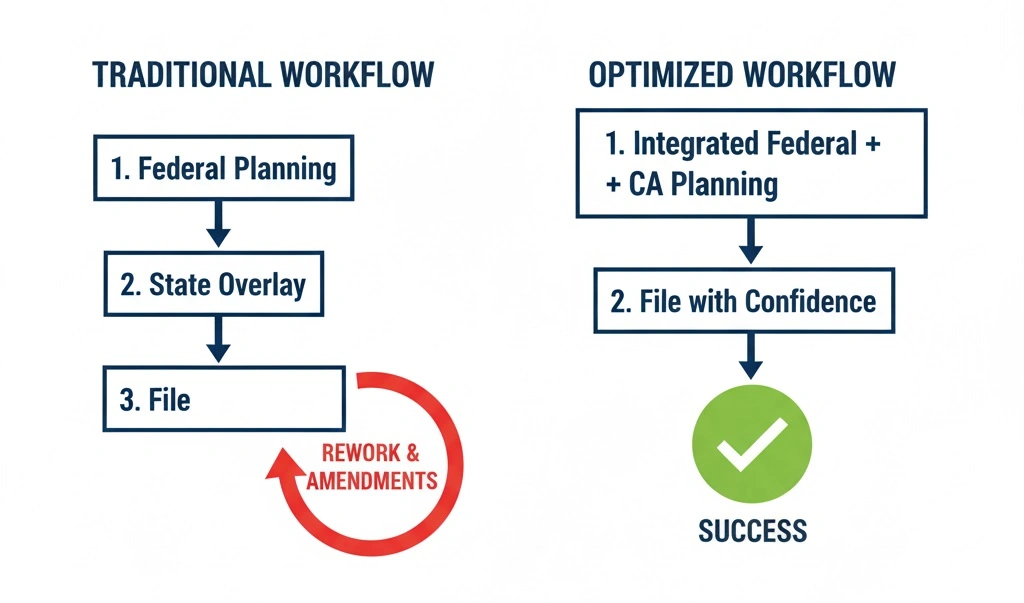
Moving California analysis to the onboarding phase eliminates the “Rework Loop.”
California Research Happens After Federal Positions Are Finalized
Many workflows treat California as a follow-up step. Federal analysis is completed first, and California adjustments are layered on later.
This sequencing leads to:
Reworked projections
Revised estimated payments
Missed or misapplied elections
By the time California issues surface, planning flexibility is already constrained.
Interpretation Varies Across Staff Levels
Junior preparers may correctly apply federal guidance while overlooking California-specific:
Thresholds
Timing rules
Non-conformity exceptions
Senior reviewers then inherit reconciliations that are harder to validate under time pressure. Similar client profiles can receive different outcomes, increasing firm-level risk.
Documentation Is Fragmented and Inconsistent
California planning assumptions are often scattered across:
Emails
Spreadsheets
Informal notes
When residency, sourcing, or elections are challenged, the rationale is difficult to reconstruct. Year-over-year consistency becomes harder to maintain or defend during FTB review.
Personal, Entity, and Multistate Planning Are Disconnected
When these areas are handled separately, changes in one area are not reflected across the engagement. This leads to duplicated effort and missed planning opportunities.
Reactive Execution Increases Error Risk
Late discovery of California issues forces firms into defensive execution:
Additional filings
Amended estimates
Compressed review timelines
These conditions increase error rates and client-facing risk during peak periods.
Process Takeaway
Firms that manage California effectively surface state-specific issues before federal positions are finalized. Early integration preserves control over planning decisions and reduces rework.
The next section explains how CPA firms use AI—selectively and responsibly—to support California tax planning without replacing professional judgment.
How CPA Firms Use AI to Support California Tax Planning
CPA firms use AI to reduce friction in California tax planning by improving early issue detection, consistency, and research discipline—not by replacing professional judgment.
AI Surfaces California-Specific Issues Earlier
AI-assisted research helps CPAs identify:
California non-conformity alongside federal guidance
FTB publications, notices, and conformity updates
State-specific limitations affecting depreciation, NOLs, and elections
By surfacing California rules earlier, firms avoid discovering state adjustments after federal positions are already finalized.
AI Improves Consistency Across California Engagements
California planning often breaks down when similar fact patterns are interpreted differently by different team members.
AI-supported systems help by:
Anchoring research to consistent authority sources
Applying uniform analytical logic across engagements
Reducing interpretation variance between preparers and reviewers
This consistency lowers review risk and improves defensibility across similar clients.
AI Supports Early Scenario Validation
California outcomes can change materially based on:
Residency assumptions
Sourcing methodology
Entity-level taxes and elections
AI-supported modeling allows CPAs to test these inputs earlier in the planning cycle, before projections, estimates, or elections are finalized. This supports more controlled decision-making in non-conforming states.
Human Judgment Remains Central
AI functions as an augmentation layer:
CPAs retain responsibility for conclusions
Planning positions remain reviewable and explainable
Documentation remains human-authored and defensible
Used correctly, AI strengthens California tax planning workflows by improving execution discipline without bypassing professional standards.
The final section explains how CPA firms can turn California’s complexity into a repeatable, defensible planning process.
Turn California Tax Complexity Into a Repeatable Planning Process
California tax planning becomes manageable when CPA firms shift from reactive adjustments to early, structured execution. The goal is not to eliminate complexity, but to control when and how it enters the workflow.
What a Repeatable California Planning Process Requires
Early California exposure identification
Residency, sourcing, entity structure, and nexus reviewed during onboarding
California implications evaluated before federal positions are finalized
Parallel federal and California analysis
Conformity differences tracked concurrently, not retroactively
Separate schedules maintained where California diverges
Consistent interpretation standards
Similar fact patterns analyzed using the same logic
Reduced variance across preparers and reviewers
Defensible documentation
Residency narratives, sourcing methodology, and election rationale documented contemporaneously
Year-over-year consistency preserved for audit readiness
Integrated workflow sequencing
Personal income, entity-level, and multistate planning evaluated together
Changes in one area reflected across the full engagement
Why This Matters for CPA Firms
Firms that operationalize California planning see:
Fewer late-stage revisions
Lower error and rework rates
More predictable review cycles
Stronger client confidence in planning outcomes
California tax risk is rarely caused by lack of technical knowledge. It is caused by late recognition and fragmented execution. Firms that surface California-specific issues early retain control over structure, timing, and strategy.
How CPA Pilot Supports California Tax Planning Workflows?
CPA Pilot helps firms support California tax planning by centralizing federal and California research, validating planning assumptions early, and maintaining consistency across staff, clients, and tax years.
CPA firms use CPA Pilot to:
Research California non-conformity alongside federal rules
Validate residency, sourcing, and entity-level assumptions early
Standardize planning logic across teams
Reduce rework caused by late California adjustments
Maintain documentation that supports FTB review and audit readiness
Instead of reacting to California issues late in the filing cycle, firms use CPA Pilot to surface risk before projections, estimates, or elections are finalized.
See How CPA Pilot Fits Into Your Planning Workflow?
If your firm manages California clients, or multistate clients with California exposure, see how CPA Pilot supports tax planning without disrupting your existing process. 👉 Request a 30-minute Demo
FAQs About California Tax Planning
How often does California decouple from federal tax law?
California periodically decouples from federal tax law by selectively adopting or rejecting provisions passed by the Internal Revenue Service. CPAs must monitor conformity updates issued by the California Franchise Tax Board to identify timing gaps that affect depreciation, losses, and credits.
Does California require separate tax planning documentation from federal files?
Yes. California tax planning requires state-specific documentation that explains residency positions, sourcing assumptions, and conformity adjustments. Federal workpapers alone are often insufficient during a California review or audit.
Can California tax planning positions be reused year over year?
Only conditionally. California tax planning positions remain valid when the underlying facts stay consistent. Changes in residency, remote work, ownership, or conformity rules require reassessment before reuse.
How early should California tax planning start in the engagement lifecycle?
California tax planning should begin during initial fact gathering. Early evaluation allows CPAs to align federal assumptions with California rules before projections, estimates, or elections are finalized.
Are California tax audits more documentation-driven than federal audits?
Yes. California audits place heavy emphasis on factual documentation, especially for residency, sourcing, and nexus. Positions lacking written rationale or contemporaneous support carry higher adjustment risk.
Do California planning risks increase for part-year residents?
Yes. Part-year residency introduces allocation and sourcing complexity. CPAs must clearly document entry and exit dates, income attribution, and continued California ties to reduce exposure.
I’m Harsh Mody, CPA, founder of CPA Pilot—an AI Tax Assistant for CPAs, Enrolled Agents, and U.S. tax firms. With 18+ years in accounting, tax auditing, consulting, and product management, I’ve seen how compliance-heavy work limits true advisory impact. I built CPA Pilot to change that—by applying AI-driven tax research, deduction optimization, and IRS/state code automation to help firms unlock tax savings and scale advisory services with speed and accuracy.