A comprehensive guide for CPAs and Enrolled Agents on IRC §170 rules for 2026 and 2027. Learn how to sequence the new 0.5% itemizer floor across asset classes, apply percentage limits to post-floor amounts, evaluate donation bunching, and maintain compliance under Form 8283 thresholds.
Harsh Mody
CPA & Founder of CPA Pilot · Nov 3, 2026·17 min read
What You'll Learn
4 key concepts covered
1The New 0.5% Floor & Statutory Ordering: How the 0.5% contribution base floor is calculated, why it reduces lower-percentage tiers (20% and 30%) before touching cash gifts, and when disallowed floor amounts can be added to carryforwards.
2Percentage Limits Across Asset Classes: Step-by-step rules for applying the 20%, 30%, 50%, and 60% ceilings to post-floor cash, ordinary income property, and long-term appreciated securities.
3The Non-Itemizer Deduction vs. Itemizing: Qualifying criteria and strategy for claiming the up to $1,000 cash allowance ($2,000 for married filing jointly) alongside standard deduction thresholds.
4Compliance, Substantiation & Year-End Tactics: Documentation thresholds for Form 8283 and written acknowledgments, 5-year carryover tracking mechanics, and when to pivot to donation bunching or Qualified Charitable Distributions (QCDs).
How much of your client's charitable donations can actually be deducted from federal taxable income in 2026 and 2027?
The answer depends on whether the recipient is a qualified charitable organization, the type of donated property, the taxpayer's adjusted gross income (AGI), and applicable IRS substantiation requirements.
For CPAs and Enrolled Agents, calculating charitable contribution deductions also involves fair market value, adjusted basis, percentage limitations, and itemized deduction rules.
Beginning with the 2026 tax year (returns generally filed in 2027), federal legislation introduced new provisions affecting both itemizers and eligible non-itemizers. These rules also apply in 2027 under current federal law.
Quick Answer: How Do Charitable Contribution Deductions Work in 2026–2027?
Charitable contributions reduce federal taxable income only to qualified organizations and must be properly substantiated. In 2026 and 2027, itemizers can deduct qualifying gifts only to the extent total contributions exceed 0.5% of their contribution base, subject to the 60%, 50%, 30%, or 20% limits. Eligible non-itemizers can deduct up to $1,000 in qualifying cash gifts ($2,000 for married couples filing jointly).
A deduction reduces taxable income, not tax dollar for dollar. The actual savings depend on the client's taxable income, marginal rate, other deductions, and applicable limitations.
2026–2027 Charitable Contribution Deduction Limits at a Glance
Provision
Tax year 2026
Tax year 2027
Itemized charitable deduction floor
0.5% of contribution base
Continues
Qualifying cash contribution ceiling
Generally 60% of contribution base
Continues
Other percentage limits
50%, 30% or 20%, as applicable
Continues
Non-itemizer cash deduction
Up to $1,000; $2,000 married filing jointly
Continues
Noncash contributions
Property-specific valuation and percentage limits
Continues
Carryforward period
Generally five succeeding tax years
Continues
High-income itemized deduction limitation
Generally caps the marginal benefit of affected itemized deductions at 35%
Continues under current law
Standard deduction
$16,100 single/MFS; $32,200 MFJ; $24,150 head of household
Use official 2027 inflation-adjusted amounts
Substantiation
Records, acknowledgments and forms required
Continues
The $1,000 and $2,000 non-itemizer limits are fixed statutory amounts. They are not automatically indexed for inflation. Source: IRC §170.
What Charitable Contributions Are Tax Deductible?
A charitable contribution is generally deductible when a taxpayer gives money or eligible property to an organization qualified under IRC §170. A recipient's federal tax-exempt status alone does not always make a gift deductible; the organization must also be eligible to receive deductible contributions.
Which Organizations Qualify for Charitable Tax Deductions?
Qualifying religious, educational, scientific & charitable organizations
Eligible nonprofit hospitals and educational institutions
Federal, state and local governments, when the gift is made exclusively for public purposes
Certain veterans' organizations and other entities recognized under IRC §170
Gifts to individuals, political campaigns and most foreign organizations generally do not qualify. Limited treaty-based exceptions may apply to certain Canadian, Mexican and Israeli organizations.
Example: A $1,000 gift to a qualifying public charity may be deductible, subject to the client's deduction method, limits, and documentation. A $1,000 payment made directly to an individual facing hardship generally is not a deductible charitable contribution.
How to Verify a Qualified Charitable Organization?
Publication 78 data for organizations eligible to receive deductible contributions
IRS determination letters
Automatic revocation information
Available Form 990-series filings
Some eligible organizations, including certain churches, may not appear in the database, so an unsuccessful search does not automatically make a gift nondeductible. Document the organization's eligibility as of the contribution date.
Are Payments for Charity Events Fully Deductible?
No. When a donor receives goods or services in exchange for a gift, the deductible amount is generally reduced by the fair market value of the benefit. If a taxpayer pays $300 for a charity dinner and receives a meal worth $80, the potentially deductible contribution is $300 − $80 = $220. See IRS Topic No. 506.
Cash vs. Noncash Charitable Contributions
Cash and noncash gifts follow different valuation, limitation, and documentation rules. Cash starts with the amount paid. Noncash property may require fair market value (FMV), adjusted basis, holding period, and property-specific calculations.
Contribution type
General valuation method
Key IRS consideration
Cash, check, credit card, electronic transfer
Amount contributed
Percentage limits and records
Clothing and household goods
FMV
Good used condition or better
Long-term appreciated securities
Often FMV
Capital-gain property rules and holding period
Vehicles
Often limited to the charity's gross sale proceeds
Cash gifts include checks, credit-card charges, electronic transfers, online payments and payroll deductions. A taxpayer who gives $500 each quarter makes $2,000 in annual cash gifts. That is the starting amount before the floor, percentage limits, and documentation rules apply.
Clothing and Household Goods
Donated clothing and household items are valued at FMV on the donation date, not original cost. Items generally must be in good used condition or better, with a limited exception for certain higher-value items supported by a qualified appraisal. Furniture bought for $2,000 may have an FMV of only $300 at donation, so $300 is the starting contribution value.
Appreciated Stock and Securities
Long-term appreciated securities given to a public charity may generally be deducted at FMV, subject to the 30% limit for capital-gain property.
Example: A taxpayer buys publicly traded stock for $4,000 and donates it after holding it for more than one year, when it is worth $10,000. If the gift qualifies for FMV treatment, the starting contribution value is $10,000, not the $4,000 basis.
Property held one year or less generally requires a reduction for gain that would not be long-term capital gain. A taxpayer may also elect to reduce the value of capital-gain property by its appreciation and use the 50% limit instead, which requires reviewing the client's overall giving.
Vehicle Donations
For a qualifying vehicle with a claimed value over $500, the deduction is generally limited to the lesser of FMV or the charity's gross sale proceeds. If a vehicle worth $8,000 is sold by the charity for $5,500, the deduction is generally $5,500. Different rules apply when the charity significantly uses or materially improves the vehicle, or gives it to a needy individual. See the Instructions for Form 8283.
Charitable Contribution Deduction Limits for 2026 and 2027
Deductions are subject to percentage limits of 20% to 60% of the contribution base. For most individuals, the contribution base is AGI, technically computed without any net operating loss carryback to the year (IRC §170).
What are the 60%, 50%, 30% and 20% Charitable Deduction Limits?
Limit
Contributions generally subject to the limit
60%
Qualifying cash contributions to public charities and certain other eligible organizations
50%
Certain other contributions to public charities and specified organizations, such as ordinary-income property
30%
Long-term capital-gain property given to public charities at FMV, and certain gifts to organizations subject to lower limits
20%
Capital-gain property given to organizations subject to lower limits, such as private non-operating foundations
These limits are not independent allowances. When a client gives several types of property, ordering rules decide which limit applies and how much carries forward.
How Does the 0.5% Charitable Deduction Floor Work?
Beginning in 2026, itemizers may deduct otherwise allowable charitable contributions only to the extent that aggregate contributions exceed 0.5% of the contribution base (IRC §170(b)(1)(I)). The floor applies to total giving, not to each gift separately, and it is applied before the percentage ceilings.
Calculation
Amount
Contribution base
$200,000
Qualifying contributions
$10,000
0.5% floor
$1,000
Potential itemized deduction
$9,000
When the floor is not exceeded, the entire gift can be lost for itemizing purposes. A client with a $300,000 contribution base has a $1,500 floor, so a $1,200 gift produces no itemized charitable deduction.
In What Order Are the 0.5% Floor and AGI Percentage Limits Applied?
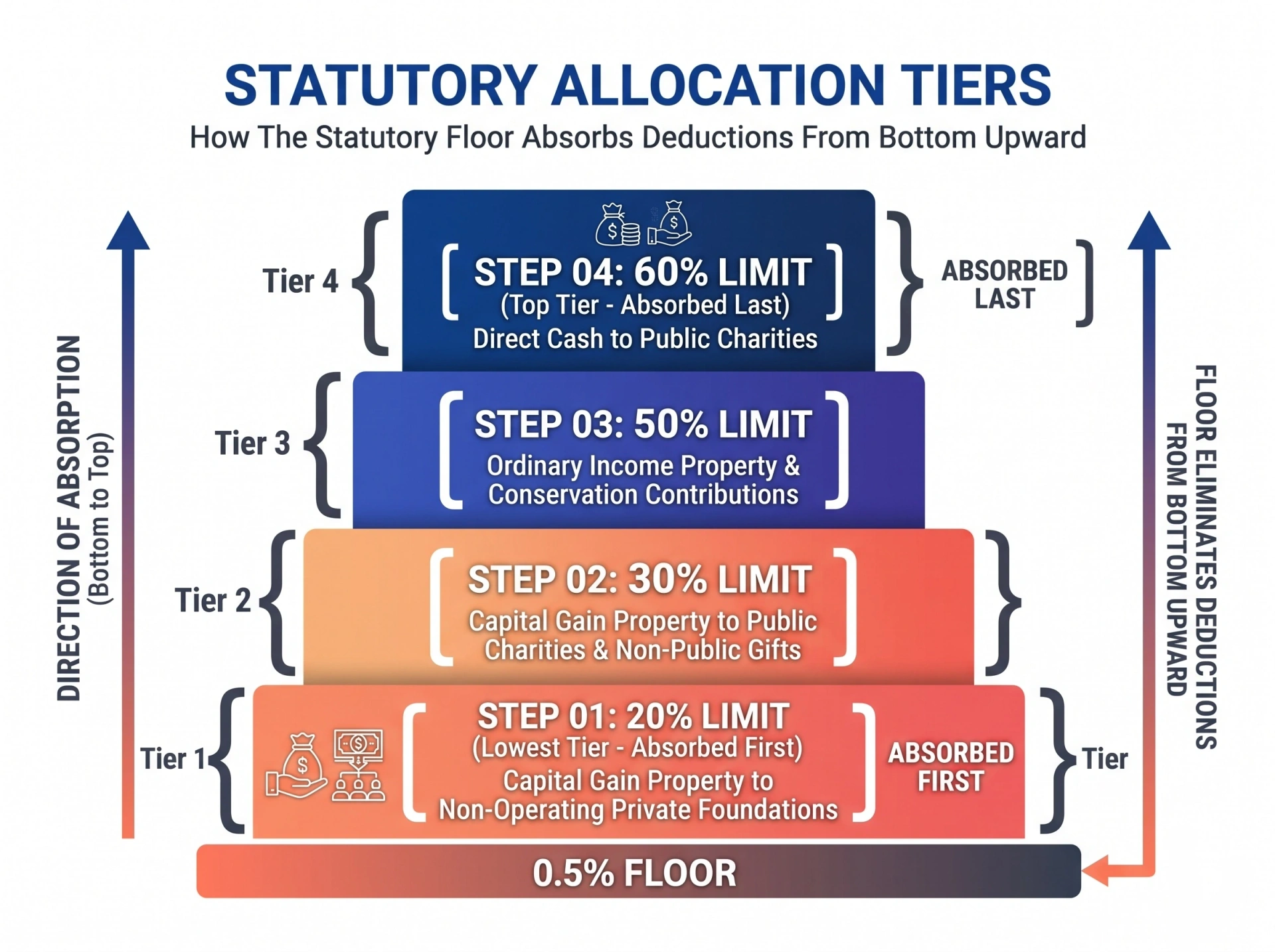
The floor comes first. Under IRC §170(b)(1)(I), it reduces contributions in a statutory order that starts with the lowest-limit categories, so the highest-limit gifts are reduced last. Then the percentage limits apply to what remains.
Capital-gain property given to organizations not described in §170(b)(1)(A), such as private non-operating foundations (generally 20%)
Capital-gain property given to public charities described in §170(b)(1)(A) (generally 30%)
Other contributions to organizations not described in §170(b)(1)(A) (generally 30%)
Qualified conservation contributions (generally 50%, or 100% for qualified farmers and ranchers)
Other contributions to §170(b)(1)(A) organizations, such as ordinary-income property or capital-gain property where the taxpayer elected basis (generally 50%)
Cash contributions subject to the 60% limit under §170(b)(1)(G), such as cash to public charities
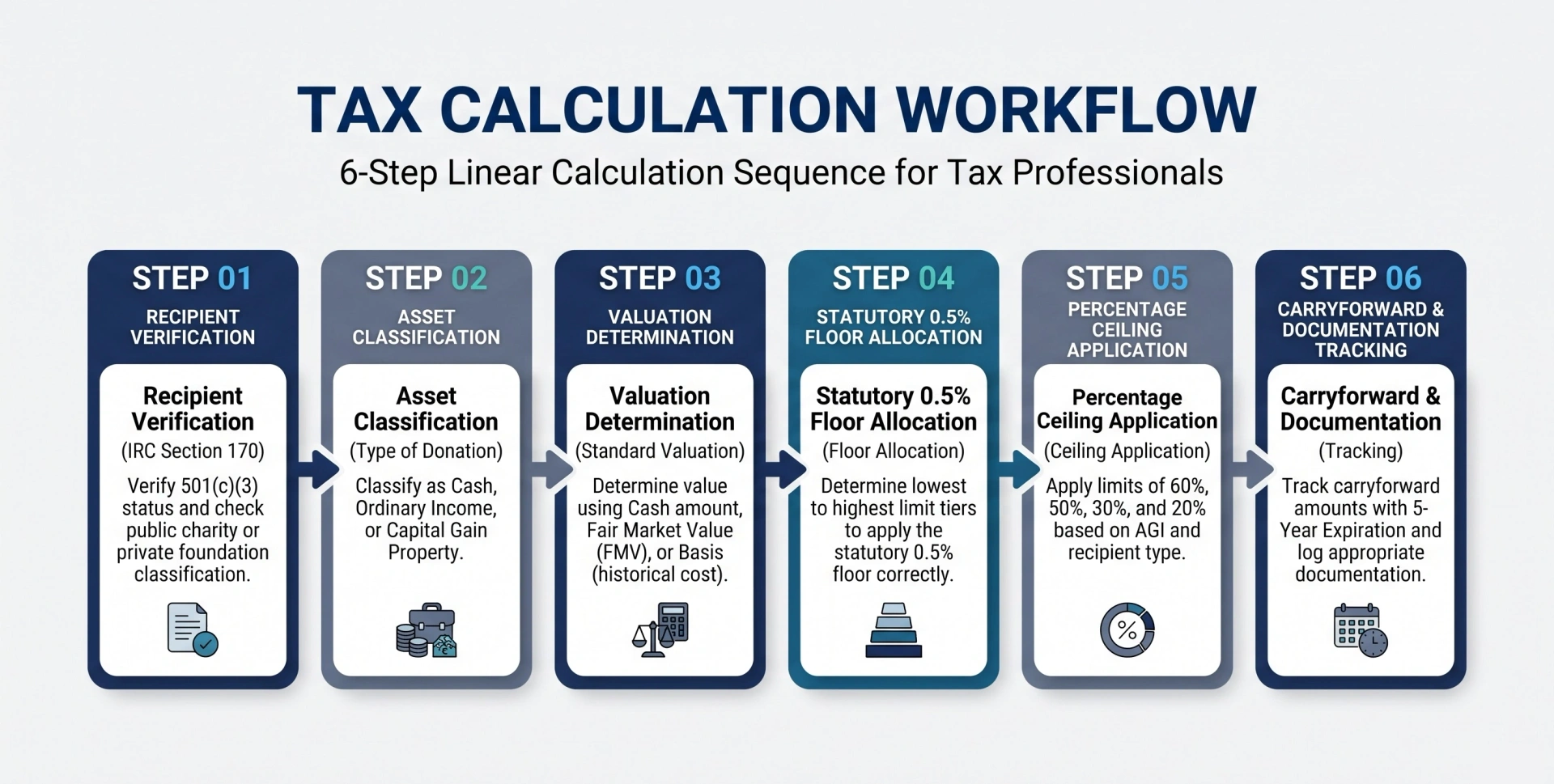
Professional review sequence:
Verify the recipient.
Classify each gift as cash, ordinary-income property, or capital-gain property.
Determine each gift's starting value (cash, FMV, or basis-reduced value).
Apply the 0.5% floor in the statutory order.
Apply the 60%, 50%, 30% or 20% limits to the post-floor amounts.
Calculate the current-year deduction and track carryforwards by originating year and category.
Do not subtract the floor as a lump sum from total giving, and do not apply the percentage limits before the floor.
Example: Calculating the 60% Ceiling and 0.5% Floor
A taxpayer who itemizes has a $100,000 contribution base and gives $70,000 in cash to a public charity in 2026.
Step
Calculation
Amount
Cash contribution
$70,000
0.5% floor
$100,000 × 0.5%
$500
Contribution after floor
$70,000 − $500
$69,500
60% ceiling
$100,000 × 60%
$60,000
Current-year deduction
Lesser of $69,500 or $60,000
$60,000
Excess over the ceiling
$69,500 − $60,000
$9,500
Floor amount added to carryforward
$500
Total carryforward
$10,000
The taxpayer deducts $60,000 in 2026 and carries forward $10,000 for up to five succeeding years. The carryforward keeps its original cash classification and remains subject to the 60% limit. Applying the ceiling before the floor would wrongly produce $59,500.
Contrast: If the same taxpayer gave only $50,000 in cash, the floor would reduce the gift to $49,500, which is under the $60,000 ceiling. The deduction would be $49,500, and the $500 floor amount would not carry forward because no percentage limit was exceeded (IRC §170(d)(1)(C)).
Example: Cash & Appreciated Stock Donated in the Same Year
A taxpayer with a $200,000 contribution base gives the following to public charities:
Contribution
Starting value
Percentage limit
Qualifying cash
$40,000
60%
Long-term appreciated stock (FMV)
$30,000
30%
Total
$70,000
Multiple limits apply
The 0.5% floor is $1,000. Capital-gain property given to a public charity (the 30% category) is reached before cash (the 60% category), so the floor reduces the stock first.
Contribution
Starting value
After floor
Applicable ceiling
Result
Appreciated stock
$30,000
$29,000
30% × $200,000 = $60,000
Within ceiling
Cash
$40,000
$40,000
60% × $200,000 = $120,000 (combined limit)
Within ceiling
Total deductible in 2026
$69,000
Both categories fit within their ceilings, so the taxpayer deducts $69,000 and no carryforward arises. Document each category, basis, holding period, FMV, ceiling, and floor allocation.
How Does the 35% Itemized Deduction Limitation Affect Charitable Donations in 2026?
Beginning in 2026, a limitation under IRC §68 generally caps the tax benefit of affected itemized deductions at 35% for taxpayers who would otherwise be in the 37% bracket. This is separate from the percentage ceilings and the 0.5% floor.
Does a $10,000 charitable deduction save $3,700 in federal tax? Not necessarily. At a 37% marginal rate with no other limitation, $10,000 would save $3,700. For a taxpayer fully affected by the limitation, the benefit is approximately $3,500.
Illustration
Amount
Allowable itemized deduction
$10,000
Benefit at 37%
$3,700
Benefit at an effective 35%
$3,500
Difference
$200
This shows the rate effect only. The actual reduction depends on taxable income, total itemized deductions, and the statutory calculation, so review IRC §68 and IRS worksheets rather than applying 35% automatically.
Charitable Contribution Carryforwards: Rules and Examples
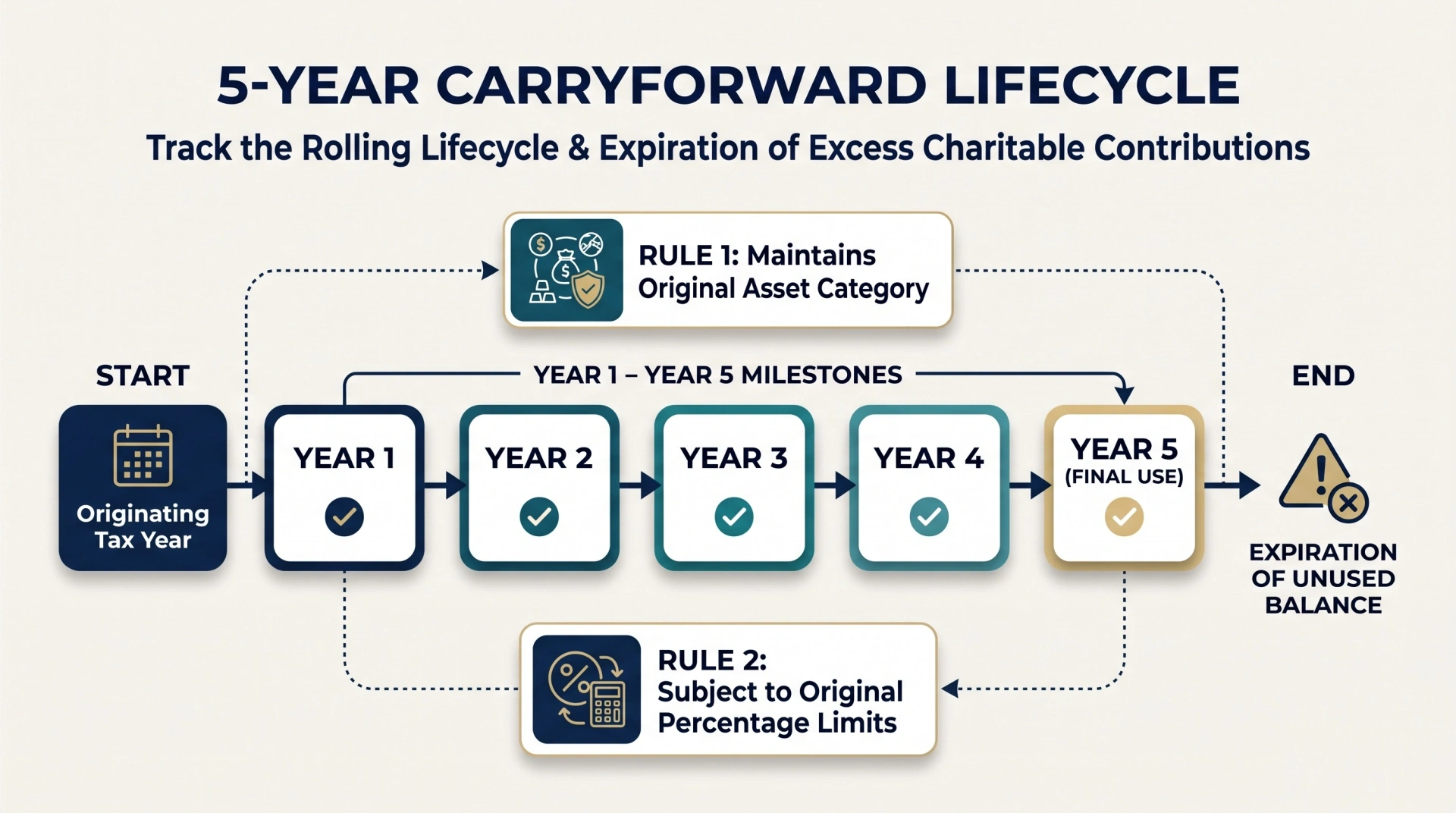
Excess contributions above the applicable percentage limits can generally be carried forward for up to five succeeding tax years. Carryovers keep their original category, remain subject to that category's limits, and are used in the order the rules require.
How Do Charitable Contribution Carryforwards From 2025 Work in 2026?
Eligible unused contributions from 2025 may generally be carried into 2026, subject to their original category, remaining carryforward period and limits. Whether those pre-2026 carryovers are also reduced by the new 0.5% floor is a point on which published professional commentary differs. Some practitioners read §170(b)(1)(I) as applying the floor to them, while others read the statute and its coordination rules as leaving pre-2026 carryovers outside the floor. Check current IRS guidance before finalizing returns.
Tax professionals should keep these buckets separate:
Contributions that exceed percentage limits
Amounts disallowed by the 0.5% floor
Carryovers originating before 2026
Carryovers originating in 2026 or later
Under IRC §170(d)(1)(C), a floor-disallowed amount does not become a carryforward just because the client gave more than 0.5% of the contribution base. It is added to a carryforward only in a year when an excess is otherwise carried forward under a percentage-limit rule.
Example: Tracking a Five-Year Charitable Contribution Carryforward
Assume a $12,000 carryforward originating in 2026, used as shown:
Tax year
Beginning balance
Amount used
Ending balance
2027
$12,000
$3,000
$9,000
2028
$9,000
$2,000
$7,000
2029
$7,000
$3,000
$4,000
2030
$4,000
$1,000
$3,000
2031
$3,000
$3,000
$0
This is a tracking illustration, not a determination that each year's deduction is allowable. A 2026 carryover must be used within the five succeeding years, ending in 2031, or it expires. Track the originating year, category, amount disallowed, annual usage, and expiration date.
Can You Deduct Charitable Donations Without Itemizing?
Yes. Beginning in 2026, eligible taxpayers who claim the standard deduction can also deduct qualifying cash gifts to eligible charities (IRS Topic No. 506):
Up to $1,000 for eligible filers other than married couples filing jointly
Up to $2,000 for married couples filing jointly
This is a maximum, not an automatic benefit. Noncash gifts (stock, clothing, vehicles, and other property) do not qualify. Gifts to donor-advised funds, certain supporting organizations, and prior-year carryovers are also excluded. Source:IRS Publication 505.
Example: $800 Cash Donation Without Itemizing
An eligible single taxpayer takes the standard deduction and gives $800 in cash to a qualifying charity in 2026. The taxpayer may generally deduct an additional $800, assuming the gift and records satisfy the rules.
Standard Deduction vs. Itemizing: Which Is Better in 2026?
Compare allowable itemized deductions with the standard deduction for the filing status, after counting any non-itemizer charitable deduction.
Filing status
2026 standard deduction
Single
$16,100
Married filing separately
$16,100
Married filing jointly
$32,200
Head of household
$24,150
These are basic amounts. Additional amounts may apply to taxpayers age 65 or older or blind. For 2027, use the IRS inflation-adjusted figures rather than assuming 2026 amounts continue. Source: IRS, Working Families Tax Cuts: Individuals and Workers.
When is Itemizing Better Than Taking the Standard Deduction?
Itemizing wins when allowable itemized deductions exceed the standard deduction plus any eligible non-itemizer cash deduction. Two simplified single-filer scenarios for 2026:
Calculation
Taxpayer A
Taxpayer B
Contribution base
$100,000
$100,000
Qualifying cash donations
$5,000
$5,000
0.5% floor
$500
$500
Itemized charitable deduction
$4,500
$4,500
Other itemized deductions
$8,000
$15,000
Total itemized deductions
$12,500
$19,500
Standard deduction + $1,000 non-itemizer deduction
$17,100
$17,100
Better method
Standard deduction plus cash deduction ($17,100)
Itemizing ($19,500)
The example assumes all gifts qualify and no other limits apply.
How Donation Bunching Can Increase Deductibility
Bunching concentrates several years of giving into one tax year. A taxpayer who normally gives $5,000 a year might give $15,000 in one year and little in the next two. Bunching can help when it pushes itemized deductions above the standard deduction, but the 0.5% floor, percentage limits, income level, and the non-itemizer deduction can change the result. Evaluate it alongside other year-end planning.
Qualified Charitable Distributions as an Alternative
A qualified charitable distribution (QCD) lets an IRA owner age 70½ or older transfer funds directly from an IRA to an eligible charity. A QCD is excluded from income rather than itemized, so the 0.5% floor does not reduce it. The same distribution cannot also be deducted as a charitable contribution. QCDs have their own annual limit, recipient restrictions, and documentation rules, so confirm the current-year limit. See IRS Publication 590-B.
Charitable Contribution Deadline for 2026 and 2027
Calendar-year individuals generally must complete contributions by December 31 of the tax year: December 31, 2026 for 2026 gifts and December 31, 2027 for 2027 gifts.
A check is generally treated as given on the mailing date.
A credit-card gift is deductible in the year of the charge, even if the bill is paid later.
A pledge alone creates no deduction before payment.
IRS Documentation and Forms Required for Charitable Deductions
Clients must keep records showing the amount, date, recipient, and nature of each gift. Requirements increase with the type and value of the gift.
Cash Donation Documentation
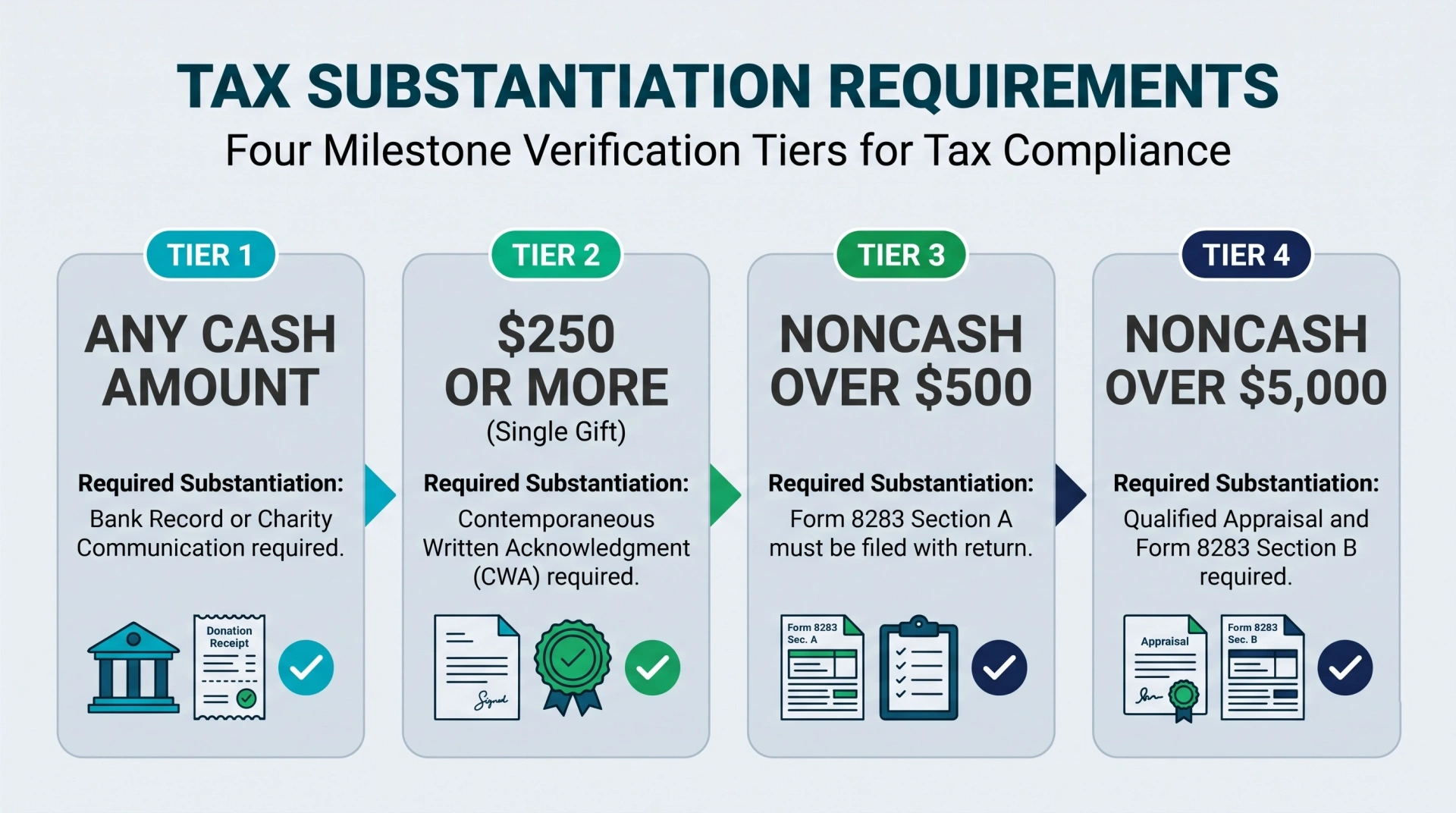
Cash gifts generally require a bank record or written communication from the charity showing its name, the date, and the amount. For any single contribution of $250 or more, a contemporaneous written acknowledgment is required. It must state whether goods or services were provided in exchange, and the taxpayer must have it by the earlier of the date the original return is filed or the return's due date, including extensions.
Several separate gifts under $250 do not trigger the acknowledgment rule just because the annual total exceeds $250. Each gift must still meet the general recordkeeping rules.
Noncash Contribution Documentation
Noncash gifts may require records of:
Property description and condition
Acquisition date and method, and adjusted basis
FMV on the contribution date and the valuation method
Holding period
Qualified appraisal information, where required
A qualified appraisal is generally required for certain noncash property valued above $5,000 per item or group of similar items, subject to exceptions. Publicly traded securities and certain vehicles follow special rules. See IRS Publication 1771.
When is IRS Form 8283 Required?
Form 8283 is generally required when a taxpayer claims more than $500 in noncash contributions.
Contribution category
General reporting requirement
Cash donations
Reported on the return; no Form 8283
Noncash over $500, generally not over $5,000
Form 8283, Section A
Certain noncash over $5,000
Generally Section B and a qualified appraisal
Publicly traded securities
Generally Section A when Form 8283 is required
Certain vehicle donations over $500
Form 8283 plus Form 1098-C or qualifying acknowledgment
Noncash amounts are generally measured before AGI-based limits create a carryover. Similar items given to different charities may need to be aggregated for reporting and appraisal thresholds.
How to Calculate a Client's Charitable Contribution Deduction: Step-by-Step
Verify the recipient. Confirm the organization can receive deductible contributions under IRC §170.
Classify the contribution. Separate cash, ordinary-income property, long-term capital-gain property, vehicles, and other noncash assets.
Determine value. Establish the cash amount or the noncash value using FMV, basis, and holding period.
Apply the floor and limits. Compute the contribution base, apply the 0.5% floor in statutory order, then the 60%, 50%, 30% or 20% ceilings to post-floor amounts, and consider the §68 limitation.
Determine carryforwards. Track excess contributions by originating year and category.
Verify substantiation and reporting. Review acknowledgments, appraisals, Form 8283, Form 1098-C, and return reporting.
Document both the current-year deduction and the reason any amount was disallowed or carried forward.
CPA Checklist for Charitable Contribution Deductions
Before finalizing a return, verify:
Recipient eligibility and EIN, where applicable
Contribution dates, amounts, and payment records
Written acknowledgments for individual gifts of $250 or more
Cash and noncash classifications
Noncash descriptions, condition and valuation support
Adjusted basis and holding-period records
Qualified appraisals where required
Form 8283 and Form 1098-C requirements
The 0.5% floor applied in statutory order
Percentage limits applied to post-floor amounts
The high-income itemized deduction limitation, where applicable
Carryforwards by originating year and category
Standard deduction versus itemizing comparison
Conclude with a documented calculation of the allowable deduction and any remaining carryforward.
Example: Explaining a Charitable Contribution Deduction to a Client
Assume a $100,000 contribution base and $5,000 in qualifying cash gifts to public charities in 2026, with the client itemizing and no other limits.
Your $5,000 gift is subject to the new 0.5% floor for people who itemize. Based on your $100,000 contribution base, the floor is $500, which leaves a potential $4,500 charitable deduction, assuming all other IRS requirements are met. The deduction reduces your taxable income. Your actual tax savings depend on your tax rate, other deductions, and applicable limits.
How CPA Pilot Helps CPAs Research Charitable Contribution Deductions
CPA Pilot helps CPAs, Enrolled Agents, and U.S. tax firms research charitable deductions by connecting IRS rules, contribution classifications, limitation calculations, and documentation standards in one AI-powered tax research workflow. For 2026–2027 planning, tax professionals can use it to:
Research rules for cash, appreciated stock, vehicles, clothing and household goods
Review the 60%, 50%, 30%, and 20% limits and the 0.5% floor ordering
Examine the $1,000 and $2,000 non-itemizer rules and the 35% itemized-benefit limitation
Review carryforward provisions and track them by originating year
Identify Form 8283, appraisal and acknowledgment requirements
Compare bunching, QCDs, and other year-end strategies
Prepare clear, source-supported explanations for client conversations
CPA Pilot supports research while keeping professional judgment, source verification, and return review central to the process.
Research charitable contribution deductions with greater efficiency. Explore CPA Pilot for CPAs and Tax Professionals →
Charitable Contribution Deductions FAQs
What is the Maximum Charitable Contribution Deduction in 2026?
For qualifying cash gifts to public charities, the deduction is generally limited to 60% of the contribution base. Other gifts may be limited to 50%, 30%, or 20%. Itemizers must also account for the 0.5% floor. Eligible non-itemizers can deduct up to $1,000, or $2,000 if married filing jointly.
Does the 0.5% Charitable Deduction Floor Apply to Every Donation Separately?
No. The floor applies to aggregate qualifying contributions for itemizers and is computed on the contribution base, not gift by gift. Multiple categories may require allocation under the statutory ordering rules.
Can Unused Charitable Deductions From 2025 Be Claimed in 2026?
Yes. Eligible carryovers from 2025 may generally be claimed in 2026, subject to their original category, percentage limits, and remaining carryforward period. How the new floor interacts with pre-2026 carryovers should be confirmed against current IRS guidance.
Are Donations to Foreign Charities Tax Deductible?
Direct gifts to foreign charities generally do not qualify. Limited treaty-based exceptions may apply to certain Canadian, Mexican, and Israeli organizations, and the recipient's eligibility must be verified.
Can Taxpayers Deduct Volunteer Time?
No. The value of donated time or services is not deductible. Qualifying unreimbursed expenses incurred while serving an eligible charity may be deductible, and the charitable mileage rate is 14 cents per mile for qualifying use.
Are GoFundMe Donations Tax Deductible?
Not automatically. Payments that benefit individuals or personal campaigns generally do not qualify. A gift may be deductible only when the actual recipient is a qualified charity and federal requirements are met.
Are Donor-Advised Fund Contributions Deductible in 2026?
Qualifying gifts to donor-advised funds may be deductible under the general itemized rules. They are excluded from the special non-itemizer cash deduction beginning in 2026.
Can January Donations Be Deducted for the Previous Tax Year?
Generally no. Calendar-year taxpayers must complete gifts by December 31 to claim them for that year, and the payment method determines the contribution date.
Note: This guide covers federal individual income tax rules for 2026 and 2027. It does not address every exception, special taxpayer category, state tax rule, or election. Calculations involving mixed categories, capital-gain property, carryforwards, and the overall itemized deduction limitation require applying the statutes and current-year IRS instructions. Treasury guidance on the floor was still developing when this guide was prepared.
Key Takeaways
5 essential insights
The 0.5% Floor for Itemizers: Taxpayers who itemize can only deduct charitable donations to the extent total qualifying contributions exceed 0.5% of their contribution base (typically AGI).
Statutory "Bottom-Up" Floor Ordering: Under IRC §170(b)(1)(I), the 0.5% floor absorbs donations starting with the lowest-percentage categories first (20% and 30% property) before reaching 60% cash contributions.
$1,000 / $2,000 Non-Itemizer Cash Deduction: Taxpayers taking the standard deduction can claim an above-the-line deduction of up to $1,000 ($2,000 for married couples filing jointly) strictly for cash gifts to qualified operating charities.
AGI Percentage Limits & 35% Benefit Cap: Annual deductions remain capped at 20% to 60% of AGI based on asset type, with the marginal tax benefit capped at 35% for donors in the top 37% tax bracket.
5-Year Carryforward & Substantiation Rules: Excess contributions above percentage limits carry forward for up to 5 tax years, while single gifts of $250 or more require written acknowledgments and noncash gifts over $500 require Form 8283.
I’m Harsh Mody, CPA, founder of CPA Pilot—an AI Tax Assistant for CPAs, Enrolled Agents, and U.S. tax firms. With 18+ years in accounting, tax auditing, consulting, and product management, I’ve seen how compliance-heavy work limits true advisory impact. I built CPA Pilot to change that—by applying AI-driven tax research, deduction optimization, and IRS/state code automation to help firms unlock tax savings and scale advisory services with speed and accuracy.